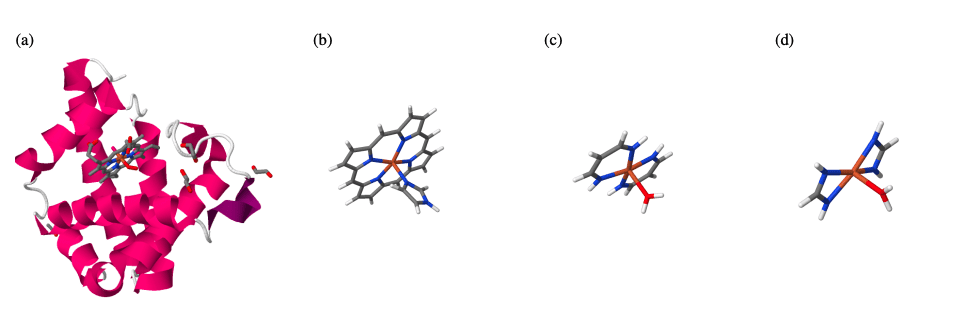
On April 11, 2025, researchers Unathi Skosana, Sthembiso Gumede, and Mark Tame published a study titled Spin-state energetics of heme-related models with the variational quantum eigensolver. The study provided insights into how VQE can be used to calculate energy separations in deoxy-myoglobin models and compared their findings with classical methods.
The study uses the variational eigensolver (VQE) algorithm to calculate spin-state energetics for a simplified deoxy-myoglobin model. Results from VQE simulations, using single- and multi-reference trial wavefunctions based on the k-UpCCGSD ansatz, were compared with classical CASSCF method outcomes, showing agreement within 1-4 kcal/mol for active spaces up to 20 spin orbitals.
Multi-reference diagnostics revealed strong electron correlation effects in the spin states. The research highlights VQE’s capability to reproduce spin-state energetics of strongly correlated systems like transition metal complexes, with results asymptotically approaching classical method accuracy as active orbital numbers increase.
Advancements in Quantum Computing: Enhancing Multi-Reference Diagnostics with VQE
Quantum computing is revolutionizing problem-solving, particularly in modeling complex molecular systems. One significant challenge this field addresses is accurately simulating multi-reference systems, molecular systems where multiple electronic states influence behavior. Traditional computational methods often struggle to capture these interactions, leading to inaccuracies.
The Variational Quantum Eigensolver (VQE), a hybrid quantum-classical algorithm, has emerged as a promising solution. VQE combines classical optimization techniques with quantum computing to improve the accuracy of multi-reference diagnostics, crucial for fields like materials science and drug discovery.
Methodology
Researchers applied VQE across various active spaces, subsets of orbitals considered in quantum computations. Larger active spaces offer greater accuracy but increase computational complexity. Testing configurations from smaller (6e,5o) to larger (8e,10o), for both T0 and T1 spin states, demonstrated the impact of active space size on performance.
The Zs(1) diagnostic tool assessed how well VQE captured multi-reference characters during optimization. This measure indicates how a system behaves as a multi-reference system, with higher or more stable values signifying better performance.
Increasing active space size significantly improved VQE’s ability to capture multi-reference effects, evidenced by stabilized and enhanced Zs(1) values across configurations. The study highlighted the importance of selecting appropriate ansatz (initial quantum state guesses) and sufficient qubit resources. However, larger active spaces demand more computational resources, underscoring the need for hardware and algorithm advancements.
This research marks a significant step in using VQE for multi-reference systems. Researchers can optimise future quantum computations by understanding how active space selection and ansatz design influence performance. As quantum technology advances, these findings will enhance the accuracy of complex molecular system modeling with practical applications in materials science and pharmaceuticals.
👉 More information
🗞 Spin-state energetics of heme-related models with the variational quantum eigensolver
🧠 DOI: https://doi.org/10.48550/arXiv.2504.08494
See today’s quantum computing news on Quantum Zeitgeist for the latest breakthroughs in qubits, hardware, algorithms, and industry deals.