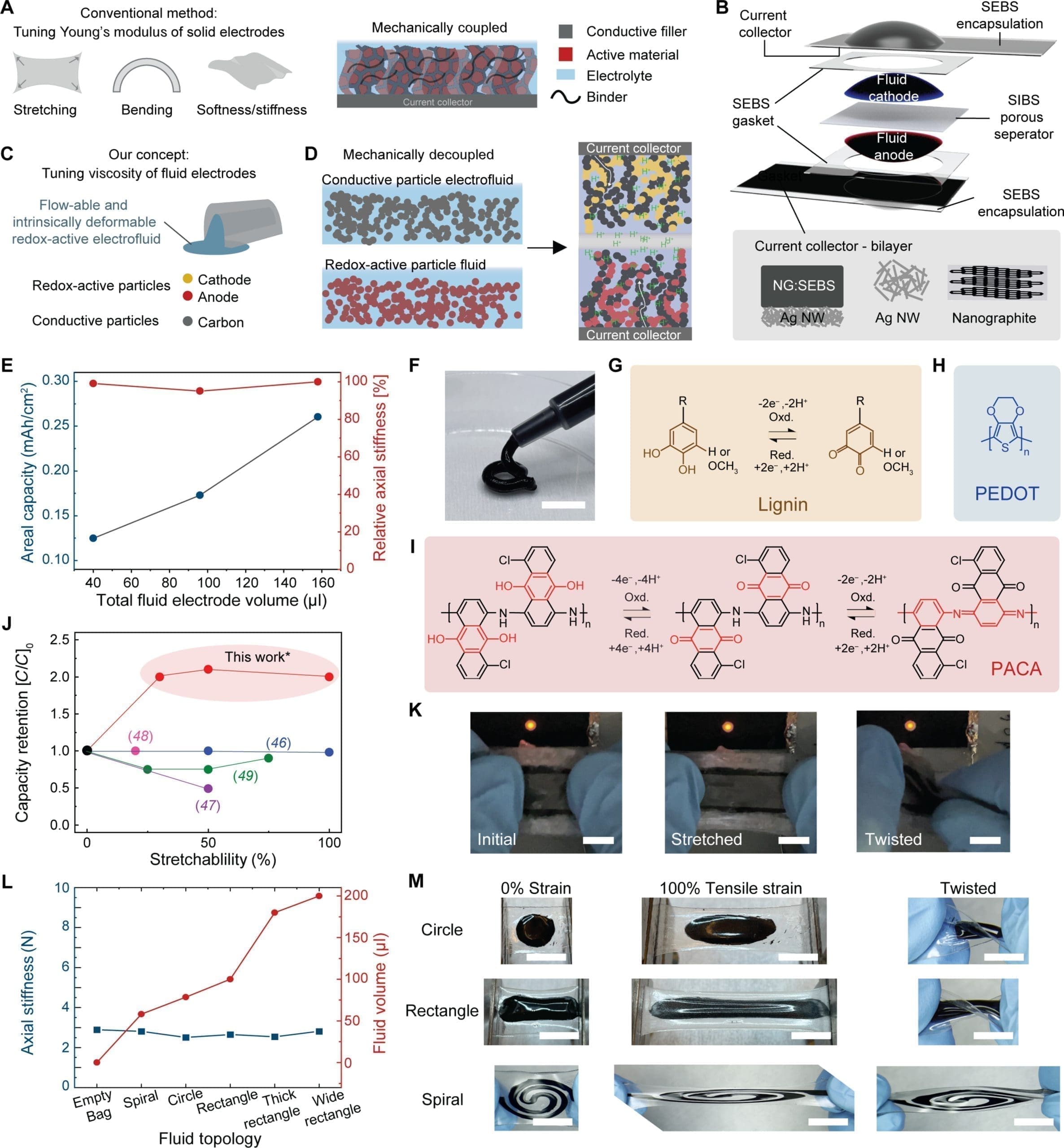
Researchers at Linköping University have developed a fluid battery capable of taking any shape, published in Science Advances. The battery uses electrodes in a liquid form made from conductive plastics and lignin, allowing it to be soft, conformable, and stretchable up to double its length while maintaining performance over 500 charge-discharge cycles.
This sustainable approach repurposes abundant materials, contributing to circular economy principles. However, the current-voltage of 0.9 volts limits practical applications, prompting ongoing research into enhancing electrical output using common metals like zinc or manganese.
Fluid Battery Breakthrough: Shape-Adaptive Energy Storage
Researchers at Linköping University have developed a fluid battery capable of adapting to any shape, offering new possibilities for future technologies. This soft and conformable battery can be integrated into devices like wearables and e-textiles, overcoming design limitations posed by traditional solid batteries.
The breakthrough lies in converting electrodes from solid to liquid form, avoiding rigidity issues. Unlike previous attempts using materials that couldn’t maintain fluidity or were environmentally harmful, this battery uses conductive plastics (conjugated polymers) and lignin, a sustainable byproduct of paper production.
With a lifespan of over 500 recharge cycles and the ability to stretch to double its length without performance loss, the fluid battery shows promise. Researchers aim to enhance efficiency by increasing voltage using zinc or manganese in future iterations.
Applications in Future Technology
The development of a fluid battery capable of adapting to any shape opens new possibilities for integrating energy storage into flexible and wearable devices. This innovation addresses the limitations posed by traditional solid batteries, which are bulky and rigid, often constraining design choices in electronics. The ability to mold the battery into various forms enables seamless integration into emerging technologies such as e-textiles, soft robotics, and medical implants.
One of the most promising applications lies in wearable medical devices, where conformable batteries can enhance user comfort and functionality. For instance, insulin pumps, pacemakers, or neural interfaces could benefit from a power source that adapts to the body’s contours without compromising performance. Similarly, e-textiles embedded with sensors for monitoring vital signs would gain from lightweight, flexible energy storage solutions.
The fluid battery’s sustainability is another key advantage. By utilizing conductive plastics and lignin—a renewable byproduct of paper production—researchers have created a more environmentally friendly alternative to conventional batteries. This approach reduces reliance on rare earth metals and hazardous materials, aligning with global efforts to develop greener technologies.
Looking ahead, the fluid battery’s adaptability could also pave the way for innovative applications in soft robotics, where machines need to interact safely with humans or delicate environments. The ability to stretch to double its length without performance loss makes it ideal for such uses.
Environmental Benefits and Future Innovations
The fluid battery’s use of conductive plastics and lignin aligns with circular economy principles by minimizing waste and promoting the use of abundant, readily available materials. By avoiding environmentally hazardous substances, the battery’s production process is greener, contributing to overall environmental stewardship.
Looking ahead, researchers are exploring methods to enhance the fluid battery’s efficiency and durability. A key focus is increasing voltage, which could improve energy storage capacity and overall performance. Potential approaches include incorporating materials like zinc or manganese, which may offer higher voltage outputs compared to current configurations. Additionally, improving charge-discharge efficiency aims to minimize energy loss during cycling.
The fluid battery’s adaptability also presents opportunities for integrating advanced functionalities. Researchers are considering how to optimize the battery’s response to temperature changes and mechanical stress, ensuring reliable operation in diverse environments. These efforts aim to address practical challenges while maintaining the battery’s unique advantages in flexibility and sustainability.
In conclusion, the fluid battery represents a significant advancement in energy storage technology, offering adaptability, sustainability, and potential for innovative applications across various industries.
More information
External Link: Click Here For More