Francesco Slongo and Cristian Micheletti published a study on April 9, 2025, introducing Computing Canonical Averages with Quantum and Classical Optimizers: Thermodynamic Reweighting for QUBO Models of Physical Systems, which bridges quantum and classical QUBO models to calculate canonical averages, providing new insights into physical systems like lattice ring polymers.
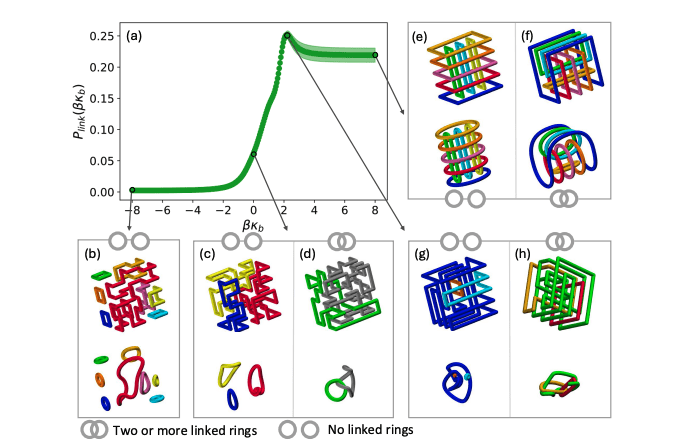
The research introduces a method for calculating canonical averages in physical models using QUBO-based sampling. A histogram reweighting scheme enables accurate recovery of the density of states, facilitating expectation value calculations at fixed temperatures. This approach advances characterization of systems represented as QUBO problems, such as lattice ring polymers. Application to space-filling melts reveals non-monotonic ring catenation probability with bending rigidity, demonstrating the method’s utility for intractable physical systems.
Recent advancements in quantum computing have significantly enhanced our ability to study complex systems and their equilibrium properties. This article examines key innovations in density of states reconstruction, Monte Carlo simulations, linking probability in ring melts, and curvature analysis, providing insights into the behavior of quantum systems.
A critical development in this research is the reconstruction of the density of states, a technique that maps the energy states a system can occupy. This method enables researchers to predict how a system will behave under various conditions without observing every state directly. By focusing on thermodynamic properties, this approach has proven invaluable for understanding quantum systems at a fundamental level.
Monte Carlo simulations have emerged as a powerful
Monte Carlo simulations have emerged as a powerful tool for exploring the behavior of quantum systems through statistical sampling. These simulations provide a probabilistic framework for solving complex problems, particularly in studying phase transitions and equilibrium states. Their ability to model scenarios that are otherwise computationally intractable has made them indispensable in advancing our understanding of quantum phenomena.
The research also investigates the linking probability of ring melts, revealing a non-monotonic relationship regardless of the number of rings involved. This finding suggests that the likelihood of rings linking together does not consistently increase or decrease with the number of rings but instead fluctuates. Such insights are particularly valuable for understanding the behavior of polymers and other cyclic structures in various environments.
Another significant area of exploration is the relationship between average curvature and bending rigidity. The study demonstrates how varying levels of bending rigidity affect the curvature profiles of ring melts, offering a deeper understanding of their structural dynamics. This analysis is essential for predicting how these systems will respond to external forces or changes in environmental conditions.
This research highlights the importance of innovative methodologies
This research highlights the importance of innovative methodologies in advancing our understanding of quantum systems. By employing density of states reconstruction and Monte Carlo simulations, scientists have gained valuable insights into the behavior of ring melts and their equilibrium properties. These findings not only contribute to the field of quantum computing but also have broader implications for materials science and polymer physics. As research continues, these advancements will undoubtedly pave the way for further discoveries, enhancing our ability to model and predict the behavior of complex systems in various applications.
🗞 Computing Canonical Averages with Quantum and Classical Optimizers: Thermodynamic Reweighting for QUBO Models of Physical Systems
🧠 DOI: https://doi.org/10.48550/arXiv.2504.07094
See today’s quantum computing news on Quantum Zeitgeist for the latest breakthroughs in qubits, hardware, algorithms, and industry deals.