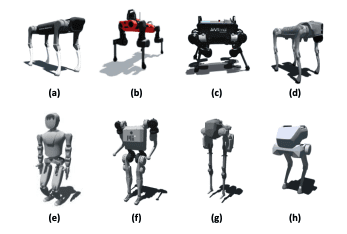
On April 7, 2025, researchers introduced PTRL: Prior Transfer Deep Reinforcement Learning for Legged Robots Locomotion. This framework addresses key challenges in legged robot motion control by proposing a novel approach to enhancing training efficiency and model transferability.
In legged robot motion control, reinforcement learning faces challenges of high computational costs and poor model generalization. A novel framework called Prior Transfer Reinforcement Learning (PTRL) is introduced to improve training efficiency and transferability across robots. PTRL employs selective layer freezing during policy transfer, marking the first use of such a method in RL. The framework involves pre-training on a source robot using the Proximal Policy Optimization algorithm, transferring the policy to a target robot, and fine-tuning with partial network freezing. Experiments show that PTRL significantly reduces training time while maintaining or improving performance, particularly when 50% of layers are frozen. This approach demonstrates strong generalization and adaptability, offering an efficient solution for RL-based legged robot control.
Transfer learning and reinforcement learning methods have emerged as powerful approaches to enhance robot adaptability. By transferring knowledge from one task to another, these techniques enable robots to leverage previously acquired skills when confronting new challenges. A particularly promising development is concurrent teacher-student reinforcement learning, where models learn simultaneously in a relationship mirroring human mentorship. This approach has shown impressive results in coordinating complex movements, such as quadrupedal locomotion, where robots must maintain balance while navigating varied terrains.
Sim-to-real transfer represents another significant breakthrough, allowing robots to train extensively in simulated environments before deploying learned capabilities in physical settings. This approach addresses the practical limitations of training directly in the real world, where mistakes can be costly or dangerous. However, successfully bridging the domain gap between virtual and physical environments remains challenging. Domain randomization, introducing controlled variability during simulation, has emerged as an effective strategy to build more robust models that generalize better to real-world conditions.
Whole-body control systems coordinate all robot components for fluid, integrated movement, a particularly crucial capability for humanoid robots. These sophisticated control architectures synchronize the actions of legs, arms, torso, and other elements to achieve efficient motion, whether walking, manipulating objects, or performing complex tasks. The seamless integration of these components represents a significant step toward robots that can move with human-like grace and effectiveness.
The applications of transfer learning extend well beyond robot locomotion. In structural assessment, robots equipped with digital twins of infrastructure elements like bridges can effectively detect damage and assess structural integrity. This capability proves invaluable in construction or disaster response scenarios, where robots can safely evaluate hazardous areas that would pose significant risks to human inspectors.
Integration with other AI tools promises to further expand robotic capabilities. Large language models could revolutionize human-robot communication through advanced machine translation, enabling more natural and intuitive interactions. Meanwhile, optimized convolutional neural networks (CNNs) enhanced through transferable knowledge dramatically improve robots’ ability to interpret visual data, allowing them to recognize objects and navigate environments more effectively.
Progressive reinforcement learning with distillation represents an exquisite approach to creating efficient robot controllers. This method transfers insights from complex, computationally intensive models to simpler ones, distilling essential knowledge while reducing processing requirements. The result is lightweight yet powerful control systems that can operate effectively with limited onboard computing resources.
The computational demands of robotic learning have spurred the development of specialized tools like Isaac Gym, which leverages GPU acceleration to dramatically speed up training processes. These high-performance environments are essential for handling the high-dimensional sensor data typical in robotics applications, enabling faster iteration and more sophisticated models.
Research incorporating neuroscience principles into robotic control systems shows particular promise. Spiking neural networks and other brain-inspired models offer a unique combination of biological plausibility and computational efficiency, potentially leading to more natural and adaptive robot behaviors. These approaches could help bridge the gap between traditional AI methods and the remarkable capabilities of biological systems.
These technological advancements collectively promise more versatile robots capable of tackling previously intractable challenges in search-and-rescue operations, industrial automation, and personal assistance. Their enhanced adaptability in dynamic environments could transform industries ranging from construction to healthcare, making robots reliable partners in increasingly complex scenarios.
Conclusion
The convergence of deep learning and robotics is creating systems that learn more efficiently, adapt more effectively, and operate more safely in real-world environments. As these technologies continue to mature, they hold the potential to address critical societal challenges while expanding the frontiers of what machines can accomplish. The ongoing dialogue between artificial intelligence research and robotics engineering continues to yield innovations that bring us closer to robots that can truly understand and navigate our world.
👉 More information
🗞 PTRL: Prior Transfer Deep Reinforcement Learning for Legged Robots Locomotion
🧠 DOI: https://doi.org/10.48550/arXiv.2504.05629

See today’s quantum computing news on Quantum Zeitgeist for the latest breakthroughs in qubits, hardware, algorithms, and industry deals.