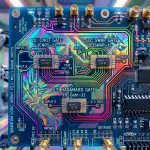
Researchers introduced a novel hybrid quantum-classical framework called Quantum Parallel Information Exchange (QPIE), leveraging transfer learning to enhance pattern recognition and time-series prediction.
The study introduces a hybrid quantum-classical model, QPIE, leveraging transfer learning by integrating pre-trained classical neural network parameters into quantum circuits using non-Clifford gates. This enhances pattern recognition and time-series prediction efficiency. Additionally, a dynamic gradient selection method combining parameter shift rules on quantum processing units (QPUs) with adjoint differentiation on GPUs is developed. Results show improved accuracy in benchmarks, an 88% reduction in convergence time for stochastic data within 100 steps, and a more unbiased Fisher information matrix spectrum across CPU/GPU and IonQ QPU simulators.
Quantum computing has long been heralded as the next frontier in technological advancement, promising to revolutionize fields ranging from cryptography to drug discovery. Recent breakthroughs have brought us closer than ever to realizing the full potential of quantum systems, with innovations that address key challenges such as error mitigation, circuit design, and practical applications. This article explores some of the most exciting developments in the field, highlighting how they are shaping the future of quantum computing.
The Promise of Quantum Computing
Quantum computers leverage the principles of quantum mechanics to perform calculations far beyond the capabilities of classical computers. By utilizing qubits, quantum bits that can exist in multiple states simultaneously, these systems have the potential to solve complex problems in fields like optimization, materials science, and artificial intelligence with unprecedented speed and efficiency.
However, realizing this potential has been hindered by several challenges, including the fragility of quantum states, the complexity of error correction, and the limited scalability of current hardware. Recent advancements, however, are addressing these issues head-on, paving the way for more robust and practical quantum systems.
Variational Quantum Circuits: A New Approach to Problem-Solving
One of the most promising innovations in quantum computing is the development of variational quantum circuits (VQCs). These hybrid models combine classical and quantum computing resources to tackle complex problems that are currently beyond the reach of purely classical or purely quantum approaches.
Variational quantum circuits work by encoding problem parameters into a quantum circuit, which is then optimized using classical algorithms. This approach has shown promise in areas such as optimization, machine learning, and materials science. For example, researchers have demonstrated using VQCs to design more efficient supply chains, optimize financial portfolios, and simulate molecular structures with high accuracy.
The flexibility of variational quantum circuits makes them particularly well-suited for near-term quantum devices, which are limited in qubit count and error rates. VQCs represent a practical path forward for applying quantum computing to real-world problems by leveraging classical resources to compensate for these limitations.
Hybrid Quantum-Classical Models: Bridging the Gap
Another exciting development is the emergence of hybrid quantum-classical models that integrate quantum circuits with traditional neural networks. These models combine the strengths of both approaches, enabling tasks such as image classification and pattern recognition with improved accuracy and efficiency.
For instance, researchers have developed shallow hybrid quantum-classical convolutional neural networks (CNNs) for image classification tasks. By incorporating quantum operations into the early layers of a CNN, these models achieve higher accuracy while maintaining computational efficiency. This approach not only demonstrates the potential of quantum-enhanced machine learning but also highlights the importance of practical implementations that can be executed on current hardware.
Error Mitigation and Scalability
One of the most significant challenges in quantum computing is the issue of error rates. Quantum states are highly sensitive to environmental noise, which can lead to errors in computations. To address this, researchers have developed novel error mitigation techniques that reduce the impact of noise without requiring full-scale error correction.
These methods involve post-processing the results of quantum computations to account for errors introduced during the calculation. By doing so, they enable more accurate results from noisy intermediate-scale quantum (NISQ) devices, which are currently the most advanced quantum computers available. This progress is critical for ensuring that quantum systems can be scaled up to larger, fault-tolerant architectures in the future.
Quantum Applications in Big Data and Beyond
The potential applications of quantum computing extend far beyond theoretical research. For example, quantum support vector machines (QSVMs) have been developed to perform classification tasks on large datasets with improved efficiency compared to classical methods. These algorithms leverage the unique properties of quantum systems to identify patterns and relationships in data that might be missed by traditional techniques.
Additionally, quantum cryptography advancements enable more secure communication protocols, which are essential for protecting sensitive information in an increasingly connected world. By harnessing the principles of quantum mechanics, researchers have developed cryptographic schemes that are resistant to attacks from both classical and quantum computers.
👉 More information
🗞 Quantum parallel information exchange (QPIE) hybrid network with transfer learning
🧠 DOI: https://doi.org/10.48550/arXiv.2504.04235