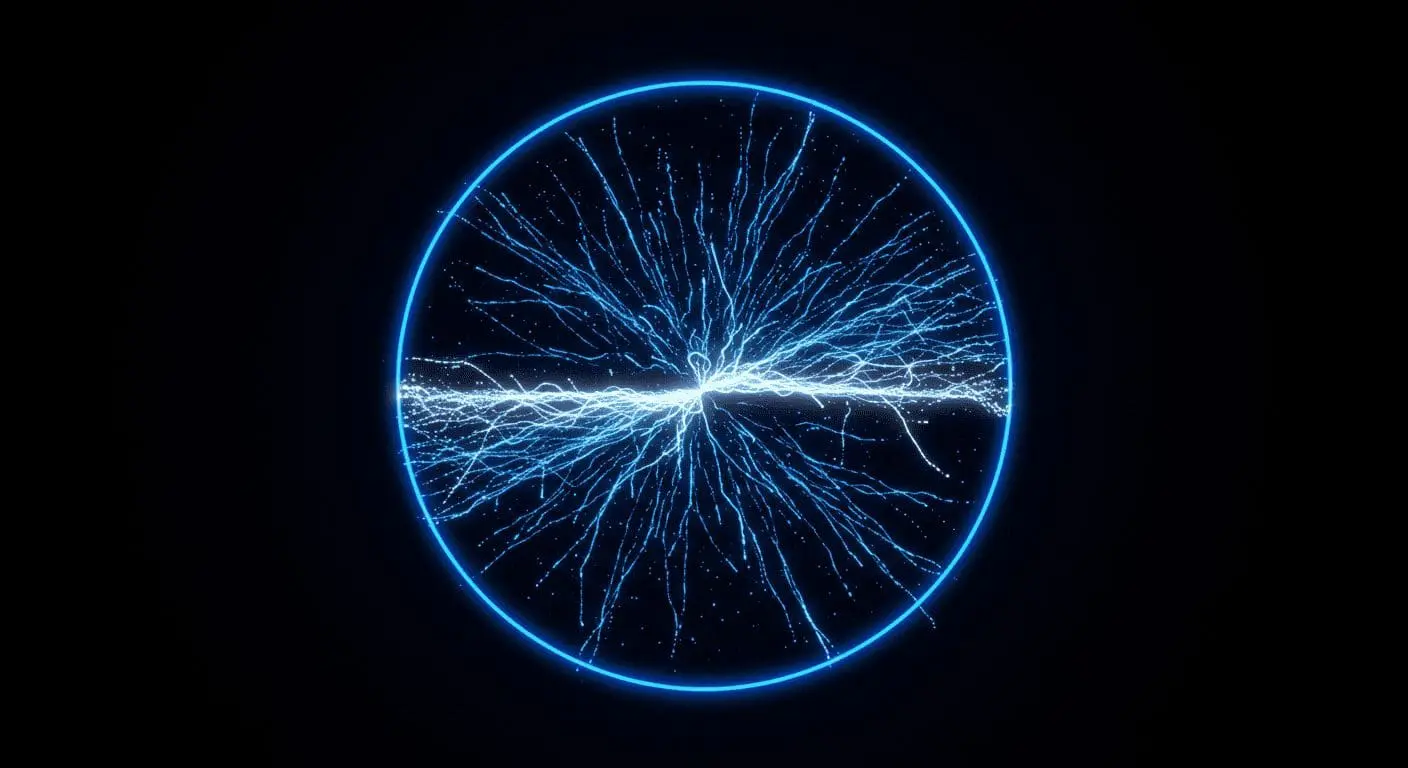
In a study titled Studies of Hadronic Showers in SND@LHC, published on April 2, 2025, the SND@LHC Collaboration details their efforts at CERN to observe neutrinos from LHC proton-proton collisions. Their detector, comprising a target with SciFi modules and a hadronic calorimeter/muon detector, was calibrated using test beams in Summer 2023. The report outlines methods for detecting and measuring the energy of hadronic showers produced by energetic neutron collisions.
The SND@LHC experiment aims to observe neutrinos from LHC proton-proton collisions using a detector with a SciFi-target and hadronic calorimeter/muon detector. Energetic neutron collisions in the target produce hadronic showers, requiring energy reconstruction by estimating deposits in both sections. To calibrate, a replica was tested in the SPS H8 beam line (100–300 GeV) in Summer 2023. Methods were developed to tag showers, locate their origin in the target, and combine SciFi and calorimeter signals for total energy measurement.
CERN, where groundbreaking experiments are reshaping our understanding of the universe. Among these, neutrino physics stands out as a frontier of discovery, with implications that could redefine particle physics and cosmology.
Neutrinos, often referred to as ghost particles, are among the most enigmatic in the subatomic realm. CERN’s experiments delve into their properties, utilizing advanced detection technologies to capture these elusive particles. These efforts are crucial for understanding the universe’s fundamental forces and the origins of matter.
To predict and analyze particle behavior, scientists employ Monte Carlo simulations, complex computational models that mimic real-world particle interactions. These simulations are essential for designing experiments and interpreting data, offering insights into phenomena that are otherwise invisible to direct observation.
CERN’s research relies on sophisticated software tools like FLUKA, PYTHIA, and GEANT4. FLUKA simulates particle transport, aiding in the design of detectors and shielding. PYTHIA generates particle collision events, while GEANT4 models detector responses, providing a virtual environment for testing hypotheses.
CERN’s work is a testament to global collaboration, with projects like SHiP (Search for Hidden Particles) involving international teams. These collaborations leverage diverse expertise, accelerating discoveries and fostering innovation in particle physics.
The Future of Particle Physics
As CERN continues its quest, the insights gained could lead to transformative technologies and deepen our philosophical understanding of existence. The pursuit of neutrino physics not only advances science but also inspires future generations, highlighting humanity’s enduring curiosity about the cosmos.
In conclusion, CERN’s experiments are pivotal in unraveling the universe’s mysteries, with potential implications for technology and philosophy. As these efforts progress, they promise to illuminate new frontiers in particle physics, driving us closer to understanding our place within the vast expanse of existence.
👉 More information
🗞 Studies of Hadronic Showers in SND@LHC
🧠 DOI: https://doi.org/10.48550/arXiv.2504.01716

See today’s quantum computing news on Quantum Zeitgeist for the latest breakthroughs in qubits, hardware, algorithms, and industry deals.