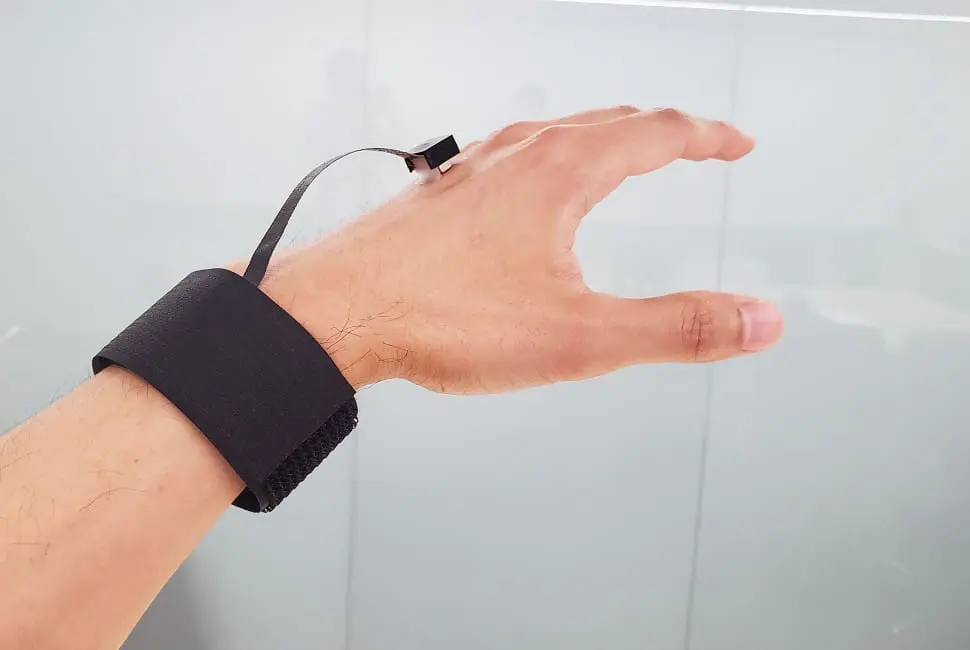
Northwestern University engineers have developed a new wearable haptic device that mimics the complexity of human touch, offering sensations such as pulling, stretching, vibrations, pressure, and twisting. The compact, lightweight, wireless device connects via Bluetooth and uses a small rechargeable battery, allowing it to be placed anywhere on the body. Designed for versatility, it has potential applications in virtual reality, assisting visually impaired individuals, simulating textures for online shopping, enabling remote healthcare interactions, and helping hearing-impaired people experience music through touch.
Engineers at Northwestern University have developed a wearable haptic feedback device designed to mimic human touch. This innovative technology employs actuators capable of full freedom of motion (FOM), enabling precise force application in multiple directions along the skin. By engaging various mechanoreceptors, the device provides realistic and nuanced tactile sensations that surpass previous technologies.
The device’s technical design integrates tiny magnets and wire coils arranged in a nested configuration. When an electrical current passes through the coils, it generates magnetic fields that interact with the embedded magnets, producing forces sufficient to move, push, pull, or twist the magnet assembly. This mechanism supports dynamic movements and versatile applications, facilitating a wide range of tactile feedback scenarios.
The device incorporates an accelerometer that monitors its orientation and movement to enhance spatial awareness. For example, when worn on the hand, it can detect whether the palm is facing up or down. The accelerometer also tracks the actuator’s motion, providing real-time data on speed, acceleration, and rotational changes. This capability ensures accurate and responsive haptic feedback aligned with the user’s physical interactions.
The technology has diverse potential applications, including replicating everyday tactile experiences such as distinguishing fabric textures during virtual shopping. Beyond sensory replication, the device can convey complex information through touch, such as translating musical sounds into physical sensations. Users can differentiate between various instruments by adjusting parameters like frequency, intensity, and rhythm, offering new ways to experience auditory content.
This advancement in haptic technology improves digital user experiences while also providing innovative pathways for assisting individuals with sensory impairments. By converting auditory information into tactile signals, the device enhances accessibility and inclusivity, enabling new methods of experiencing music and other forms of audio communication.
More information
External Link: Click Here For More
See today’s quantum computing news on Quantum Zeitgeist for the latest breakthroughs in qubits, hardware, algorithms, and industry deals.