Researchers at Harvard University’s John A. Paulson School of Engineering and Applied Sciences (SEAS) have developed a new type of interferometer, called a cascaded-mode interferometer, which enables precise control over the frequency, intensity, and mode of light in a single compact device. This innovation replaces traditional beam-splitting waveguides used in fiber-optic communications and offers improved capabilities for simultaneously controlling multiple aspects of light.
The device, built on a silicon-on-insulator platform with nanoscale gratings etched into a single waveguide, allows for optical spectral shaping by manipulating the amplitude and phase of light. Applications include advanced nanophotonic sensors and on-chip quantum computing. The research, published in Science Advances, was led by postdoctoral fellow Jinsheng Lu under the supervision of Federico Capasso, with support from the Air Force Office of Scientific Research and the National Science Foundation.
Introduction to Interferometers
Interferometers are devices designed to modulate various properties of light, such as frequency, intensity, and mode. They enable precise modulation and switching of light signals, which is crucial in fiber-optic communications, gas sensing, and optical computing.
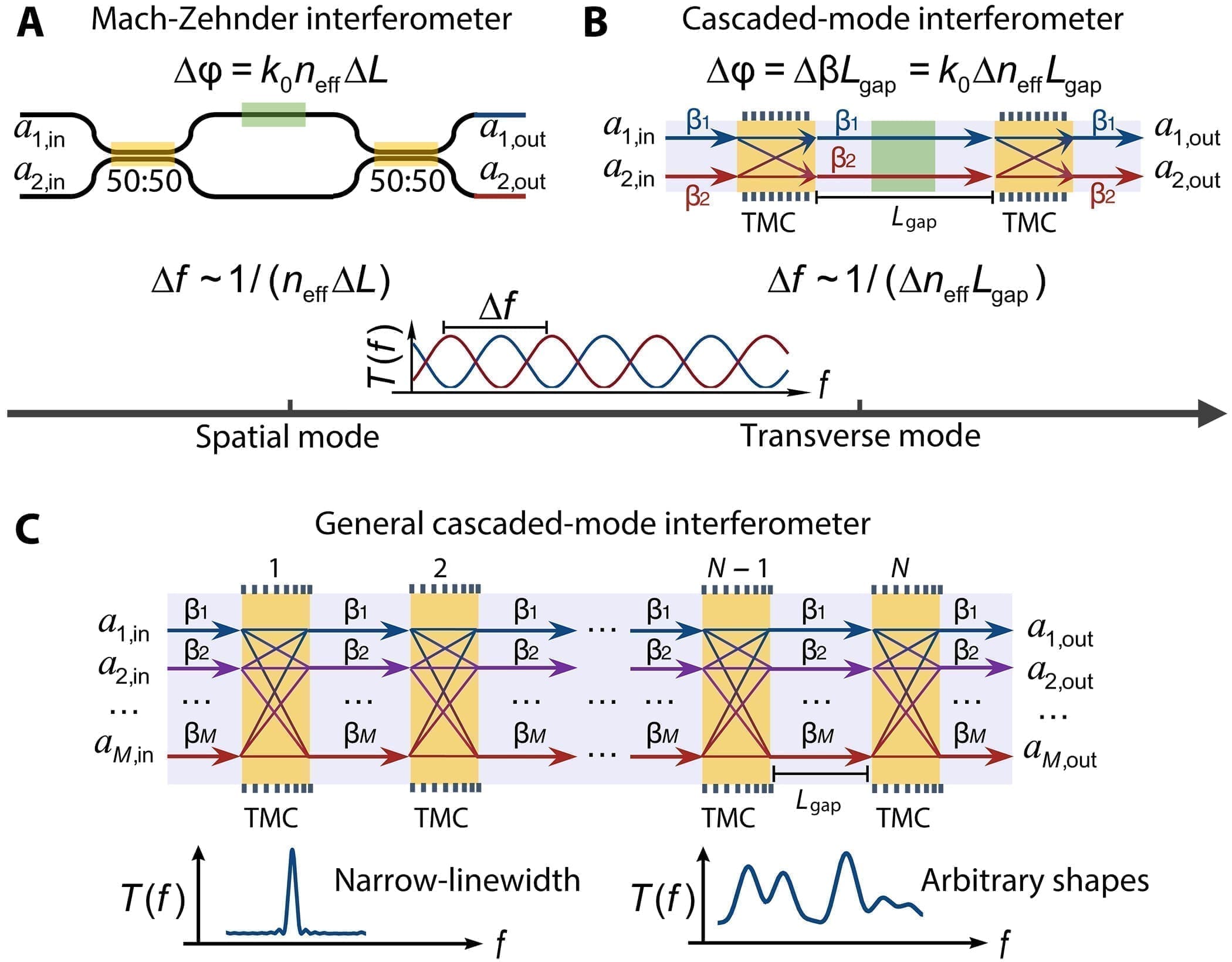
Traditionally, Mach-Zehnder interferometers have been widely used. They function by splitting a light beam into two paths to toggle its output. However, these devices have limitations, particularly in their ability to control different aspects of light simultaneously. This often necessitates using multiple interferometers sequentially, increasing space requirements and limiting signal capacity.
In contrast, the newly developed cascaded-mode interferometer offers significant advancements. Integrated into a single-chip waveguide, it eliminates the need for beam-splitting by utilizing nanoscale gratings to control energy exchange between light modes. This innovation allows for precise spectral shaping, enabling simultaneous adjustment of intensity and phase across different light colours.
The cascaded-mode interferometer’s ability to manipulate multiple light characteristics within a compact structure presents advantages in applications such as advanced sensors and on-chip quantum computing. Its design represents a substantial step forward in optical modulation, addressing previous limitations with enhanced functionality and efficiency.
Invention of the Cascaded-Mode Interferometer
The cascaded-mode interferometer represents a novel advancement in optical modulation technology. Unlike traditional Mach-Zehnder interferometers, which rely on beam-splitting to toggle light outputs, this new device integrates nanoscale gratings within a single-chip waveguide structure. These gratings facilitate precise control over energy exchange between different light modes, enabling simultaneous adjustments to intensity and phase across multiple wavelengths.
This innovation allows for highly efficient spectral shaping, a capability that is particularly valuable in applications requiring complex light manipulation. The compact design of the cascaded-mode interferometer eliminates the need for bulky beam-splitting components, reducing space requirements while maintaining or enhancing performance.
The device’s ability to manipulate multiple light characteristics within a single structure offers significant advantages over conventional systems. These include improved signal processing capabilities and enhanced integration potential for advanced sensors and quantum computing applications. The development of this technology addresses key limitations of existing interferometers, providing researchers and engineers with a more versatile tool for optical modulation tasks.
The cascaded-mode interferometer’s design demonstrates a clear progression in optical engineering. It offers practical solutions to challenges associated with traditional beam-splitting approaches. Its implementation could lead to more efficient and scalable systems across various domains, from telecommunications to quantum information processing.
Theoretical Framework for Extending Device Physics
The cascaded-mode interferometer represents an advancement in optical modulation technology. Unlike traditional Mach-Zehnder interferometers, which rely on beam-splitting to toggle light outputs, this new device integrates nanoscale gratings within a single-chip waveguide structure. These gratings facilitate precise control over energy exchange between different light modes, enabling simultaneous adjustments to intensity and phase across multiple wavelengths.
This innovation allows for highly efficient spectral shaping, a particularly valuable capability in applications requiring complex light manipulation. The cascaded-mode interferometer’s compact design eliminates the need for bulky beam-splitting components, reducing space requirements while maintaining or enhancing performance.
The device’s ability to manipulate multiple light characteristics within a single structure offers significant advantages over conventional systems. These include improved signal processing capabilities and enhanced integration potential for advanced sensors and quantum computing applications. The development of this technology addresses key limitations of existing interferometers, providing researchers and engineers with a more versatile tool for optical modulation tasks.
The cascaded-mode interferometer’s design demonstrates a clear progression in optical engineering. It offers practical solutions to challenges associated with traditional beam-splitting approaches. Its implementation could lead to more efficient and scalable systems across various domains, from telecommunications to quantum information processing.
More information
External Link: Click Here For More




See today’s quantum computing news on Quantum Zeitgeist for the latest breakthroughs in qubits, hardware, algorithms, and industry deals.