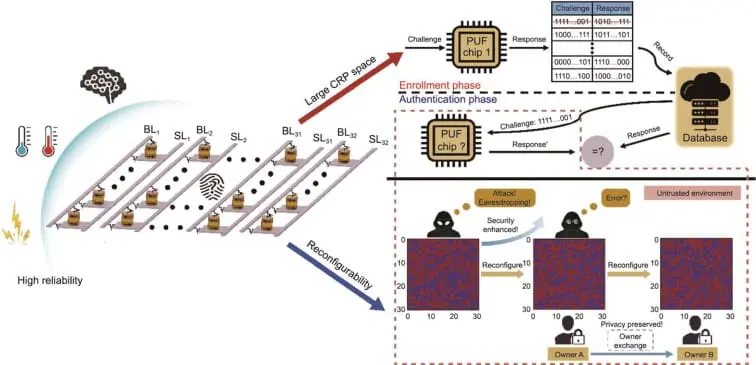
Researchers from Beihang University and Truth Memory Corporation have developed a 1 Kbit spin-orbit torque magnetic random access memory (SOT-MRAM) chip with a physical unclonable function (PUF), published in Engineering. This innovation addresses IoT security challenges by offering high reliability, resistance to machine-learning attacks, and reconfigurability, providing a robust solution for securing IoT devices.
Introduction to IoT Security Challenges
The rapid expansion of IoT has introduced significant security vulnerabilities due to the constrained resources of many IoT devices, which often lack robust encryption mechanisms. This makes private data susceptible to attacks, highlighting the need for innovative security solutions.
Physical Unclonable Functions (PUFs) are hardware-based security primitives that leverage inherent physical variations in electronic components to generate unique identifiers or cryptographic keys. These identifiers are unclonable and tamper-proof, making PUFs a promising solution for securing IoT devices against various attacks.
Development of Spin-Based SOT-MRAM sr-PUF
Spin-orbit torque (SOT)-based magnetic random-access memory (MRAM) is emerging as a leading candidate for implementing PUFs due to its high scalability, non-volatility, and low power consumption. In this work, we propose and demonstrate a SOT-MRAM-based strong robust PUF (sr-PUF) that leverages the intrinsic variability of magnetic tunnel junctions (MTJs) in SOT-MRAM devices.
The proposed sr-PUF architecture consists of an array of MTJ cells, where each cell exhibits unique resistance variations due to manufacturing tolerances. These variations are exploited to generate challenge-response pairs (CRPs), which serve as the foundation for secure authentication protocols. The use of SOT-MRAM enables high-speed operation and low-power consumption, making it suitable for IoT applications.
Performance Metrics and Reliability of SOT-MRAM sr-PUF
The performance of the proposed sr-PUF is evaluated in terms of key metrics, including uniqueness, randomness, and reliability. The uniqueness of the PUF responses is quantified using the Hamming distance between CRPs generated by different devices. Randomness is assessed using statistical tests, such as the NIST SP 800-90A entropy test.
The reliability of the sr-PUF is evaluated under various operating conditions, including temperature variations and supply voltage fluctuations. The results demonstrate that the proposed architecture achieves high reliability while maintaining strong security properties. Additionally, the use of SOT-MRAM enables the sr-PUF to operate at significantly lower power levels compared to traditional PUF implementations.
Reconfigurability and Resistance to Machine-Learning Attacks in SOT-MRAM PUF
One of the key advantages of the proposed SOT-MRAM-based sr-PUF is its reconfigurability, which allows for dynamic adjustment of CRPs in response to environmental changes or aging effects. This feature enhances the long-term reliability and security of the PUF.
Furthermore, the proposed architecture demonstrates strong resistance to machine-learning attacks, which are a significant threat to conventional PUFs. By leveraging the high dimensionality and unpredictability of SOT-MRAM devices, the sr-PUF achieves robust protection against various attack vectors, including template attacks and model inversion attacks.
In conclusion, the proposed SOT-MRAM-based strong robust PUF offers a secure and energy-efficient solution for IoT security applications. Its unique combination of high reliability, low power consumption, and resistance to machine-learning attacks makes it an attractive candidate for next-generation IoT devices.
More information
External Link: Click Here For More