A research team led by Professor Hyunchul Oh at UNIST, along with collaborators from Soongsil University, Technical University of Munich (TUM), and Helmholtz-Zentrum Berlin (HZB), has developed a copper-based metal-organic framework (MOF) capable of efficiently separating deuterium (D2) from hydrogen (H2) at 120 K (-153°C). This temperature exceeds the liquefaction point of natural gas, making the material suitable for large-scale industrial applications.
The study, published in Nature Communications, demonstrates that the MOF maintains its effectiveness at higher temperatures due to lattice expansion, enabling quantum sieving for D2 separation. Deuterium is crucial for enhancing semiconductor performance and fusion energy production, yet its efficient extraction has been challenging. The new material’s ability to operate at elevated temperatures could facilitate economical D2 production using existing liquefied natural gas infrastructure. Experimental validations through X-ray diffraction (XRD), quasielastic neutron scattering (QENS), and thermogravimetric analysis confirmed the material’s functionality, highlighting its potential for advancing hydrogen isotope separation technologies.
Revolutionizing Deuterium Separation with Cu-ZIF: A Breakthrough in High-Temperature Performance
In a groundbreaking development, researchers have unveiled a novel porous material, Cu-ZIF, capable of efficiently separating deuterium (D₂) from hydrogen (H₂) at elevated temperatures up to 120 K. This advancement not only surpasses the liquefaction point of natural gas (111 K) but also opens new possibilities for integrating with existing liquefied natural gas (LNG) infrastructure, significantly enhancing scalability.
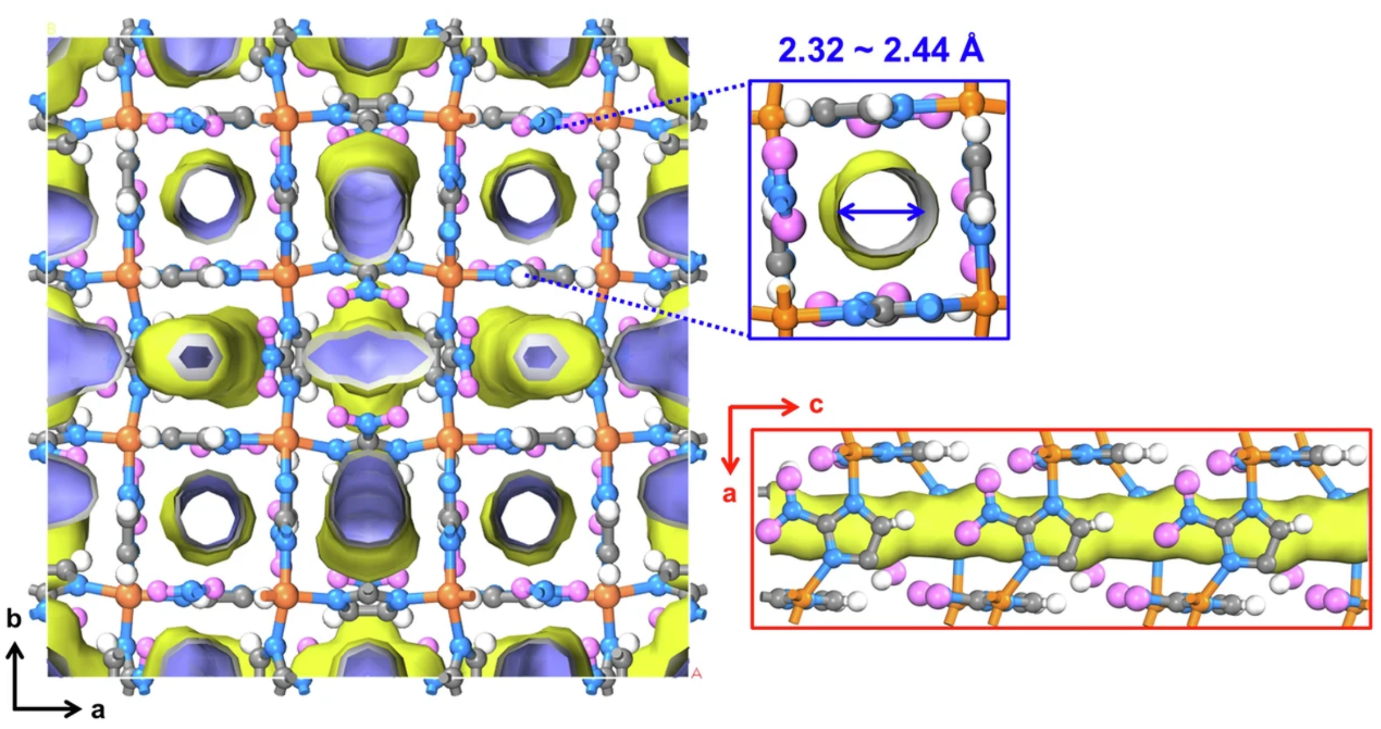
The material’s functionality is based on a lattice-driven gating mechanism. At lower temperatures, the lattice structure allows heavier D₂ molecules to pass through more efficiently than H₂, leveraging quantum sieving effects. As temperatures rise, the lattice expands, enabling gas permeation while maintaining separation efficiency.
Experimental validations using X-ray diffraction, neutron scattering, and thermal desorption spectroscopy confirmed Cu-ZIF’s effectiveness. These methods provided critical insights into molecular motion and diffusion behavior within the porous structure, essential for understanding its performance.
This research has substantial implications for industrial applications, particularly in the energy and technology sectors. Utilizing existing LNG infrastructure makes the process more economical, paving the way for sustainable isotope separation technologies that could revolutionize industries reliant on deuterium.
Current methods for D₂ production face significant limitations due to reliance on cryogenic temperatures. Traditional techniques require cooling hydrogen gas to extremely low temperatures, often below 20 K, making them energy-intensive and challenging to scale. The quantum sieving effect underpins these methods but maintaining such conditions is technically demanding and economically prohibitive for large-scale applications.
The development of Cu-ZIF addresses these challenges by enabling efficient deuterium separation at significantly higher temperatures, up to 120 K. This advancement reduces energy requirements and aligns with the operational parameters of existing LNG infrastructure, offering a cost-effective and scalable solution for isotope separation.
The ability to operate at elevated temperatures enhances efficiency and broadens potential applications in industries such as energy, healthcare, and advanced materials. This shift represents a practical solution to long-standing challenges in D₂ production, offering a more sustainable and accessible approach to isotope separation.
More information
External Link: Click Here For More
See today’s quantum computing news on Quantum Zeitgeist for the latest breakthroughs in qubits, hardware, algorithms, and industry deals.