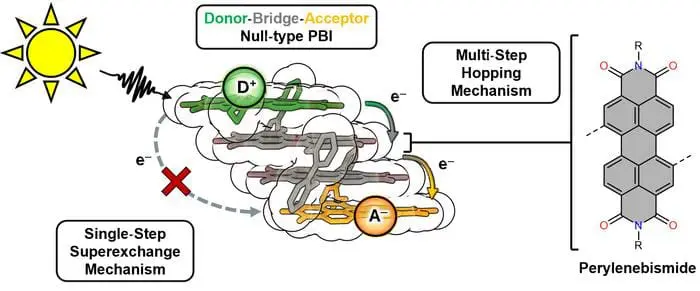
Researchers at the University of Würzburg, led by Professor Frank Würthner, have developed a stacked dye system that mimics an early step in natural photosynthesis. This advancement, detailed in Nature Chemistry, involves four perylene bisimide dyes arranged to absorb light and transfer energy efficiently. This marks progress toward artificial photosynthesis for sustainable energy production and carbon capture.
Introduction to Artificial Photosynthesis
Artificial photosynthesis is an emerging field of research aimed at replicating the process by which plants convert sunlight, water, and carbon dioxide into energy-rich molecules. This process holds significant potential for addressing global challenges such as climate change and sustainable energy production. By mimicking natural photosynthesis, researchers seek to develop systems that efficiently harness solar energy to produce fuels or valuable chemicals.
The complexity of natural photosynthesis, which involves numerous molecular components working in concert, presents a substantial challenge for artificial replication. However, advancements in materials science and nanotechnology are enabling scientists to design synthetic systems that approximate key aspects of this process. One such effort is the work of Professor Frank Würthner and his team at Julius-Maximilians-Universität (JMU) Würzburg, who have developed a stacked dye system that efficiently captures and transfers light energy.
Their research focuses on creating artificial dye arrays that can perform charge separation and transport, critical steps in photosynthesis. The team has synthesized a four-dye stack composed of perylene bisimide molecules, which demonstrates efficient and rapid charge hopping—a process essential for energy transfer. This achievement represents a significant step toward the development of functional artificial photosynthetic systems.
Looking ahead, Würthner’s team aims to expand their nanosystem by increasing the number of stacked components, with the ultimate goal of creating supramolecular wires capable of transporting energy over longer distances. Such advancements could lead to novel photofunctional materials with improved performance in solar energy applications.
The Complexity of Natural Photosynthesis
Natural photosynthesis is a highly efficient and complex process that involves multiple steps and molecular components. It begins with light absorption by chlorophyll molecules, which excite electrons and initiate a series of redox reactions. These reactions are facilitated by specialized proteins and enzymes, enabling the conversion of sunlight into chemical energy stored in glucose.
The intricate coordination of these processes is a significant challenge for artificial replication. Researchers must design synthetic systems that can mimic the efficiency and specificity of natural photosynthesis while overcoming limitations such as material stability and scalability.
Breakthroughs in Artificial Photosynthesis
Recent advancements in artificial photosynthesis have focused on developing materials and architectures that can replicate key aspects of natural processes. Professor Würthner’s team at JMU has made significant progress with their stacked dye system, which efficiently captures and transfers light energy. Their four-dye stack, composed of perylene bisimide molecules, demonstrates rapid charge hopping—a critical step in energy transfer.
This breakthrough brings researchers closer to developing functional artificial photosynthetic systems that produce fuels or valuable chemicals from sunlight, water, and carbon dioxide. Such systems could be vital in transitioning to sustainable energy sources and reducing greenhouse gas emissions.
The future of artificial photosynthesis lies in scaling up laboratory demonstrations into practical applications. Professor Würthner’s team is focusing on expanding their nanosystem by increasing the number of stacked components, aiming to create supramolecular wires capable of transporting energy over longer distances. This scalability will be essential for achieving efficient and reliable energy conversion at a meaningful scale.
Developing novel photofunctional materials with improved performance in solar energy applications remains a key goal. By refining their dye arrays into extended supramolecular structures, researchers aim to bridge the gap between laboratory demonstrations and real-world applications, bringing closer the possibility of sustainable energy solutions based on artificial photosynthesis.
Frank Würthner and his team at JMU employ a multidisciplinary approach combining materials science, chemistry, and physics in their research. Their methodology involves designing and synthesizing novel dye molecules, assembling them into stacked architectures, and characterizing their photophysical properties. Advanced spectroscopic techniques are used to study charge transfer dynamics and energy conversion efficiency.
The findings from this research demonstrate the potential of synthetic dye arrays for mimicking natural photosynthesis. By focusing on scalability and efficiency, the team aims to contribute significantly to the field of artificial photosynthesis and advance sustainable energy solutions.
More information
External Link: Click Here For More