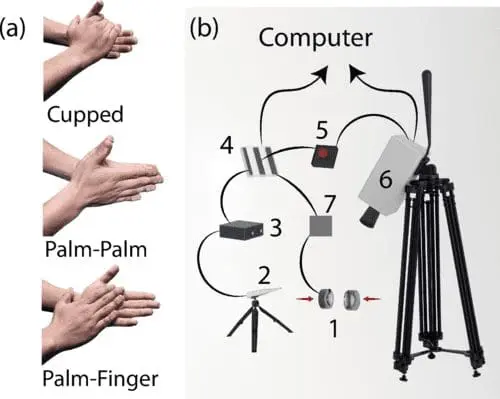
Sunny Jung, a professor at Cornell University, led a study published in Physical Review Research that investigates the physics behind hand clapping. The research involved high-speed camera observations of volunteers clapping, revealing how the size and shape of the cavity between hands influence sound frequency. By comparing these findings to Helmholtz resonators, the team identified principles applicable to bioacoustics and personal identification through unique handclap signatures, which could be used for attendance or other forms of recognition.
Inspiration from Popular Culture
The study on hand clapping acoustics was inspired by a scene from the 2006 film X-Men: The Last Stand, where a character claps hands to generate a shockwave. This intriguing moment led Sunny Jung, a professor at Cornell University, to investigate the physical mechanisms behind hand clapping. By analyzing high-speed camera footage of volunteers clapping in various configurations, cupped hands, flat hands, and fingers-to-palm, the researchers uncovered how the size and shape of the cavity between the palms influence sound frequency.
The research revealed that larger cavities produce lower-frequency sounds because the hands act as resonators. This finding was supported by comparing human data with simplified replicas and theoretical models, such as the Helmholtz resonator. Additionally, the study explored why claps are brief compared to traditional resonators, attributing it to the softness of hand tissues absorbing energy quickly.
A notable application of this research is its potential use in personal identification systems, leveraging unique characteristics of individual claps based on factors like hand size and skin texture. This work advances our understanding of acoustics and opens doors to practical applications in everyday technology.
Methodology and Experimental Setup
The study employed a comprehensive experimental setup to investigate hand clapping acoustics. Researchers utilized high-speed cameras to capture detailed footage of volunteers clapping in various configurations, including cupped hands, flat hands, and fingers-to-palm positions. This approach allowed them to analyze how the size and shape of the cavity between the palms influence sound frequency.
The team compared human data with simplified replicas and theoretical models, such as the Helmholtz resonator, to validate their findings. The experimental setup also incorporated measurements of force, pressure, and energy absorption. While the research was thorough, questions remain about how cavity shape affects frequency beyond volume, the methodology of measurements, and individual differences among volunteers.
The interdisciplinary approach highlights the physics behind clapping and suggests future studies on factors like skin texture or moisture influencing acoustic properties.
The study found that larger cavities produce lower-frequency sounds as the hands act similarly to a Helmholtz resonator. This phenomenon was validated by comparing human data with theoretical models. The brief duration of clapping sounds is attributed to the softness of hand tissues, which absorb energy quickly, reducing sustain compared to traditional resonators.
The research highlights potential applications in bioacoustics and personal identification systems. Unique clap characteristics, such as hand size and skin texture, could be used for individual recognition. The interdisciplinary approach underscores the physics of clapping and suggests future investigations into factors like skin moisture or texture influencing acoustic properties.
More information
External Link: Click Here For More




See today’s quantum computing news on Quantum Zeitgeist for the latest breakthroughs in qubits, hardware, algorithms, and industry deals.