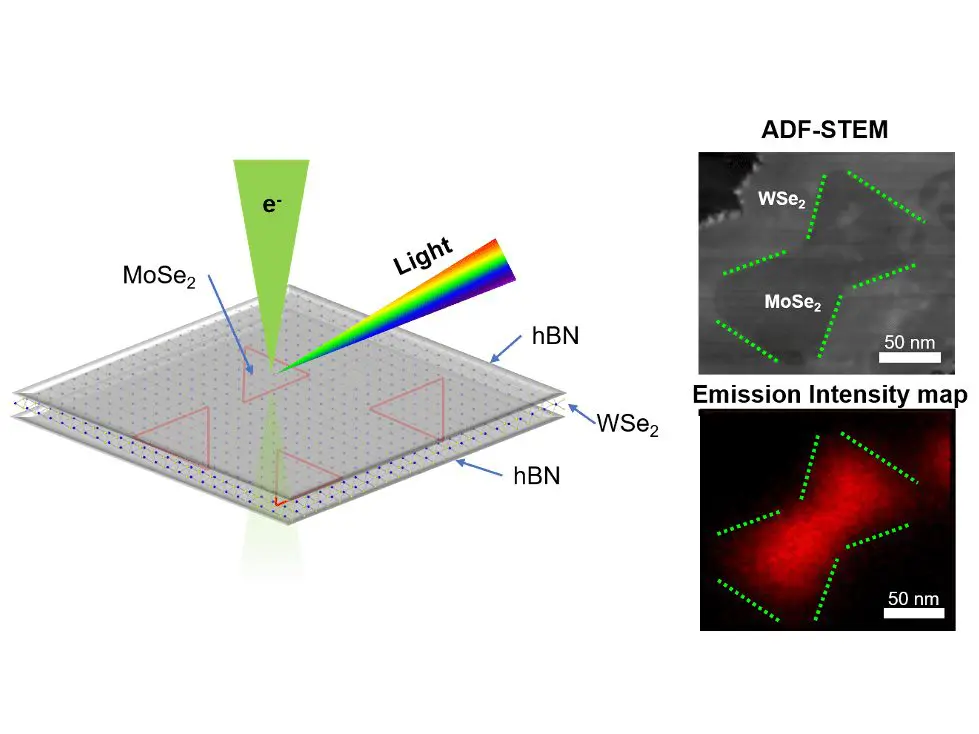
An international research team led by Penn State University and Université Paris-Saclay has developed a method to precisely control light emission by embedding molybdenum diselenide nanodots into tungsten diselenide within two-dimensional materials. This breakthrough enables the manipulation of light properties, such as color and frequency, through quantum confinement effects, where smaller nanodots emit higher-frequency light. The technique utilizes cathodoluminescence with a transmission electron microscope for high-resolution observation of individual nanodot emissions. This advancement could lead to more efficient devices, including higher-resolution displays and advancements in quantum computing. The researchers aim to expand this work to explore further applications and practical implementations.
Cathodoluminescence Imaging in 2D Materials: A Path to Advanced Applications
Cathodoluminescence (CL) imaging emerges as a pivotal technique in the study of light emissions from two-dimensional materials such as molybdenum diselenide (MoSe₂) and tungsten diselenide (WSe₂). By employing electron beams to excite these materials, researchers capture emitted light, gaining insights into how nanoscale structural changes influence optical properties like brightness and color. This capability is crucial for optimizing materials for applications requiring precise light control.
Band gap engineering involves combining MoSe₂ and WSe₂ in specific ratios to adjust the energy difference between valence and conduction bands, enabling precise control over electron behavior and light emission characteristics. This method allows researchers to tailor materials for specific wavelengths, beneficial for displays and quantum computing.
Quantum confinement effects, where nanoscale size alterations influence electronic states, offer further potential for controlling optical properties. This could lead to advancements in quantum computing components, where precise light emission is essential for qubit communication.
Challenges and Collaborative Efforts
Key challenges include maintaining precise nanodot control and ensuring material stability and scalability. Addressing these issues likely involves exploring new manufacturing techniques or alternative material combinations to overcome scalability hurdles.
Collaborative efforts funded by programs like Fulbright and NSF are bridging the gap between academic research and industrial application, fostering innovation through interdisciplinary expertise.
Role of Cathodoluminescence Imaging
CL imaging not only observes but also guides material engineering. Researchers use emission spectra data to adjust material compositions or structures, optimizing properties for specific applications. This iterative process is crucial for refining materials towards desired performance metrics.
Durability and Real-World Applications
The durability of these 2D materials under real-world conditions remains a concern. Factors such as temperature, humidity, and mechanical stress could impact long-term reliability. Future research must address these aspects to ensure materials are suitable for sustained use in practical applications.
Conclusion
This interdisciplinary research holds promise for revolutionizing display technologies and quantum computing by leveraging advanced imaging techniques and material science. While challenges remain, ongoing efforts aim to unlock the full potential of 2D materials, driving innovation across multiple scientific domains.
More information
External Link: Click Here For More




See today’s quantum computing news on Quantum Zeitgeist for the latest breakthroughs in qubits, hardware, algorithms, and industry deals.