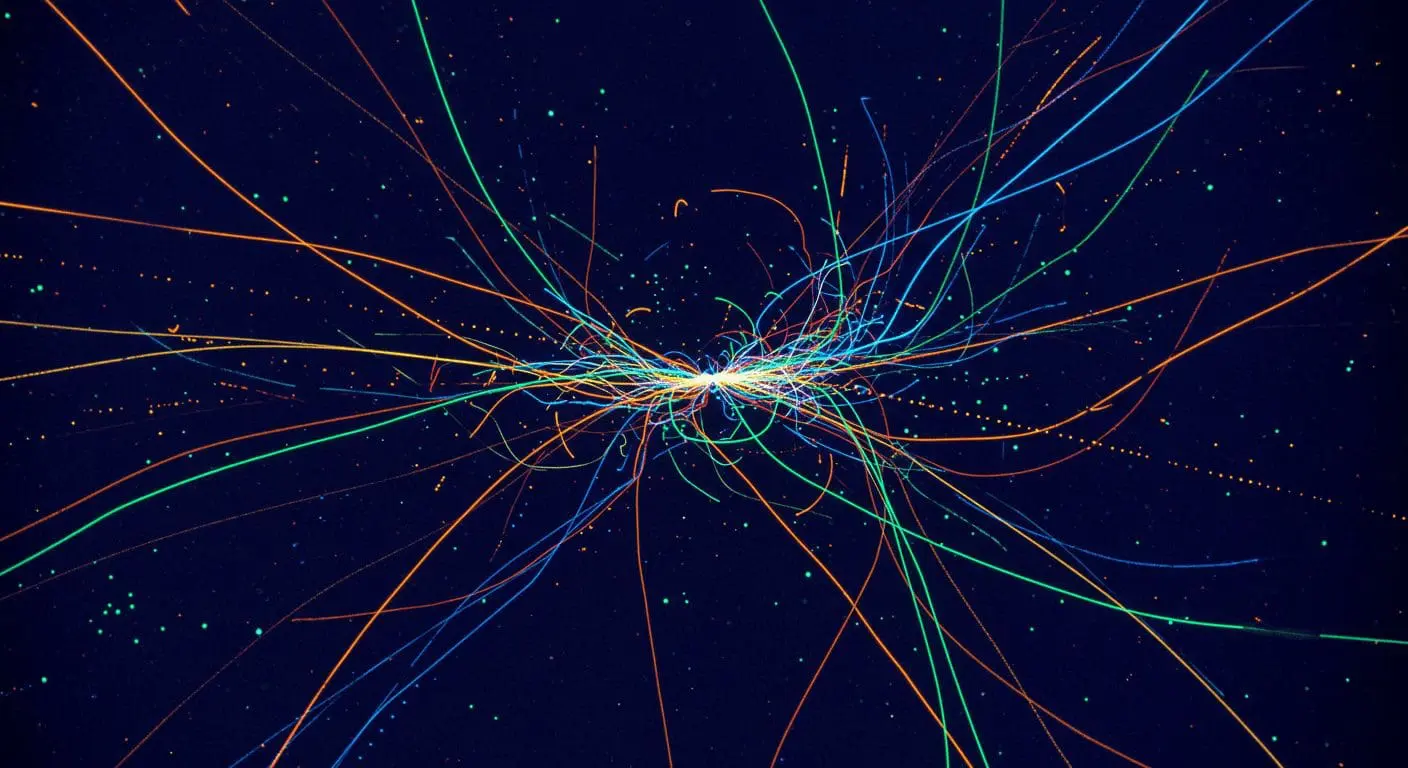
Particle physics seeks to explore phenomena beyond the Standard Model through collider experiments, which investigate known particles like the Higgs boson and search for deviations suggesting new physics. These experiments aim to discover new particles and structures, such as extra dimensions or novel force carriers. Theoretical models, including the Two-Higgs Doublet Model, predict multiple Higgs bosons that could unify different particle sectors. Next-generation colliders, like the Future Circular Collider, are being developed to extend energy and luminosity limits, enabling exploration of previously inaccessible frontiers.
Cosmology provides another avenue for understanding new physics by addressing unresolved questions about dark matter, matter-antimatter asymmetry, and force unification. Observations from telescopes and missions analyze large-scale structures, cosmic microwave background radiation, and early universe processes to test frameworks like string theory and supersymmetry. These theories propose mechanisms explaining cosmological puzzles, such as dark matter and the hierarchy problem. Missions like Planck use cosmological data to constrain models by testing inflation and dark energy predictions.
The intersection of particle physics and cosmology is crucial for refining fundamental theories. Phenomena like missing energy and rare decays are studied for deviations from Standard Model expectations, potentially signaling new physics. Sophisticated measurements and analyses are essential to detect these signals amidst background noise. As experiments progress, they will test theoretical predictions, refine our understanding of the subatomic world, and aim to unify all fundamental forces, providing a comprehensive theory explaining the universe’s structure and evolution.
The Search For Supersymmetry
The quest for supersymmetry (SUSY) in particle physics represents a significant endeavor to address unresolved questions within the Standard Model of particle physics. SUSY posits that every known elementary particle has a superpartner with identical mass but differing spin properties, potentially offering solutions to issues such as the hierarchy problem and providing candidates for dark matter.
The Large Hadron Collider (LHC) at CERN has been instrumental in searching for evidence of supersymmetry through high-energy proton-proton collisions. Despite extensive efforts, no conclusive signs of superpartners have been observed, leading to increased scrutiny of SUSY models. This lack of discovery has prompted researchers to refine their theoretical frameworks and explore alternative approaches.
Theoretical motivations for SUSY include its potential to unify the fundamental forces under a single framework and to provide a natural explanation for the existence of dark matter. The lightest supersymmetric particle (LSP), often hypothesized to be stable, is considered a leading candidate for dark matter due to its ability to remain undetected in current experiments.
Experimental challenges in detecting SUSY particles stem from their predicted high masses and the complexity of identifying their decay products amidst background noise. Advanced analysis techniques and improved detector technologies are being developed to enhance sensitivity to potential SUSY signatures, though progress remains incremental.
Future directions in SUSY research include continuing to operate the LHC at higher energies and exploratory projects such as the proposed Future Circular Collider (FCC). Additionally, indirect searches through cosmic ray observations and precision measurements of known particles are being pursued to complement direct collider experiments. These efforts reflect the enduring scientific interest in uncovering the universe’s fundamental structure.
Extra Dimensions And String Theory
Unification in particle physics has led scientists beyond the Standard Model, addressing unresolved issues such as dark matter, dark energy, and quantum gravity. String theory emerges as a potential solution, proposing that particles are vibrating strings rather than point-like entities. This framework could unify all fundamental forces, including gravity, which remains unexplained within the current model.
String theory introduces extra dimensions beyond the three spatial dimensions accounted for in the Standard Model. Depending on the version of string theory, these dimensions number 10 or 11. The concept of compactification suggests that these additional dimensions are curled up at a microscopic scale, making them imperceptible to our everyday experience. This idea explains why gravity appears weaker than other forces, as it might leak into these extra dimensions.
Another significant contribution of string theory is addressing quantum gravity. While the Standard Model struggles to reconcile general relativity with quantum mechanics, string theory offers a framework where both can coexist. By treating particles as strings, this theory provides a potential path to a consistent theory of quantum gravity, unifying all four fundamental forces.
Despite its promise, testing string theory presents challenges due to the energy levels required, which far exceed current technological capabilities. However, indirect evidence could be found through observations such as supersymmetric particles or gravitational wave anomalies hinting at extra dimensions.
Successful theories like string theory have profound implications. They could potentially revolutionize our understanding of the universe and lead to new technologies and insights into cosmology. While speculative, continued research and experimental tool advancements are essential for further exploring these ideas.
Dark Matter Candidates And Detection
Dark Matter constitutes approximately 27% of the universe’s mass-energy content, playing a pivotal role in the formation and evolution of galaxies. Its existence is inferred from gravitational effects observed in galaxy rotation curves, where visible matter alone cannot account for the observed rotational speeds. This discrepancy suggests the presence of unseen mass, which does not interact electromagnetically, making it invisible to telescopes that detect light or other electromagnetic radiation.
The leading candidates for dark matter include Weakly Interacting Massive Particles (WIMPs), which are hypothesized within supersymmetry models extending the Standard Model of particle physics. WIMPs are posited to have masses in the range of 10 GeV to a few TeV and interact via the weak force, making them ideal candidates for dark matter due to their ability to remain stable over cosmic timescales. Theoretical frameworks such as the Minimal Supersymmetric Standard Model (MSSM) provide a natural WIMP candidate in the form of the lightest supersymmetric particle, often the neutralino.
Another compelling candidate is the axion, which is proposed to solve the strong CP problem in quantum chromodynamics. Axions are ultra-light particles with masses ranging from micro electronvolts to millielectronvolts. They could form a significant dark matter component if their abundance matches cosmological observations. The QCD axion’s properties make it a promising candidate for cold dark matter, as its low mass and weak interactions align with the requirements for structure formation in the early universe.
Detecting dark matter involves both direct and indirect methods. Direct detection experiments, such as LUX and XENON, aim to observe WIMP interactions with nuclei in underground detectors to shield against background radiation. These experiments measure recoil energies resulting from collisions between WIMPs and target nuclei. Indirect detection strategies involve searching for products of dark matter annihilation or decay, such as gamma rays, neutrinos, or cosmic rays, using space-based telescopes like Fermi-LAT or ground-based observatories.
The Large Hadron Collider (LHC) contributes to the search for dark matter by probing high-energy particle collisions that could produce supersymmetric particles. While no direct evidence of WIMPs has been found, the LHC’s data constrains supersymmetric models and informs the parameter space for dark matter candidates. Ongoing experiments and future detectors, such as the proposed DARWIN experiment, aim to increase sensitivity and potentially confirm or refute the WIMP hypothesis.
Neutrino Physics Beyond The Standard Model
Neutrino physics presents a compelling frontier beyond the Standard Model of particle physics. The Standard Model assumes neutrinos are massless, yet experimental evidence, such as oscillations between neutrino flavors, confirms they possess tiny masses. This discrepancy necessitates theories that extend the Standard Model to account for neutrino mass generation.
The seesaw mechanism is a prominent theory explaining why neutrinos have such small masses. It posits the existence of heavy particles, such as Majorana fermions or gauge bosons, which interact with neutrinos through a high-energy scale process. This mechanism effectively “seesaws” the light neutrino mass against the heavy particle mass, providing a natural explanation for their minuscule values.
Sterile neutrinos, hypothetical particles that do not interact via the weak force, have gained attention due to experimental anomalies. Observations from reactor experiments like Daya Bay and accelerator experiments like MiniBooNE suggest possible interactions beyond the Standard Model. These anomalies hint at sterile neutrinos, which could resolve inconsistencies in neutrino oscillation data.
The implications of neutrino physics extend into cosmology. Neutrino masses influence the large-scale structure of the universe by affecting matter clustering. Additionally, leptogenesis, a theory linking neutrino masses to the matter-antimatter asymmetry, suggests that processes involving neutrinos and antineutrinos could explain the universe’s observed imbalance.
Various theoretical models incorporate neutrino physics into broader frameworks. Grand Unified Theories (GUTs) predict mechanisms for neutrino mass generation by unifying fundamental forces. Supersymmetry introduces superpartners that may play roles in neutrino interactions, offering additional avenues for exploration beyond the Standard Model.
Quantum Gravity And Unification
The Standard Model of particle physics has been remarkably successful in describing the fundamental particles and their interactions. However, it does not account for phenomena such as dark matter, dark energy, or the unification of forces, particularly gravity. This has led physicists to explore theories beyond the Standard Model, aiming to unify all fundamental forces into a single framework.
One prominent approach is supersymmetry (SUSY), which posits that every particle has a superpartner with different spin properties. SUSY not only extends the Standard Model but also provides a candidate for dark matter in the form of the lightest supersymmetric particle. Additionally, it addresses the hierarchy problem, which concerns why the Higgs boson’s mass is not much higher due to quantum corrections.
String theory offers another perspective by describing particles as vibrations of one-dimensional strings. This framework naturally incorporates gravity and provides a potential path toward unifying all forces. However, string theory requires extra dimensions beyond the familiar four (three spatial, one temporal), complicating experimental verification.
Despite extensive efforts, experiments like those at the Large Hadron Collider (LHC) have not yet provided conclusive evidence for supersymmetry or string theory. This has led to increased skepticism and a shift toward alternative theories, including loop quantum gravity, which attempts to quantify spacetime without relying on extra dimensions or superpartners.
The quest for unification remains one of theoretical physics’s most challenging and important areas. While progress is slow and often met with setbacks, continued research could eventually lead to a comprehensive understanding of the universe’s fundamental laws, bridging the gap between quantum mechanics and general relativity.
Dark Energy Implications For Particle Physics
Dark energy, the enigmatic force driving the universe’s accelerated expansion, poses significant challenges and opportunities for particle physics. Its existence suggests a gap in our understanding of fundamental forces and particles, prompting researchers to explore beyond the Standard Model.
One hypothesis links dark energy to vacuum energy, a concept rooted in quantum field theory where space contains fluctuating virtual particles. However, the discrepancy between theoretical predictions and observed values is staggering, off by approximately . This mismatch implies missing elements in our current theories, potentially involving new particles or forces.
Scalar fields, such as quintessence, offer an alternative explanation. Unlike a static cosmological constant, quintessence involves a dynamic scalar field that evolves, providing a different framework for understanding dark energy’s role in cosmic expansion.
The Higgs field is another area of interest. Its potential could contribute to vacuum energy, but reconciling this with observed dark energy requires novel mechanisms or undiscovered physics. This connection underscores the need for experimental exploration into phenomena beyond the Standard Model.
Research efforts are multifaceted, combining particle accelerators like the LHC with cosmological observations from missions such as Planck. These endeavors aim to uncover new particles or theoretical adjustments that could explain dark energy’s influence on the universe’s expansion.
In summary, dark energy challenges our understanding of particle physics, driving research into exotic concepts and experimental discoveries that may redefine our knowledge of the cosmos.
Future Collider Experiments And Technologies
Next-generation colliders, such as the High-Luminosity LHC (HL-LHC), Future Circular Collider (FCC), and Linear Collider, are pivotal in advancing particle physics beyond the Standard Model. These projects aim to explore dark matter and supersymmetry phenomena by achieving higher energies and luminosities. The HL-LHC, an upgrade to the current LHC, will significantly increase collision rates, enhancing discovery potential. Similarly, the FCC, proposed with a larger circumference, targets even greater energy levels, while the Linear Collider in Japan focuses on precision measurements using advanced technologies like superconducting radiofrequency cavities.
The development of these colliders necessitates cutting-edge technological innovations. Superconducting magnets are crucial for achieving higher magnetic fields; future projects may transition from niobium-titanium to niobium-aluminum or other materials for improved performance. Cryogenics will also play a key role in maintaining the low temperatures required for superconductivity, ensuring the efficient operation of these advanced systems.
These colliders have specific objectives beyond the Standard Model, including detecting dark matter candidates and supersymmetric particles. Experiments involving upgraded ATLAS and CMS detectors at the LHC will benefit from higher energy environments, enabling more precise observations and potentially groundbreaking discoveries.
Data analysis presents a significant challenge due to the vast amounts of data generated by increased collision rates. Advanced algorithms and computational techniques are essential for efficiently processing and interpreting this data, necessitating continuous innovation in data handling technologies.
Realizing these ambitious projects requires substantial international collaboration and funding. Overcoming technical hurdles and securing resources are critical steps in advancing our understanding of fundamental physics through next-generation colliders.
Collider Physics And New Force Carriers
The Standard Model of particle physics is a highly successful framework that describes the fundamental particles and their interactions, excluding gravity. However, it leaves several questions unanswered, such as the nature of dark matter, the origin of the universe’s matter-antimatter asymmetry, and the hierarchy problem, which concerns why the Higgs boson has a relatively low mass compared to other particles in the model. To address these issues, physicists have proposed extensions beyond the Standard Model, including supersymmetry (SUSY), which introduces new particles called superpartners for each known particle. SUSY provides a potential candidate for dark matter and helps stabilize the Higgs mass against quantum corrections. The Large Hadron Collider (LHC) has been searching for evidence of these superpartners, though no definitive signals have been observed yet.
One area of focus in collider physics is the search for new force carriers beyond the Standard Model. These hypothetical particles could mediate interactions between dark matter and ordinary matter or provide a bridge to unify the fundamental forces. For example, dark photons are proposed as gauge bosons associated with a hidden sector that interacts weakly with the Standard Model particles. Such particles could explain anomalies in astrophysical observations, such as the apparent lack of specific decay channels for mesons. Another candidate is the axion, which was initially proposed to solve the strong CP problem in quantum chromodynamics (QCD). Axions are also considered a leading dark matter candidate and could be produced in collider experiments under specific conditions.
The Higgs boson, discovered at the LHC in 2012, remains a central focus for understanding physics beyond the Standard Model. While its properties largely align with predictions from the Standard Model, there are hints of possible deviations that could indicate new physics. For instance, the Higgs boson’s couplings to other particles might differ slightly from expectations, suggesting interactions with as-yet-undiscovered particles. Collider experiments are designed to measure these couplings with increasing precision, which could reveal evidence of new force carriers or additional Higgs-like bosons. Theoretical models such as the Two-Higgs Doublet Model (2HDM) predict the existence of multiple Higgs bosons, and their discovery would provide a significant step toward unifying different sectors of particle physics.
Collider experiments are tools for discovering new particles and probing the fundamental structure of spacetime. Theorists have proposed that extra dimensions could exist beyond the familiar three spatial dimensions, which might be accessible at high energies. Particles moving through these extra dimensions could leave signatures in collider data, such as missing energy or unusual particle decay patterns. Additionally, searching for new force carriers often involves looking for deviations from Standard Model predictions in processes like lepton flavor violation or rare decays of B mesons. These searches require precise measurements and sophisticated analysis techniques to distinguish potential signals from background noise.
The quest for unification in particle physics continues to drive the development of next-generation colliders, such as the Future Circular Collider (FCC) or the Compact Linear Collider (CLIC). These machines aim to achieve higher energies and luminosities than the LHC, enabling physicists to explore new frontiers in collider physics. The discovery of new force carriers could provide insights into long-standing questions about the universe’s structure and evolution, potentially leading to a more comprehensive theory that unifies all fundamental forces. As experiments progress, they will continue to test theoretical predictions and refine our understanding of the subatomic world.
Cosmology As A Window To New Physics
Unresolved questions about dark matter, matter-antimatter asymmetry, and the unification of fundamental forces drive the quest to understand the universe beyond the Standard Model of particle physics. Cosmology provides a unique window into these phenomena through observations of large-scale structures, cosmic microwave background radiation, and high-energy processes in the early universe.
Unification efforts, such as string theory and supersymmetry, propose frameworks in which the four fundamental forces emerge from a more unified structure. These theories predict new particles and interactions that could explain cosmological puzzles like dark matter and the hierarchy problem, the vast disparity between gravitational and other force strengths. Observational evidence from cosmic phenomena helps constrain these models, offering insights into their validity.
Dark matter, inferred from gravitational effects in galaxies and clusters, remains undetected. Cosmological observations, including those from the Large Synoptic Survey Telescope (LSST), aim to detect its presence or identify particle candidates like weakly interacting massive particles (WIMPs). These efforts bridge particle physics with astrophysics, using cosmic data to guide theoretical developments.
Cosmological models study the early universe’s extreme conditions, which are unachievable in Earth-based experiments. Observations of the cosmic microwave background and large-scale structures provide clues about inflationary dynamics and quantum gravity effects. These insights help refine theories like string theory and loop quantum gravity, which propose mechanisms for a unified description of nature.
The hierarchy problem, concerning why gravity is weaker than other forces, motivates theories involving extra dimensions or supersymmetry. Cosmological data, such as measurements from the Planck satellite, constrain these models by testing predictions about cosmic inflation and dark energy. These intersections between particle physics and cosmology highlight how observations of the universe’s structure inform fundamental theory.



See today’s quantum computing news on Quantum Zeitgeist for the latest breakthroughs in qubits, hardware, algorithms, and industry deals.