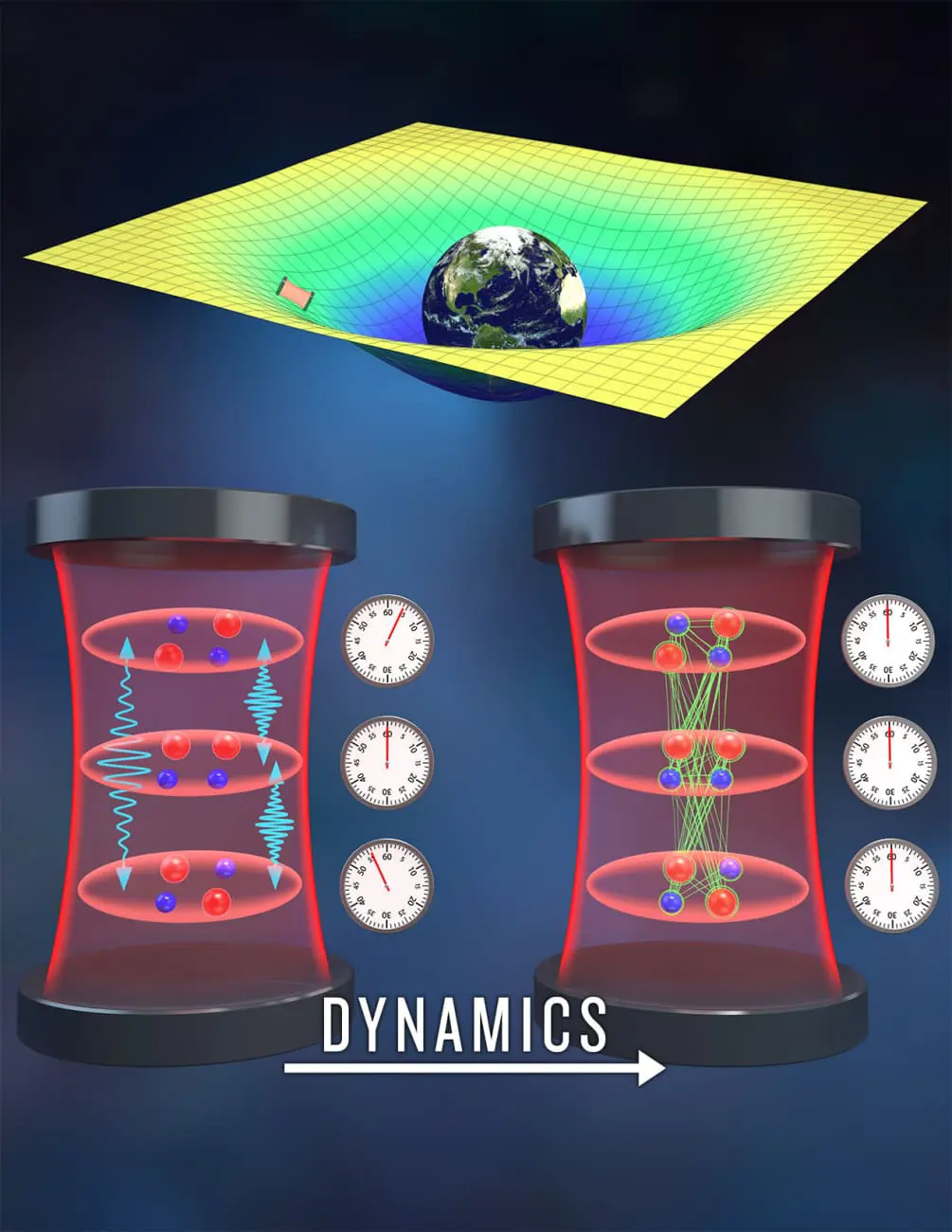
Optical lattice clocks are precision tools researchers from JILA, NIST, the University of Colorado Boulder, Leibniz University, the Austrian Academy of Sciences, and the University of Innsbruck use to explore the interplay between quantum mechanics and general relativity. Their studies reveal that gravitational redshift can synchronize atomic oscillations within these clocks, despite differences caused by gravity, leading to quantum entanglement. These findings were published in Physical Review Letters.
For over a century, physicists have sought to reconcile quantum mechanics, which governs microscopic particles, with general relativity, which describes spacetime on a cosmic scale. One promising tool in this endeavor is the optical lattice clock, one of the most precise timekeeping devices available. These clocks trap atoms in a lattice potential formed by laser beams, allowing for meticulous control over quantum interactions. Simultaneously, Einstein’s theory of general relativity predicts that time progresses more slowly in stronger gravitational fields, an effect known as gravitational redshift. Researchers are now leveraging optical lattice clocks to measure these subtle relativistic effects and explore their influence on many-body quantum systems.
Investigating Quantum Entanglement and Gravitational Redshift
A team led by JILA and NIST Fellows Jun Ye and Ana Maria Rey, in collaboration with researchers from institutions in Austria and Germany, has developed practical protocols to examine the effects of relativity on quantum entanglement and atomic interactions within an optical clock. Their study, published in Physical Review Letters, revealed that the interplay between gravitational redshift and quantum interactions can lead to unexpected behaviors, such as atomic synchronization and entanglement.
According to Dr. Anjun Chu, the study’s first author, interactions between atoms help synchronize their oscillations despite gravitational redshift. This finding suggests that gravitational effects and quantum interactions do not act independently but rather influence each other in a way that modifies the fundamental ticking of atomic clocks.
Distinguishing Gravitational Effects from Other Influences
A key challenge in these experiments is isolating genuine gravitational redshift effects from other perturbations, such as magnetic field fluctuations. To achieve this, the researchers employed a technique known as a dressing protocol, which manipulates the internal states of particles using laser light. Since energy and mass are related through Einstein’s equation (E = mc²), changes in an atom’s energy state slightly alter its mass, affecting its gravitational potential energy. By carefully tuning atoms into a superposition of energy states, the team achieved unprecedented control over gravitational redshift, enabling precise differentiation between gravitational and non-gravitational influences.
Synchronization and Quantum Entanglement in Optical Clocks
Beyond distinguishing gravitational effects, the team explored how quantum interactions influence atomic behavior in optical cavities. When atoms interact through photon-mediated energy exchanges, they experience a collective effect that can counteract gravitational desynchronization.
Ordinarily, atoms at different heights in a gravitational field experience slight variations in their oscillation frequencies due to gravitational redshift. However, when photon-mediated interactions are introduced, these atoms begin to synchronize, effectively “locking” their ticking together. This synchronization is an emergent quantum phenomenon where gravitational effects and quantum interactions compete, rather than acting separately.
Additionally, this process leads to quantum entanglement, in which the state of one atom becomes correlated with another, irrespective of distance. The researchers found that the speed at which atoms synchronize could serve as an indirect measure of entanglement, providing a novel approach to quantifying the connection between relativity and quantum mechanics.
Implications for Future Research
This study represents a step toward understanding how general relativity and quantum mechanics interact in many-body systems. The protocols developed by the team could enhance experimental techniques in precision measurement, quantum computing, and fundamental physics. As atomic clocks reach unprecedented accuracy, they may offer new insights into gravitational effects on quantum systems, bringing physics closer to bridging the gap between these two foundational theories.
The research was supported by the Sloan Foundation, the Simons Foundation, the Heising-Simons Foundation, and JILA PFC.
External Link: Click Here For More
See today’s quantum computing news on Quantum Zeitgeist for the latest breakthroughs in qubits, hardware, algorithms, and industry deals.