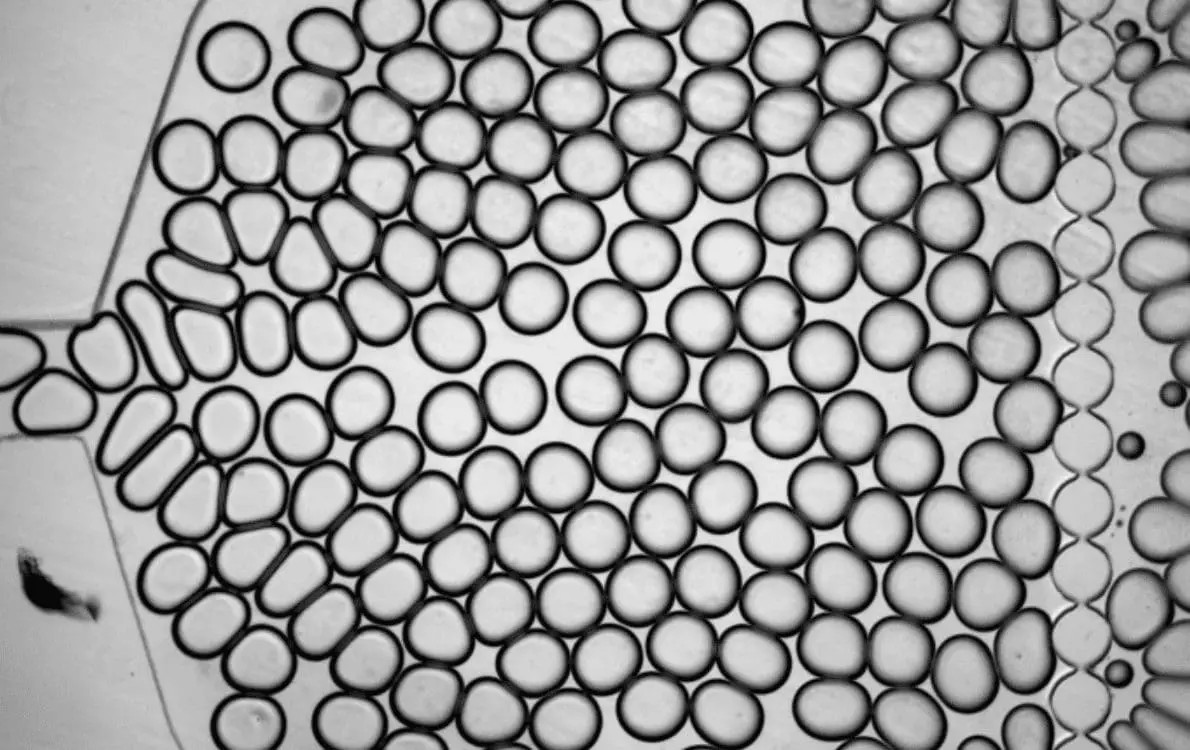
Researchers at Lawrence Berkeley National Laboratory (Berkeley Lab) and UC Berkeley have developed a novel quantum sensing technique using nanodiamonds embedded in microfluidic droplets to detect exact trace chemicals.
This method, led by Ashok Ajoy, employs nanodiamonds containing nitrogen vacancies as sensors, activated by a green laser and microwaves, to emit light indicating specific ions or molecules. Published in Science Advances, this approach surpasses current techniques in detecting paramagnetic substances. Potential applications range from monitoring environmental contaminants to diagnosing cell health and optimizing bioreactors for producing medicines and biofuels.
Quantum Sensors Meet Microfluidics
Integrating quantum sensors with microfluidics has led to innovative advancements in chemical detection. This technology combines nanodiamonds with nitrogen vacancies acting as quantum sensors and microfluidic systems to create a precise and efficient detection mechanism.
Microdroplets containing nanodiamonds are exposed to target chemicals, and green lasers excite the nitrogen vacancies, causing photon emissions whose characteristics change with the presence of specific substances. This mechanism allows for the accurate identification and measurement of chemicals. Microwaves further enhance the system by tuning sensor responses or processing signals.
This approach offers several advantages, including high sensitivity, simultaneous testing capabilities, and scalability across various applications such as environmental monitoring, medical diagnostics, and industrial process control. Despite its potential, challenges remain in maintaining sensor stability, addressing ecological interference, and reducing production costs for widespread adoption.
Integrating nanodiamond quantum sensors
Microfluidic droplets enhance this system by enabling controlled sample volumes and high-throughput analysis. Each droplet functions independently, minimizing cross-contamination and allowing simultaneous testing of multiple samples. Applications span environmental monitoring, medical diagnostics, and industrial process control, offering efficient detection of pollutants, biomarkers, and chemical levels, respectively.
Despite its potential, the technology faces challenges such as maintaining sensor stability, addressing environmental interference, and production costs. The use of microwaves contributes to tuning sensor responses or signal processing, enhancing detection accuracy. Scalability is a strength, with the system capable of handling numerous samples efficiently. However, practical considerations like sensitivity to environmental factors and the technical complexity of producing consistent nanodiamonds must be addressed for widespread adoption.
This technology presents a promising solution for precise chemical detection across various domains, though challenges remain in achieving practicality and scalability.
More information
External Link: Click Here For More
See today’s quantum computing news on Quantum Zeitgeist for the latest breakthroughs in qubits, hardware, algorithms, and industry deals.