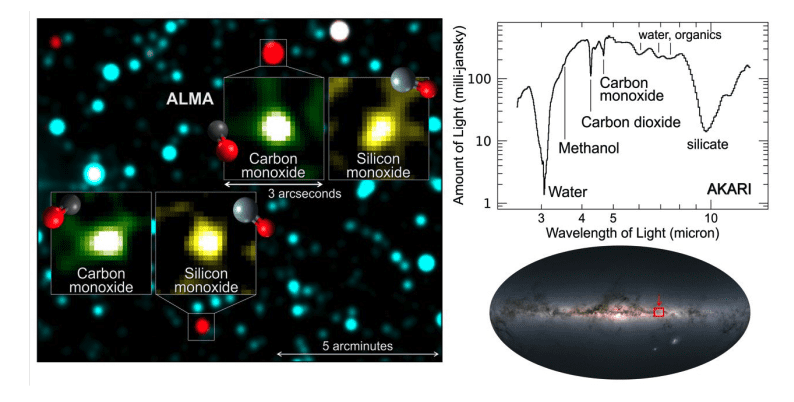
Astronomers from Niigata University and the University of Tokyo utilized the Atacama Large Millimeter/ submillimeter Array (ALMA) in Chile to study two enigmatic interstellar objects discovered by the AKARI satellite. These objects, rich in ices containing water and organic molecules, were observed to determine their distance, motion, size, and chemical composition.
The findings revealed that these objects do not align with previously known interstellar icy bodies, suggesting they may represent a new class of such objects. This research was published in The Astrophysical Journal on February 25, 2025.
Mysterious Interstellar Icy Objects Discovered
Astronomers from Niigata University and the University of Tokyo have made a significant discovery using the Atacama Large Millimeter/Submillimeter Array (ALMA) in Chile. They observed two enigmatic interstellar objects initially detected by the Japanese infrared satellite AKARI. These objects, rich in ices containing water and organic molecules, were previously shrouded in mystery due to their unclear properties.
The ALMA observations provided critical insights into these objects, revealing their distance, motion, size, and chemical composition. However, these characteristics do not align with any known interstellar icy objects where ices have been detected, suggesting the possibility of a new class of interstellar icy objects.
This discovery implies that these objects might offer an environment conducive to the formation of organic molecules, potentially expanding our understanding of molecular evolution in space. Takashi Shimonishi, Takashi Onaka, and Itsuki Sakon authored the findings, which were published in The Astrophysical Journal on February 25, 2025.
ALMA Observations Reveal Unique Characteristics
The ALMA observations of these enigmatic interstellar objects have provided unprecedented insights into their physical and chemical properties. Researchers determined their distance, motion, size, and composition by analyzing the molecular gas associated with these objects. These measurements revealed that the objects exhibit characteristics distinct from previously identified interstellar icy bodies. This uniqueness suggests they may belong to a new class of interstellar icy objects, potentially offering a novel environment for forming organic molecules.
The discovery highlights the importance of these objects as potential sites for molecular evolution in space. Their chemical composition, rich in water and organic molecules, indicates that they could play a significant role in forming complex compounds. This finding expands our understanding of interstellar chemistry and raises questions about the diversity of environments where such molecules can form. The study underscores the value of high-resolution observations like those from ALMA in uncovering the mysteries of these enigmatic icy objects.
New Insights into Organic Molecule Formation
The discovery of these interstellar icy objects has opened a new avenue for understanding how organic molecules form in space. By analyzing their chemical composition, researchers found that these objects contain water and organic molecules, suggesting they may serve as unique environments for molecular evolution. The distinct characteristics of these objects, such as their motion and size, do not match any previously identified interstellar icy bodies, indicating a potential new class of objects.
The findings highlight the importance of studying these enigmatic structures to uncover how complex compounds form in space. Their rich chemical composition suggests they could play a critical role in the processes leading to organic molecule formation, potentially offering insights into the origins of life’s building blocks. This discovery underscores the value of high-resolution observations like those from ALMA in revealing the mysteries of interstellar chemistry and the diversity of environments where such molecules can emerge.
The study provides compelling evidence that these objects may represent a novel site for organic molecule formation, expanding our understanding of molecular evolution in space. Their unique properties and chemical composition offer a new perspective on how complex compounds form in interstellar environments, raising questions about the variety of conditions conducive to organic synthesis. This research advances our knowledge of interstellar chemistry and emphasizes the need for continued exploration of these enigmatic icy objects to fully understand their role in molecular evolution.
More information
External Link: Click Here For More