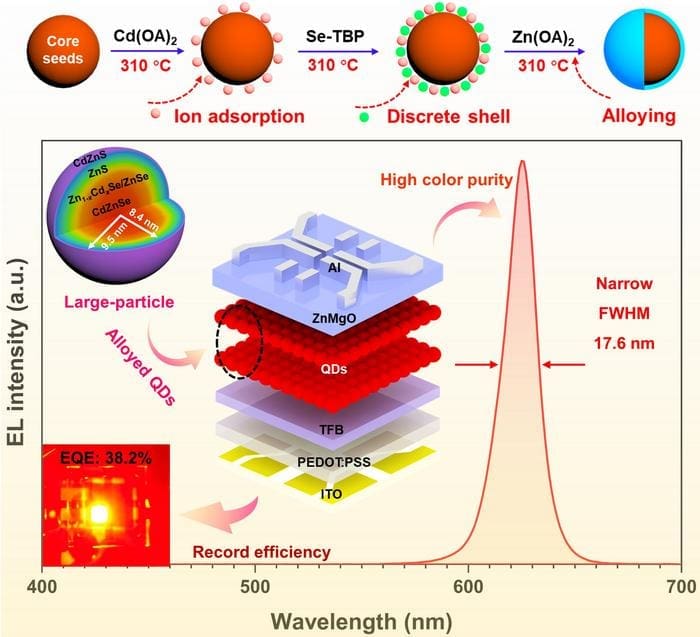
Researchers from Soochow University, Macau University of Science and Technology, and other institutions developed a new synthesis strategy called HT-SILAR for quantum dots, achieving high color purity and performance in red QLEDs. This method produced QDs with near-unity photoluminescence quantum yield (PLQY) and a narrow full width at half maximum (FWHM) of 17.1 nm.
The resulting QLEDs demonstrated a record external quantum efficiency (EQE) of 38.2%, luminance exceeding 120,000 cd/m², and an operational lifetime T95 of over 24,000 hours at 1,000 cd/m². This breakthrough addresses the challenge of high color purity in red QLEDs, enhancing ultra-high definition displays.
Quantum Dot Technology Breakthrough
Researchers from Soochow University, in collaboration with Macau University of Science and Technology and other institutions, have developed a novel strategy for synthesizing quantum dots (QDs) using the high-temperature successive ion layer adsorption and reaction (HT-SILAR) method. This approach enables the precise growth of large-particle alloyed red QDs with tailored structures, enhancing their optical properties.
The HT-SILAR technique allows for synthesizing gradient alloyed QDs, specifically CdZnSe/ Zn1−xCdxSe/ZnSe/ZnS/CdZnS, exhibiting improved color purity. By controlling the shell thicknesses, the method reduces compressive strain. It suppresses heavy-hole energy band splitting, leading to a narrow full width at half maximum (FWHM) of 17.1 nm and a near-unity photoluminescence quantum yield (PLQY). These advancements result in high-quality red QLEDs with exceptional performance metrics.
The resulting red QLEDs achieve a peak external quantum efficiency (EQE) of 38.2%, surpassing previous records. Additionally, the devices demonstrate a luminance exceeding 120,000 cd/m² at a driving voltage of 6 V and a T95 lifetime over 21,000 hours, ensuring long-term stability. The use of large-size QDs significantly reduces heat generation within the device, mitigating the risk of screen burn-in and enhancing overall longevity.
Facile Tailored Synthesis Strategy
The HT-SILAR technique enables precise control over the synthesis of gradient alloyed quantum dots, specifically CdZnSe/Zn1−xCdxSe/ZnSe/ZnS/CdZnS structures. This method allows researchers to tailor shell thicknesses, reducing compressive strain and suppressing heavy-hole energy band splitting. These adjustments contribute to a narrow full width at half maximum (FWHM) of 17.1 nm and a near-unity photoluminescence quantum yield (PLQY), enhancing the optical properties of red QLEDs.
The synthesis strategy also improves carrier confinement, critical for achieving high-quality emission characteristics. Additionally, surface passivation techniques reduce non-radiative recombination, further improving device efficiency. These advancements result in red QLEDs with a peak external quantum efficiency (EQE) of 38.2%, surpassing previous records and demonstrating significant progress in quantum dot technology.
Using large-size quantum dots minimizes heat generation within the device, reducing the risk of screen burn-in and enhancing long-term stability. This approach ensures robust performance metrics, including a luminance exceeding 120,000 cd/m² at a driving voltage of 6 V and a T95 lifetime over 21,000 hours. These improvements address key challenges in red QLED technology, offering practical benefits for display applications with brighter, more stable, and longer-lasting screens.
More information
External Link: Click Here For More