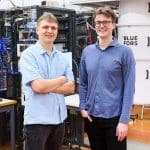
Ben Jones, a physicist at the University of Texas at Arlington (UTA), has been awarded the 2025 International Committee for Future Accelerators (ICFA) Early Career Researcher Instrumentation Award for advancing particle physics instrumentation.
Jones, who accepted the award at the Vienna Conference on Instrumentation in Austria, leads research focused on neutrinos. He leverages techniques such as fluorescence microscopy and quantum computing to explore their properties and potential role in the early universe. His work aims to uncover previously unknown aspects of neutrino behavior, which could provide insights into fundamental physics and the origins of matter.
Ben Jones Receives ICFA Early Career Researcher Instrumentation Award
Ben Jones, an associate professor of physics at the University of Texas at Arlington (UTA), has been recognized with the 2025 International Committee for Future Accelerators (ICFA) Early Career Researcher Instrumentation Award. This prestigious honor acknowledges his groundbreaking contributions to the development of advanced instruments used in particle physics research. Jones received the award at the 2025 Vienna Conference on Instrumentation in Austria, where his work was celebrated for its potential to drive impactful advancements in the field.
As associate director of the UTA Center for High Energy and Nuclear Physics and co-director of the UTA Center for Advanced Detector Technology, Jones leads a multidisciplinary research group focused on neutrino physics. His team employs innovative nuclear physics, quantum computing, materials science, and machine learning techniques to explore previously unknown aspects of neutrinos—fundamental particles that play a critical role in understanding the universe’s origins.
Jones’ research is particularly notable for its focus on uncovering the origin of neutrino mass, a question with profound implications for our understanding of the early universe. His work includes contributions to the NEXT program (Neutrino Experiment with a Xenon TPC), where his team has developed novel fluorescence microscopy techniques, and involvement in the Project 8 experiment, which aims to measure the neutrino’s mass using cold atomic tritium sources.
Jones’ research is significant beyond the laboratory. By advancing our understanding of neutrinos, he is helping to shed light on the mechanisms that generated matter in the early universe and providing insights into fundamental physics at extremely small scales. The U.S. Department of Energy’s Nuclear Physics sub-program supports his work, underscoring its importance to broader scientific goals.
Jones emphasized the collaborative nature of his achievements, highlighting the crucial contributions of UTA graduate students and undergraduate researchers who have played a vital role in these advancements. “I consider this award to be a recognition of the whole team’s achievements,” he said, reflecting on the collective effort behind his work.
Alex Weiss, professor and chair of the UTA Department of Physics, praised Jones’ leadership and mentorship, noting that his research could lead to important discoveries with far-reaching implications. “He’s doing very important work, assisted by graduate and undergraduate students for whom he serves as an excellent mentor,” Weiss said. “It’s work that could enhance our understanding of the origins of the universe.”
Through his innovative approach to neutrino research and dedication to fostering collaboration, Ben Jones is making significant strides in unlocking some of the universe’s most enduring mysteries.
One of the most significant aspects of Jones’ work is his exploration of the origin of neutrino mass. This pursuit is not only a fundamental question in particle physics but also has far-reaching implications for cosmology. By participating in projects such as the NEXT program, which utilizes xenon-based detectors, and Project 8, which employs cold atomic tritium sources to measure neutrino mass, Jones is contributing to efforts that could fundamentally alter our understanding of the universe’s evolution.
Jones’ work exemplifies how cutting-edge instrumentation can unlock new insights into the fundamental nature of matter and the universe. By advancing our ability to study neutrinos, he is helping to unravel some of the most enduring mysteries in physics, paving the way for future discoveries that could redefine our understanding of reality.
More information
External Link: Click Here For More