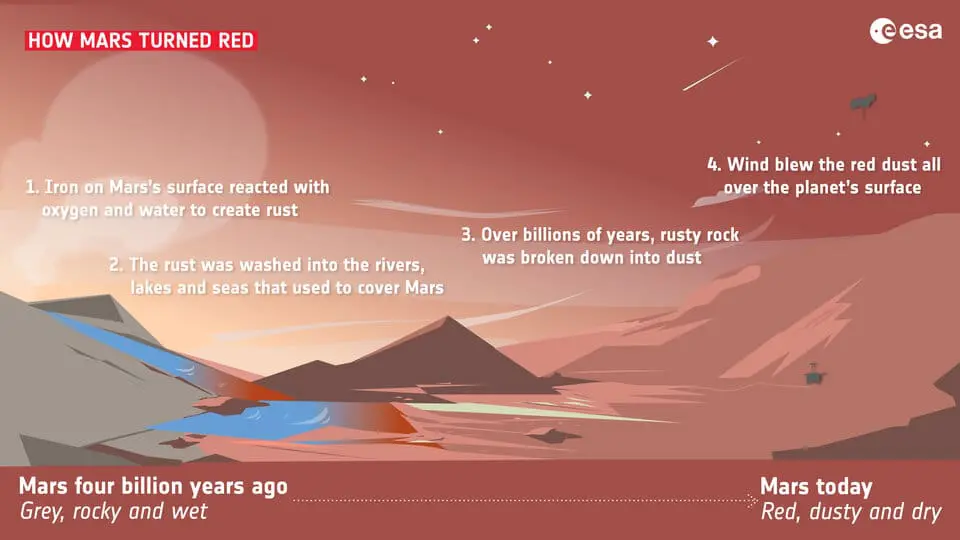
Scientists have reevaluated the red color of Mars by combining data from ESA and NASA spacecraft with laboratory experiments on replica Martian dust, revealing that the planet’s rusty appearance is due to ferrihydrite, an iron oxide formed in the presence of water during Mars’ early history. This finding suggests that Mars rusted earlier than previously thought when liquid water was more widespread, transforming our understanding of the planet’s environmental conditions and its potential for past habitability.
The Mystery of Mars Red Color
Mars’ iconic red hue has long been attributed to rusted iron minerals in its dust, formed through interactions with water or oxygen in the planet’s early history. However, recent findings challenge previous assumptions about how and when this reddening occurred. By combining data from ESA and NASA spacecraft with novel laboratory experiments, scientists have uncovered a wetter history for Mars’ rusty dust than previously believed.
Earlier studies suggested that hematite, an iron oxide formed under dry conditions, was responsible for the planet’s red color. This conclusion was based on the absence of water signatures in martian dust observed by spacecraft. However, new research reveals that ferrihydrite, a water-rich iron mineral, may instead be the dominant component of Mars’ dust. This discovery implies that liquid water played a significant role in shaping the planet’s surface far more recently than previously thought.
The breakthrough came through detailed analysis of dust samples and laboratory recreations of martian dust using data from missions like ESA’s Mars Express and NASA’s Mars Reconnaissance Orbiter. These experiments showed that ferrihydrite, rather than hematite, best matches the observed properties of martian dust. This finding not only reshapes our understanding of Mars’ geological history but also raises new questions about the planet’s potential to support past or present life.
Future missions, such as ESA’s Rosalind Franklin rover and the NASA-ESA Mars Sample Return campaign, will provide further insights into the composition of martian dust and its implications for the planet’s water history. Until then, the enigmatic red color of Mars continues to captivate scientists and stargazers alike, offering a window into the planet’s dynamic past.
Previous Theories on Martian Rust Formation
Previous theories on the formation of Martian rust suggested that hematite, an iron oxide formed under dry conditions, was responsible for the planet’s red color. This conclusion was based on early observations and analyses of martian dust, which appeared to lack water-rich signatures. Scientists hypothesized that the reddening process occurred in a desiccated environment, where iron minerals oxidized over time without significant interaction with liquid water.
These theories were supported by initial data from spacecraft and ground-based rovers, which seemed to confirm the absence of hydrated minerals in the dust. The idea that Mars’ red hue was primarily due to hematite fit well within the broader narrative of a dry, ancient Martian landscape. However, this understanding began to shift as more detailed observations and laboratory experiments revealed complexities in the composition of martian dust.
The discovery of ferrihydrite, a water-rich iron mineral, challenged these earlier assumptions. By recreating martian dust in the lab using data from missions like ESA’s Mars Express and NASA’s Mars Reconnaissance Orbiter, researchers found that ferrihydrite better matched the observed properties of the dust. This breakthrough suggested that liquid water played a more significant role in shaping Mars’ surface than previously thought, rewriting the story of how and when the planet acquired its iconic red color.
These findings not only reshaped our understanding of Mars’ geological history but also raised new questions about the planet’s potential to support past or present life. The presence of ferrihydrite implies a wetter environment in Mars’ relatively recent past, offering clues about the availability of water and the conditions necessary for microbial survival.
As future missions like ESA’s Rosalind Franklin rover and the NASA-ESA Mars Sample Return campaign continue to explore Mars, they will provide even deeper insights into the composition of martian dust and its implications for the planet’s history. Until then, the enigmatic red color of Mars remains a captivating mystery, offering a window into the planet’s dynamic past.
Future Missions and the Search for Life
The discovery that ferrihydrite may be the dominant mineral in Martian dust suggests that liquid water played a more significant role in shaping Mars’ surface than previously believed. This conclusion was reached by analyzing data from ESA and NASA missions, such as Mars Express and Mars Reconnaissance Orbiter, and recreating Martian dust in laboratory settings to identify the best-matching mineral. Ferrihydrite, being water-rich, implies a wetter environment in Mars’ recent past, which has profound implications for the potential of microbial life on the planet.
This finding challenges earlier assumptions that hematite, formed under dry conditions, was responsible for Mars’ red color. The presence of ferrihydrite suggests more recent and extensive interaction with water, reshaping our understanding of Mars’ geological history. Future missions, like the Rosalind Franklin rover and the Mars Sample Return campaign, are eagerly anticipated to provide further insights into Martian dust composition and its implications for the planet’s water history.
This discovery also raises questions about where future missions should focus their search for signs of life, potentially guiding exploration towards regions that may have been more habitable due to the presence of liquid water. Overall, this breakthrough highlights the dynamic nature of Mars’ past and underscores the importance of continued exploration to unravel its mysteries.
More information
External Link: Click Here For More