Quandela, a leading European quantum computing company, has made a pivotal advancement in the field. They reduced the number of components required for fault-tolerant quantum computation by a factor of 100,000. This achievement relies on a hybrid approach. It leverages photonic qubits generated with unprecedented efficiency. These qubits come from artificial atoms or semiconductor quantum emitters.
Quandela’s innovative method minimizes resource overhead. This enables the company to accelerate the scaling up of its quantum computers. It brings them closer to practical applications. The breakthrough is rooted in developing three schemes. These schemes construct a specific type of photonic resource state. This state is essential for fusion-based quantum computation.
Notably, the approach utilizes deterministic single-photon sources that embed a qubit. This substantially shortens the path toward fault-tolerant photonic quantum computation. It also highlights the potential of hybrid platforms to drive progress in the field.
Photonic quantum computation is a promising approach to scalable quantum processing. This is due to the inherent advantages of photons. These advantages include low decoherence and high-speed transmission. Nevertheless, photon loss presents a significant challenge, as it can degrade computational fidelity and introduce errors.
Fusion-based quantum computation (FBQC) is a fault-tolerant framework. It constructs photonic lattices using finite-sized graph states and fusion gates. By leveraging redundancy and entanglement, FBQC mitigates the effects of photon loss while enabling large-scale quantum computations.
Constructing Resource States for FBQC
A critical need for FBQC is the efficient generation of resource states, which are the fundamental building blocks for computation. This process involves three key stages: single-photon generation, seed state production, and target state construction. The study presents three distinct architectures for constructing a 24-photon Shor-encoded (2,2) 6-ring resource state.
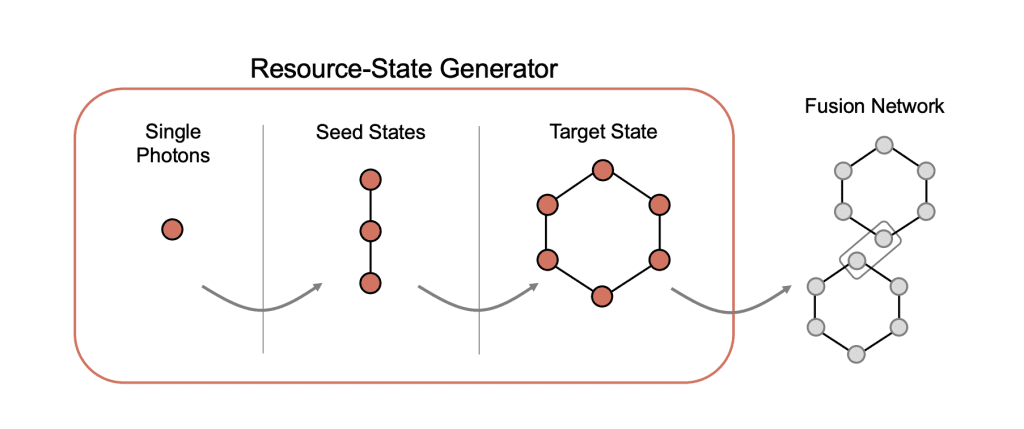
The first approach employs an all-photonic architecture that uses deterministic single-photon sources to generate resource states directly. While conceptually straightforward, this method requires highly efficient photon sources and precise loss mitigation strategies. The second architecture utilizes a deterministic source of caterpillar graph states fused to construct the final resource state.
This method improves efficiency by reducing the number of fusion operations needed. The third approach uses a repeat-until-success (RUS) strategy. Multiple sources of caterpillar graph states are entangled using probabilistic control-Z gates. This technique allows for high connectivity and loss resilience while optimizing resource consumption.
Benchmarking Architectures: Figures of Merit and Simulation Results
The study evaluates the feasibility of these architectures. It introduces figures of merit such as resource efficiency. Other figures include loss tolerance and error resilience. Simulations are conducted to assess the performance of each approach under realistic experimental conditions. These simulations provide insights into their scalability. They also offer insights into their practicality. The results highlight the trade-offs between hardware complexity, resource overhead, and operational fidelity.
Future Prospects and Resource Optimization
Photonic quantum computers offer several advantages, including modularity, scalability, and flexibility. The study demonstrates a significant reduction in resource overhead. This is achieved by using deterministic single-photon sources. They employ a single matter qubit degree of freedom. Among the architectures considered, the RUS module-based approach is the most resource-efficient. It uses deterministic entangling gates. These gates enable highly selective and loss-tolerant state construction.
This work advances the understanding of resource-efficient state generation for fault-tolerant photonic quantum computing. The study presents and compares multiple architectures. It provides a pathway toward low-loss, high-performance quantum state preparation. This brings photonic quantum computation closer to practical implementation.

External Link: Click Here For More