The pursuit of efficient space exploration has led to the development of advanced propulsion systems, including Hall thrusters, which harness the power of plasma technology to achieve high fuel efficiency and substantial thrust. These electric propulsion devices are crucial for missions such as SpaceX’s Starlink constellation and NASA‘s Psyche asteroid mission, and their demand is increasing as the space industry continues to grow.
To address this need, researchers at KAIST have made a notable advancement by developing an AI-based technique that accurately predicts the performance of Hall thrusters, enabling the rapid development of highly efficient and mission-optimized propulsion systems.
By leveraging a neural network ensemble model and high-quality training data generated from in-house numerical simulations, the team has achieved prediction errors of less than 10%, paving the way for the creation of digital twins that can accurately predict thruster performance within seconds.
This innovation is set to be tested in orbit with the launch of the KAIST-Hall Effect Rocket Orbiter (K-HERO) CubeSat, which will demonstrate the in-orbit performance of an AI-designed Hall thruster and mark a significant step forward in the development of high-efficiency propulsion systems for space exploration.
Introduction to Hall Thrusters
Hall thrusters are electric propulsion devices that utilize plasma technology to generate thrust. They are known for their high efficiency and are widely used in various space missions, including satellite constellations, deorbiting maneuvers, and deep space exploration. The principle behind Hall thrusters involves the acceleration of ions using an electric field, resulting in a high-specific-impulse propulsion system. This technology is crucial for modern space exploration, accelerating spacecraft while minimizing propellant consumption.
The development of Hall thrusters is a complex process that requires accurate performance prediction. Conventional methods have limitations, as they struggle to handle the complex plasma phenomena within these devices or are only applicable under specific conditions, leading to lower prediction accuracy. To address this challenge, researchers at KAIST have developed an AI-based technique to accurately predict Hall thrusters’ performance. This innovation has the potential to significantly reduce the time and cost associated with the iterative design, fabrication, and testing of these devices.
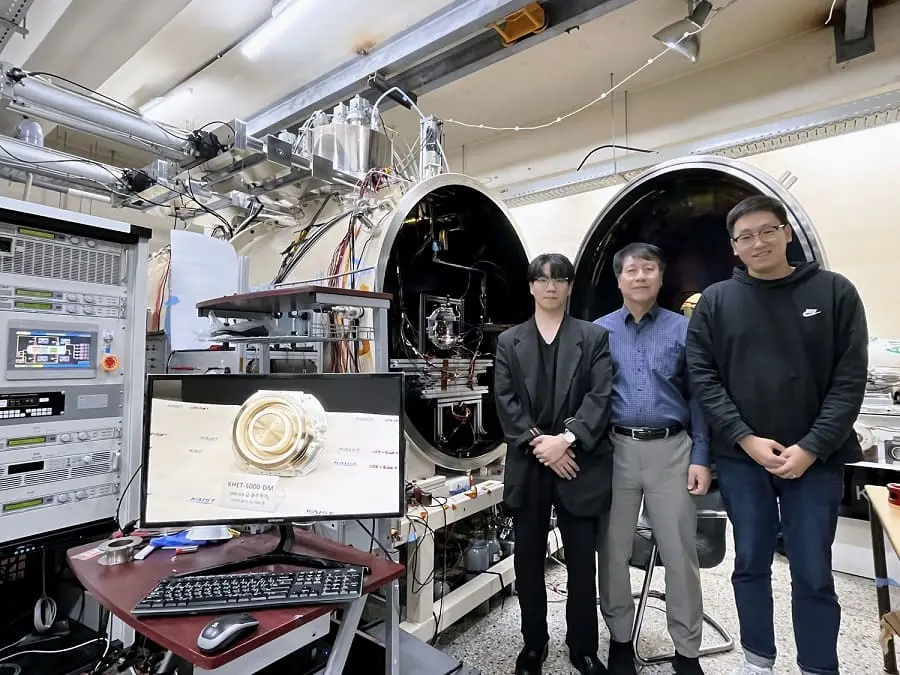
The KAIST research team, led by Professor Wonho Choe, has been at the forefront of electric propulsion development in Korea since 2003. Their recent breakthrough involves the application of a neural network ensemble model to predict thruster performance using a large dataset generated from their in-house numerical simulation tool. This approach accurately predicts Hall thruster performance within seconds, based on design variables such as propellant flow rate and magnetic field. The trained neural network ensemble model acts as a digital twin, offering detailed analyses of performance parameters such as thrust and discharge current.
AI-Based Prediction Technique for Hall Thrusters
The AI-based prediction technique developed by the KAIST team is highly accurate and validated through experiments. The neural network ensemble model demonstrated an average prediction error of less than 5% for in-house Hall thrusters and less than 9% for a high-power Hall thruster developed by the University of Michigan and the U.S. Air Force Research Laboratory. This confirms the broad applicability of the AI prediction method across different power levels of Hall thrusters.
The AI model processes design variables like channel geometry and magnetic field information and outputs key performance metrics like thrust and prediction accuracy. This enables efficient thruster design and performance analysis, making it highly valuable for developing high-efficiency Hall thrusters. The technique can also be applied beyond Hall thrusters to various industries through ion beam sources, including semiconductor manufacturing, surface processing, and coating.
CubeSat Hall Thruster
The CubeSat Hall thruster, developed using the AI technique in collaboration with Cosmo Bee, an electric propulsion company, will be tested in orbit aboard the K-HERO 3U CubeSat this November. This mission will demonstrate the effectiveness of the AI-based prediction technique in a real-world setting and pave the way for the widespread adoption of Hall thrusters in space exploration.
The research was published online in Advanced Intelligent Systems and was selected as the journal’s cover article, highlighting its innovation. The National Research Foundation of Korea’s Space Pioneer Program supported the study, which aims to develop high-thrust electric propulsion systems. The success of this project demonstrates the potential of AI-based techniques in advancing space technology and enabling more efficient and sustainable space exploration.
External Link: Click Here For More


See today’s quantum computing news on Quantum Zeitgeist for the latest breakthroughs in qubits, hardware, algorithms, and industry deals.