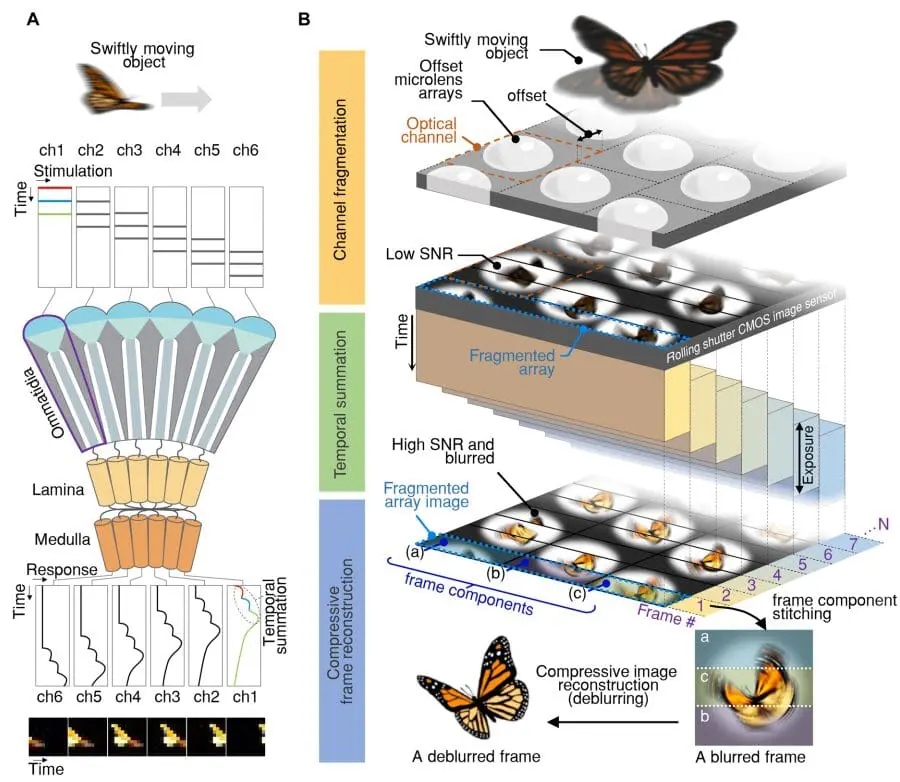
In a remarkable convergence of biology and technology, researchers at KAIST have developed an ultra-high-speed camera that captures 9,120 frames per second, inspired by the compound eyes of insects. By mimicking the visual structure of insect eyes, which can detect fast-moving objects in parallel and enhance sensitivity in low-light conditions, the team has created a low-cost, high-speed camera that overcomes the limitations of conventional cameras.
This innovative device employs a compound-eye-like structure, utilizing multiple optical channels and temporal summation to achieve high-quality imaging under high-speed and low-light conditions, making it capable of capturing objects up to 40 times dimmer than those detectable by conventional high-speed cameras. With its compact design, less than one millimeter thick, and advanced image processing algorithms, this bio-inspired camera has the potential to revolutionize various applications, including biomedical imaging, mobile devices, and security surveillance.
Introduction to Insect-Eye-Inspired Camera Technology
The development of high-speed cameras that can capture images in low-light conditions has been a significant challenge in the field of optics. Conventional high-speed cameras often struggle with decreased sensitivity as frame rates increase, due to the reduced time available for light collection. To address this issue, researchers at KAIST have drawn inspiration from the compound eyes of insects, which are capable of detecting fast-moving objects in parallel and enhancing sensitivity in low-light conditions by integrating signals over time.
The insect eye’s unique structure, comprising multiple optical channels called ommatidia, allows for the parallel acquisition of frames from different time intervals. This biological mechanism has been replicated in a novel bio-inspired camera developed by the KAIST research team, led by Professors Ki-Hun Jeong and Min H. Kim. The camera employs a compound-eye-like structure, utilizing multiple optical channels and temporal summation to achieve ultra-high-speed imaging with high sensitivity.
The bio-inspired camera’s design is based on the principle of temporal summation, where light is accumulated over overlapping time periods for each frame, increasing the signal-to-noise ratio. This approach enables the camera to capture objects up to 40 times dimmer than those detectable by conventional high-speed cameras. The researchers have also introduced a “channel-splitting” technique to significantly enhance the camera’s speed, achieving frame rates thousands of times faster than those supported by the image sensors used in packaging.
Technical Details of the Bio-Inspired Camera
The bio-inspired camera developed by the KAIST research team is less than one millimeter thick and extremely compact, capable of capturing 9,120 frames per second while providing clear images in low-light conditions. The camera’s high-speed and high-sensitivity capabilities are made possible by the use of a rolling shutter image sensor, which simultaneously acquires multiple frames by channel division, and temporal summation is performed in parallel to realize high speed and sensitivity even in a low-light environment.
The camera’s frame components are stitched into a single blurred frame, which is subsequently deblurred by compressive image reconstruction. This process eliminates blur caused by frame integration and reconstructs sharp images. The resulting bio-inspired camera is capable of capturing high-quality images in low-light conditions, making it suitable for applications such as biomedical imaging, mobile devices, and security surveillance.
The research team has experimentally validated the performance of the insect-eye-inspired camera, demonstrating its ability to capture fast-moving objects with high accuracy. For example, the camera was able to accurately capture a rotating plate at 1,950 rpm at 9,120 fps, as well as the pinch-off of a flame with a faint intensity of 880 µlux at 1,020 fps.
Potential Applications and Future Developments
The bio-inspired camera developed by the KAIST research team has significant potential for applications in various fields, including biomedical imaging, mobile devices, and security surveillance. The camera’s high-speed and high-sensitivity capabilities make it an attractive solution for capturing high-quality images in low-light conditions.
The research team plans to extend this technology to develop advanced image processing algorithms for 3D imaging and super-resolution imaging. This could enable the development of more sophisticated camera systems capable of capturing detailed images in a variety of environments. Additionally, the compact size and low power consumption of the bio-inspired camera make it suitable for use in portable camera systems, which could have significant implications for fields such as medical imaging and security surveillance.
The study’s findings were published in the international journal Science Advances in January 2025, and the research was supported by the Korea Research Institute for Defense Technology Planning and Advancement (KRIT) of the Defense Acquisition Program Administration (DAPA), the Ministry of Science and ICT, and the Ministry of Trade, Industry and Energy (MOTIE).
Conclusion and Future Outlook
The development of the bio-inspired camera by the KAIST research team represents a significant breakthrough in the field of optics, offering a novel solution for high-speed imaging in low-light conditions. The camera’s unique design, based on the principle of temporal summation and channel-splitting, enables it to capture high-quality images at frame rates thousands of times faster than those supported by conventional image sensors.
As the technology continues to evolve, we can expect to see further advancements in image processing algorithms and camera system design. The potential applications of this technology are vast, ranging from biomedical imaging and mobile devices to security surveillance and beyond. With its compact size, low power consumption, and high-speed capabilities, the bio-inspired camera is poised to make a significant impact in the field of optics and beyond.
External Link: Click Here For More


See today’s quantum computing news on Quantum Zeitgeist for the latest breakthroughs in qubits, hardware, algorithms, and industry deals.