A new European quantum technology initiative has been launched with the EQUSPACE consortium receiving 3.2 million euros from the European Innovation Council’s Pathfinder Open funding program. The project aims to develop a silicon-based quantum platform using donor spin qubits, which utilize the spin of impurity atoms to process information.
Researchers from the Helmholtz-Zentrum Dresden-Rossendorf, led by Dr. Nico Klingner, will contribute their expertise in atomic modification of silicon for quantum applications. The team will work alongside other partners including the University of Jyväskylä, VTT Technical Research Center of Finland, NWO Institute AMOLF, and Finnish start-up SemiQon Oy.
Professor Juha Muhonen, coordinator of the project, emphasizes the importance of this development in strengthening Europe’s position in the global quantum competition. The project seeks to create a scalable solution for quantum computing, leveraging silicon’s existing infrastructure to process qubits, the quantum mechanical information units.
Introduction to Quantum Computing in Silicon
The development of quantum computing has been a rapidly advancing field, with various approaches being explored to create a scalable and reliable quantum platform. One such approach is the use of silicon-based quantum technologies, which leverages the existing infrastructure and expertise in semiconductor technology. The EQUSPACE consortium, comprising researchers from several European countries, has received funding to develop a novel silicon-based quantum platform using donor spin qubits. This approach aims to create a long-term future for silicon-based quantum computing in Europe.
Silicon as a material for quantum computing is not new, but it has not been the primary focus of current quantum computer concepts. However, silicon’s well-established infrastructure and the potential for scalability make it an attractive option. Donor spin qubits, which utilize the spin of impurity atoms to process information, have shown promise in this regard. These qubits are characterized by their long coherence times, making them suitable for quantum mechanical computing operations. The EQUSPACE project seeks to develop a scalable solution for all aspects of a quantum platform, including control and readout mechanisms, spin-spin coupling between qubits, and transmission of quantum information.
The project involves connecting qubits via sound waves in vibrating structures, using lasers and single-electron transistors for electrical readout. This innovative method has the potential to overcome current limitations in scaling up donor spin qubits. The EQUSPACE consortium brings together expertise from various fields, including materials science, ion beam physics, and quantum computing. By combining these strengths, the project aims to create a complete quantum information platform that includes qubits, interconnects, and scalable control and readout electronics.
Expertise in Silicon Quantum Technology
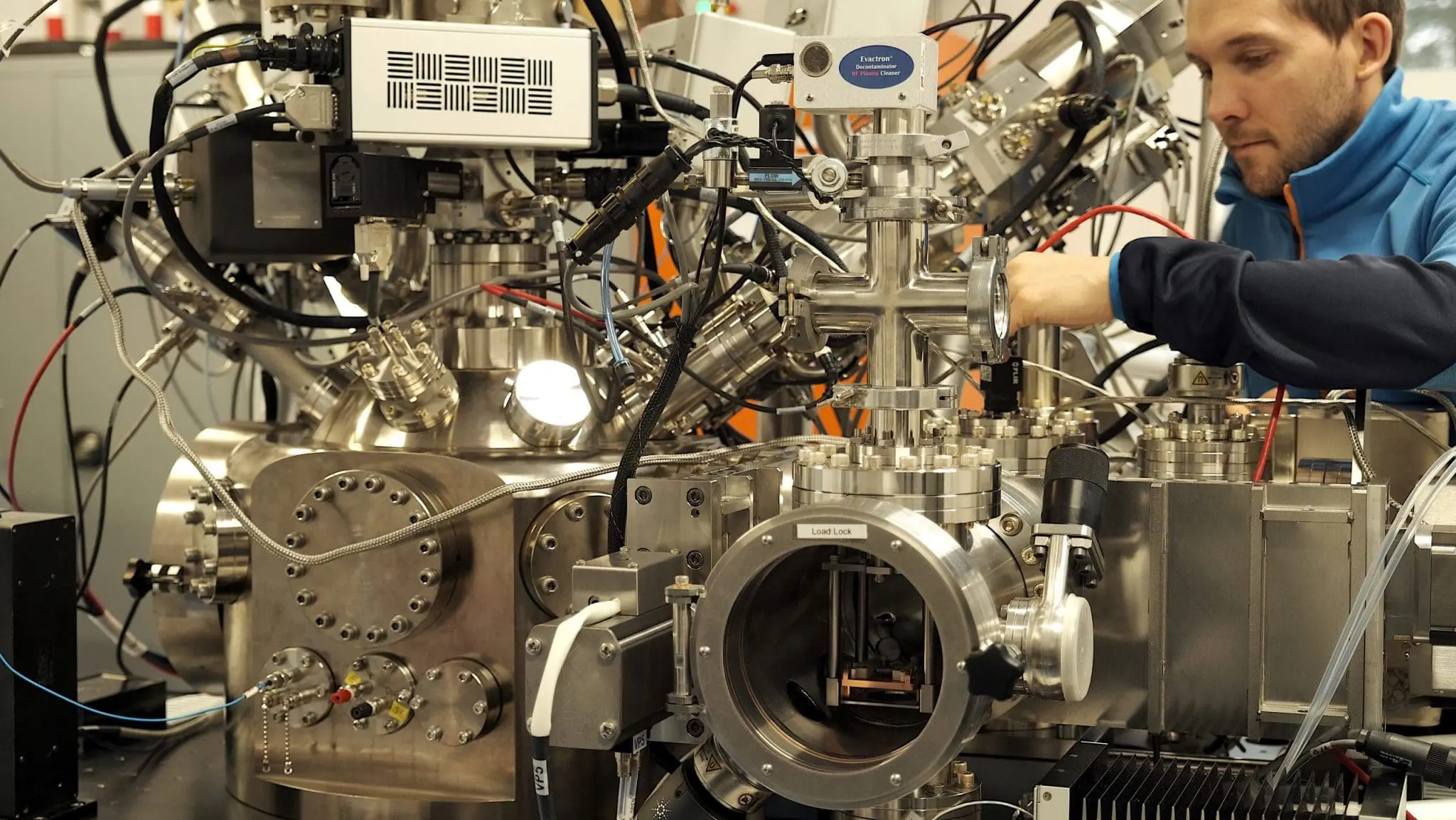
The Institute of Ion Beam Physics and Materials Research at HZDR is contributing its expertise in atomic modification of silicon for quantum applications. The team will use focused ion beams to locally enrich ultra-pure silicon with the isotope silicon-28, which has a zero-spin nucleus that minimizes interactions with magnetic fields or other particles. This targeted enrichment allows for longer coherence times, enabling more complex quantum operations. Additionally, the team is developing single-ion implantation of donor atoms, such as bismuth, whose spin forms a two-state system that can exist in superpositions at very low temperatures.
The stability of donor spin qubits compared to other types of qubits, such as those based on superconducting circuits, is a significant advantage. The spin in a donor atom is less susceptible to environmental perturbations, allowing the quantum state to be maintained over longer periods. This stability is crucial for scaling quantum computers to a larger number of qubits without losing coherence or precision. The contributions from HZDR, particularly in isotope purification, implantation, and strain engineering in semiconductors, are fundamental to the success of the EQUSPACE project.
Strengthening Europe’s Position in Quantum Computing
The EQUSPACE consortium reflects Europe’s growing commitment to the global quantum competition. As global competition intensifies, the European quantum industry faces significant challenges from leading countries such as the USA, China, Canada, and Australia. The funding received by EQUSPACE is part of the Horizon Europe funding program, which aims to strengthen the European quantum industry in the long term. By building a strong research network in Europe based on donor spin qubits, EQUSPACE’s approach is crucial for ensuring that Europe remains competitive in the rapidly advancing field of quantum technologies.
The collaboration between researchers from various European countries and institutions demonstrates the region’s determination to advance its position in the global quantum landscape. The project’s success will depend on the effective combination of expertise and resources from its partners, including the University of Jyväskylä, VTT Technical Research Center of Finland, HZDR, NWO Institute AMOLF, and SemiQon Oy. By working together, these institutions can drive innovation and progress in silicon-based quantum computing, ultimately strengthening Europe’s position in the global quantum competition.
Future Prospects for Silicon-Based Quantum Computing
The EQUSPACE project has the potential to make significant contributions to the development of silicon-based quantum computing. By overcoming current limitations and creating a scalable solution for donor spin qubits, the project can pave the way for more powerful and reliable quantum computers. The use of silicon as a material for quantum computing offers several advantages, including its well-established infrastructure, scalability, and potential for low-cost production.
As the project progresses, it is likely to face challenges and opportunities that will shape the future of silicon-based quantum computing. The development of new materials and techniques, such as advanced ion beam technologies and novel qubit architectures, may further enhance the performance and scalability of donor spin qubits. Additionally, the integration of silicon-based quantum computing with other quantum technologies, such as superconducting circuits or topological quantum computing, could lead to even more powerful and versatile quantum systems.
The success of the EQUSPACE project will depend on its ability to address the technical challenges associated with scaling up donor spin qubits and creating a complete quantum information platform. However, if successful, the project has the potential to make significant contributions to the advancement of quantum computing and strengthen Europe’s position in the global quantum competition. As research in silicon-based quantum computing continues to evolve, it is likely that new breakthroughs and innovations will emerge, driving progress toward the development of more powerful and reliable quantum computers.
External Link: Click Here For More




See today’s quantum computing news on Quantum Zeitgeist for the latest breakthroughs in qubits, hardware, algorithms, and industry deals.