
Quantum stocks have recently experienced significant declines. For instance, IonQ Inc. (IONQ) saw its stock price drop by approximately 39% before recovering slightly, Rigetti Computing Inc. (RGTI) by about 45%, and Quantum Computing Inc. (QUBT) by around 36% on January 8, 2025.
This downturn was largely thought triggered by NVIDIA CEO Jensen Huang comments during an analyst event as CES. Huang suggested that “very useful” quantum computers are still 15 to 30 years away. He believes 20 years is a reasonable estimate.
NVIDIA CEO Sparks Quantum Stocks Plunge?
The catalyst triggered mainly by comments from NVIDIA CEO Jensen Huang during an investor conference at CES 2025. Huang projected that practical quantum computing applications are likely 15 to 30 years away.
Jensen Huang: “If you said 15 years for very useful quantum computers, that would probably be on the early side. If you said 30, it’s probably on the late side. But if you picked 20, I think a whole bunch of us would believe it.”
Huang’s remarks introduced a more cautious perspective. Recent technological advancements had buoyed the market. Optimistic projections had also supported the market. In December 2024, Google unveiled its new quantum chip. It achieved a computational feat previously deemed unattainable by classical computers. This had invigorated investor enthusiasm. This breakthrough contributed to a rally in quantum computing stocks. Companies like Rigetti Computing and D-Wave Quantum experienced significant gains.
Yet, the following market correction underscores the volatility inherent in emerging technologies. The quantum computing industry is making notable strides. Nonetheless, it remains in a developmental phase. Practical, large-scale applications are still on the horizon. Huang’s assessment serves as a reminder of the challenges that lie ahead. These challenges include the need for substantial advancements in qubit stability. They also involve improvements in error correction and scalable architectures.
Investors should approach the quantum computing sector with a balanced perspective. They must recognize both its transformative potential and the uncertainties linked to its development timeline. While recent breakthroughs are promising, the path to widespread practical applications is complex and protracted. Market participants should thoroughly conduct due diligence. They should also maintain a long-term investment horizon when considering exposure to this nascent industry.
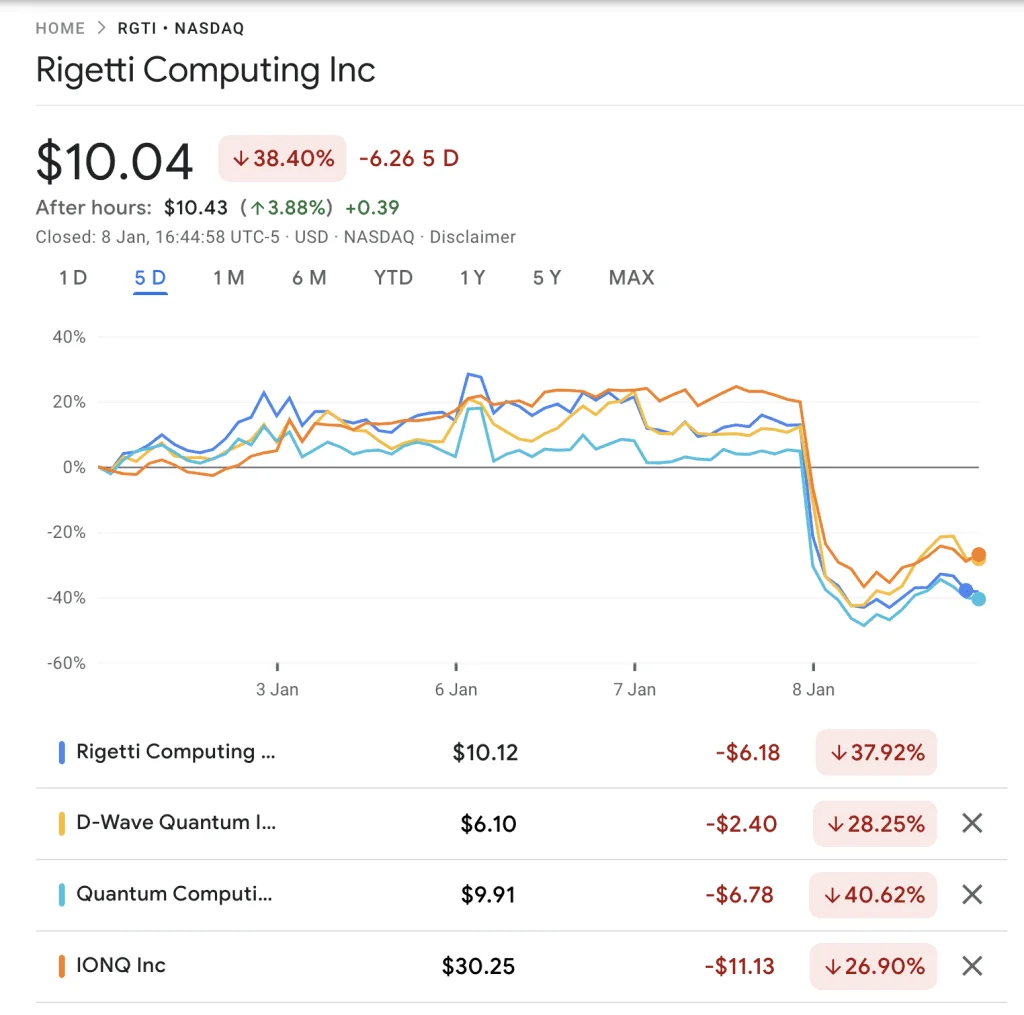
The recent stock declines might interpreted in two ways:
- Bubble Burst: The sharp drop may indicate that earlier valuations were inflated, driven by overly optimistic expectations about the near-term viability of quantum computing. Huang’s comments might have served as a reality check, prompting a market correction.
- Healthy Pullback: Alternatively, just be a temporary correction, reflecting a more realistic appraisal of the industry’s development timeline. While quantum computing holds significant long-term potential, achieving practical and widespread applications will take time.
The recent decline in quantum computing stocks appears to be a healthy market correction. We see it as observers of the market. It is prompted by a recalibration of expectations regarding the technology’s maturation timeline. Such adjustments are typical in the evolution of groundbreaking technologies. They serve to align investor sentiment with the current state of technological progress.
Quantum Zeitgeist does not provide personal investment or financial advice, or act as personal financial, legal, or institutional investment advisors, or individually advocate the purchase or sale of any security or investment or the use of any particular financial strategy. All investment strategies include the risk of loss for some or even all of your capital. Before pursuing any financial strategies discussed or relying on information within this website, you should always consult with a licensed financial advisor. Any analysis we provide is for informational purposes only and does not take into consideration your circumstances or other factors that may be important in making decisions. It should not be considered an individualized recommendation or personalized investment advice. Any investment vehicles, stocks, or securities mentioned may not be suitable for all investors.




See today’s quantum computing news on Quantum Zeitgeist for the latest breakthroughs in qubits, hardware, algorithms, and industry deals.