Researchers at Osaka University have made a crucial advancement in developing next generation memory devices with reduced energy consumption. Led by Takamasa Usami and Kohei Hamaya, the team has introduced an innovative technology for magnetoresistive RAM, or MRAM, which offers several advantages over traditional random access memory, including non-volatility, high speed, and increased storage capacity.
The new technology enables an electric-field-based writing scheme with reduced energy consumption compared to the present current-based approach. This breakthrough could potentially provide an alternative to traditional RAM, such as dynamic RAM, or DRAM, which requires constant energy input to retain data. MRAM devices use magnetic states to write and store data, making them a promising option for low power consumption.
The researchers have developed a new component for electric field controlling of MRAM devices using a multiferroic heterostructure, which could lead to the development of low-power writing technology for a wide range of applications requiring persistent and safe memory.
Introduction to Next-Generation RAM Technology
The development of modern memory devices has led to the emergence of various memory types, each aiming to overcome the limitations imposed by traditional random access memory (RAM). One such memory type is Magnetoresistive RAM (MRAM), which offers several advantages over conventional RAM, including non-volatility, high speed, increased storage capacity, and enhanced endurance. Despite these improvements, reducing energy consumption during data writing remains a critical challenge for MRAM devices. Researchers from Osaka University have recently proposed a new technology to address this issue, enabling an electric-field-based writing scheme with reduced energy consumption compared to the present current-based approach.
The traditional dynamic RAM (DRAM) devices have basic storage units consisting of transistors and capacitors, where the stored data is volatile, requiring energy input to retain it. In contrast, MRAM uses magnetic states, such as the orientation of magnetization, to write and store data, enabling non-volatile data storage. This property makes MRAM a promising alternative to DRAM in terms of low power consumption in the standby state. The researchers’ new technology has the potential to provide an alternative to traditional RAM, with reduced energy consumption during data writing.
The proposed technology is based on a multiferroic heterostructure with magnetization vectors that can be switched by an electric field. This approach enables the control of magnetic states using an electric field, rather than an electric current, which is used in conventional MRAM devices. The response of the heterostructure to an electric field is characterized by the converse magnetoelectric (CME) coupling coefficient, with larger values indicating a stronger magnetization response. The researchers have developed a new component for electric field controlling of MRAM devices, which has shown promising results in reducing energy consumption during data writing.
The development of this technology has significant implications for the future of memory devices. With the increasing demand for low-power consumption and high-performance memory devices, the proposed technology has the potential to revolutionize the field of spintronics. The researchers’ work has demonstrated the feasibility of using multiferroic heterostructures to control magnetic states, paving the way for the development of practical MRAM devices with reduced energy consumption.
Multiferroic Heterostructures and Converse Magnetoelectric Effect
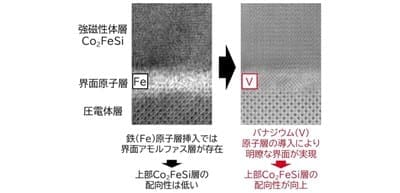
The key technology behind the proposed MRAM device is a multiferroic heterostructure with magnetization vectors that can be switched by an electric field. This heterostructure consists of a ferromagnetic layer, a piezoelectric layer, and an ultra-thin vanadium layer inserted between them. The insertion of the vanadium layer has been shown to improve the stability of the configuration, enabling reliable control of the magnetic anisotropy in the ferromagnetic layer. The CME effect, which characterizes the response of the heterostructure to an electric field, has reached a value larger than that achieved with similar devices that did not include a vanadium layer.
The converse magnetoelectric effect is a critical component of the proposed technology, as it enables the control of magnetic states using an electric field. The CME effect is characterized by the coupling between the magnetic and electric fields, where the application of an electric field induces a change in the magnetic state. The researchers have demonstrated that two different magnetic states can be reliably realized at zero electric field by changing the sweeping operation of the electric field. This means that a non-volatile binary state can be intentionally achieved at zero electric field, which is a key requirement for implementing practical magnetoelectric (ME)-MRAM devices.
The use of multiferroic heterostructures has several advantages over conventional MRAM devices. The ability to control magnetic states using an electric field reduces the energy consumption during data writing, making it a promising technology for low-power applications. Additionally, the multiferroic heterostructure enables the development of ME-MRAM devices, which can be used in a wide range of applications requiring persistent and safe memory.
Experimental Demonstration and Results
The researchers have experimentally demonstrated the feasibility of using multiferroic heterostructures to control magnetic states. The experimental setup consisted of a ferromagnetic Co2FeSi layer, an ultra-thin vanadium layer, and a piezoelectric layer. The insertion of the vanadium layer was shown to improve the crystal orientation of the ferromagnetic Co2FeSi layer, enabling reliable control of the magnetic anisotropy. The CME effect was characterized using a sweeping operation of the electric field, which demonstrated that two different magnetic states can be reliably realized at zero electric field.
The experimental results have shown promising outcomes for the proposed technology. The use of multiferroic heterostructures has enabled the control of magnetic states using an electric field, reducing energy consumption during data writing. The demonstration of a non-volatile binary state at zero electric field is a key requirement for implementing practical ME-MRAM devices. The researchers’ work has paved the way for the development of low-power MRAM devices with high performance and persistent memory.
Future Implications and Applications
The proposed technology has significant implications for the future of memory devices. With the increasing demand for low-power consumption and high-performance memory devices, the use of multiferroic heterostructures has the potential to revolutionize the field of spintronics. The development of ME-MRAM devices can be used in a wide range of applications requiring persistent and safe memory, such as mobile devices, data centers, and automotive systems.
The researchers’ work has demonstrated the feasibility of using multiferroic heterostructures to control magnetic states, paving the way for the development of practical MRAM devices with reduced energy consumption. The proposed technology has the potential to provide a significant reduction in energy consumption during data writing, making it a promising solution for low-power applications. As the demand for high-performance and low-power memory devices continues to grow, the use of multiferroic heterostructures is likely to play a critical role in shaping the future of spintronics.
Conclusion
In conclusion, the proposed technology has demonstrated the feasibility of using multiferroic heterostructures to control magnetic states, enabling an electric-field-based writing scheme with reduced energy consumption. Multiferroic heterostructures have several advantages over conventional MRAM devices, including reduced energy consumption during data writing and the ability to develop ME-MRAM devices with persistent and safe memory. The researchers’ work has paved the way for the development of low-power MRAM devices with high performance and persistent memory, which can be used in a wide range of applications requiring low-power consumption and high-performance memory devices.
External Link: Click Here For More
See today’s quantum computing news on Quantum Zeitgeist for the latest breakthroughs in qubits, hardware, algorithms, and industry deals.