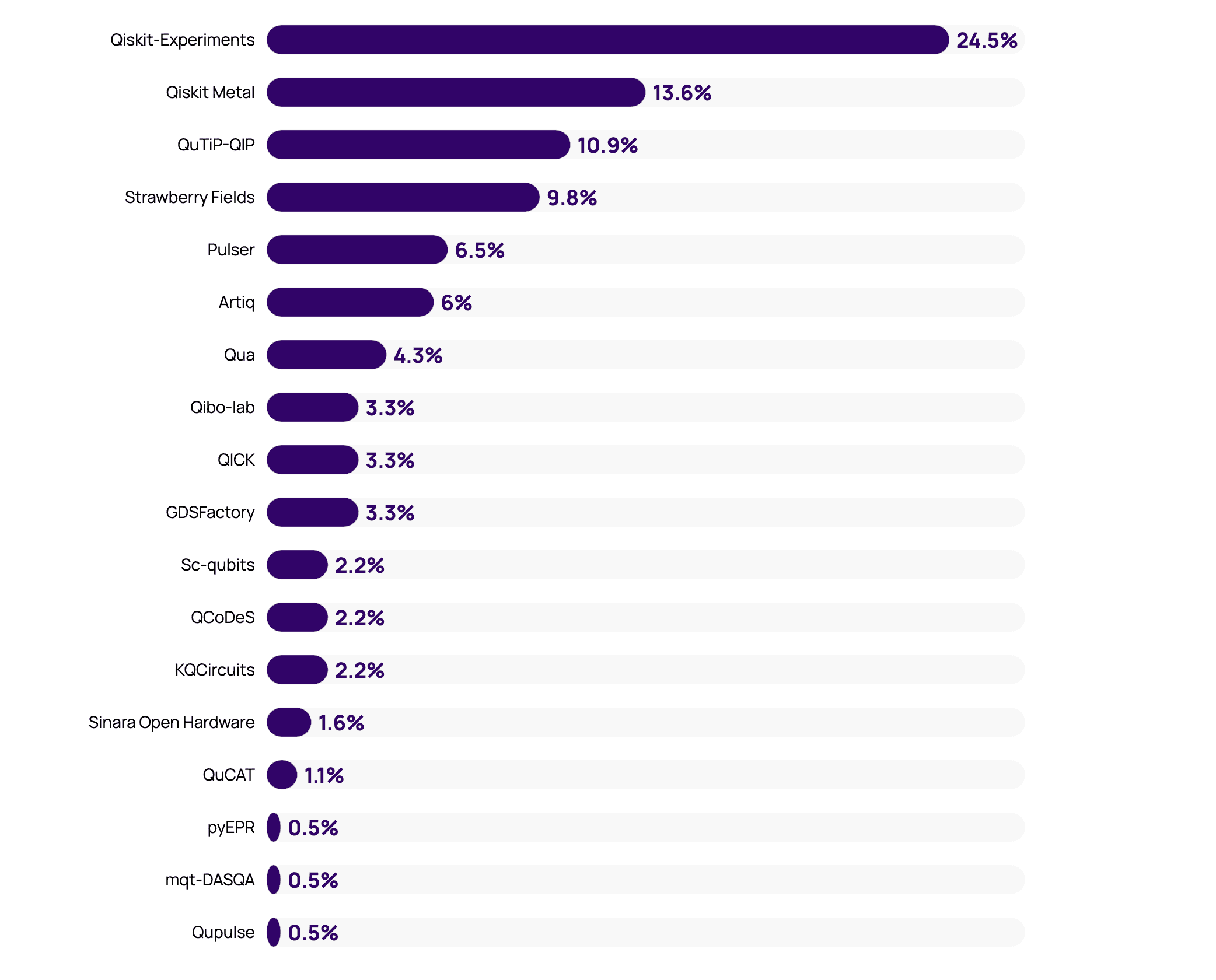
A recent survey conducted by Unitary Fund has shed light on the quantum software community and its needs. The survey gathered responses from over 600 individuals involved in quantum software development, including those from major companies such as Google and IBM.
The results highlight the importance of open-source software in the quantum community, with most respondents viewing it as very positive.
The survey also reveals that resources such as GitHub, Stack Overflow, and YouTube are crucial for learning and contributing to quantum open-source projects. Key figures like the Unitary Fund advisory board members played a role in shaping the survey. The findings will likely influence the direction of companies like Google, which offers Colab, and IBM, which provides Quantum Computing services, as well as other players in the field, such as qBraid and MyBinder.
Demographics and Tools
- The majority of respondents use Jupyter Notebooks or other notebooks (78.9%) and integrated development environments (IDEs) (68.9%).
- Most respondents use cloud services, with Google Colab being the most popular (71.1%).
- Text editors and command-line interfaces are also widely used.
Workflow and Development
- Most respondents use a workflow involving quantum software development using an IDE or Jupyter Notebooks.
- Many respondents participate in hackathons or live coding sessions, with Google Colab being the most popular platform (71.1%).
Resource Estimation and Benchmarking
- Only 19.9% of respondents use resource estimation for software development and research.
- The main roles of resource estimation include benchmarking, cost estimation, and feasibility studies.
Open-Source Software and Community
- Most respondents (82.1%) believe that open-source software has a very positive impact on the quantum software community.
- Respondents rely on various sources for answers or information when developing quantum software, including project documentation, Stack Overflow, and YouTube.
Learning and Contributing
- Many respondents find mentorship programs, participative courses, and digital education text resources helpful for learning or contributing to quantum open-source projects.
- Hackathons and video resources are also popular.
Feedback on the Quantum OSS Community
- Respondents provided feedback on the community, including appreciation and encouragement, constructive criticism, and practical and financial challenges.
- Some respondents suggested that the community should be more inclusive and provide more educational resources and mentorship opportunities.
Overall, the survey provides insights into the tools, workflows, and challenges the quantum OSS community faces. It highlights the importance of open-source software, collaboration, and education in advancing the field of quantum computing.
External Link: Click Here For More



See today’s quantum computing news on Quantum Zeitgeist for the latest breakthroughs in qubits, hardware, algorithms, and industry deals.