A new algorithm developed by Dr Le Bin Ho and his team at Tohoku University has made a significant breakthrough in quantum machine learning, enabling quantum computers to multitask more efficiently. Quantum computers use qubits that can exist in multiple states simultaneously due to superposition and entanglement, allowing them to process complex data.
However, traditional quantum compilation algorithms optimize only one target at a time, limiting their ability to handle complex applications. The new multi-target quantum compilation algorithm overcomes this limitation by optimizing multiple targets simultaneously, increasing flexibility and performance. This development has the potential to improve simulations of complex systems and tasks involving multiple variables in quantum machine learning, with applications across various scientific disciplines.
Dr Le Bin Ho’s team published their study in the journal Machine Learning Science and Technology, paving the way for more efficient handling of complex tasks by quantum computers.
Introduction to Quantum Computing and Machine Learning
Quantum computers are fundamentally different from classical computers in that they utilize qubits, which can exist in multiple states simultaneously due to quantum phenomena such as superposition and entanglement. This property allows quantum computers to process complex data and simulate dynamic processes more efficiently than their classical counterparts. However, for a quantum computer to perform these tasks, it must first translate the complex input data into “quantum data” that it can understand, a process known as quantum compilation. Quantum compilation is essentially the programming of the quantum computer, converting a high-level goal into an executable sequence of quantum operations.
The traditional approach to quantum compilation involves optimizing a single target at a time. While effective for certain applications, this approach has limitations when dealing with complex tasks that require multitasking. Many scientific disciplines, such as materials science and physics, often involve simulating quantum dynamical processes or preparing quantum states for experiments, which necessitate managing multiple operations simultaneously to achieve accurate results. Handling one target at a time becomes inefficient in these situations, highlighting the need for a more flexible and efficient approach to quantum compilation.
To address this challenge, researchers have developed a multi-target quantum compilation algorithm that enables a quantum computer to optimize multiple targets at once. This algorithm increases flexibility and maximizes performance, leading to improvements in complex-system simulations or tasks that involve multiple variables in quantum machine learning. The development of this algorithm represents a significant advancement in quantum computing, bringing us closer to the day when quantum computers can efficiently handle complex, multi-faceted tasks.
The potential applications of this multi-target algorithm are vast and varied. For instance, in materials science, researchers could use this algorithm to simultaneously explore multiple properties of a material at the quantum level. In physics, the algorithm may assist in studying systems that evolve or require various interactions to be fully understood. By enabling a quantum computer to optimize multiple targets at once, this algorithm opens the door to new applications previously limited by the single-target approach.
Quantum Compilation and Multi-Target Optimization
Quantum compilation is a crucial step in the operation of a quantum computer, as it translates complex input data into “quantum data” that the computer can understand. The traditional approach to quantum compilation involves optimizing a single target at a time, which can be limiting when dealing with complex tasks that require multitasking. To overcome this limitation, researchers have developed a multi-target quantum compilation algorithm that enables a quantum computer to optimize multiple targets simultaneously.
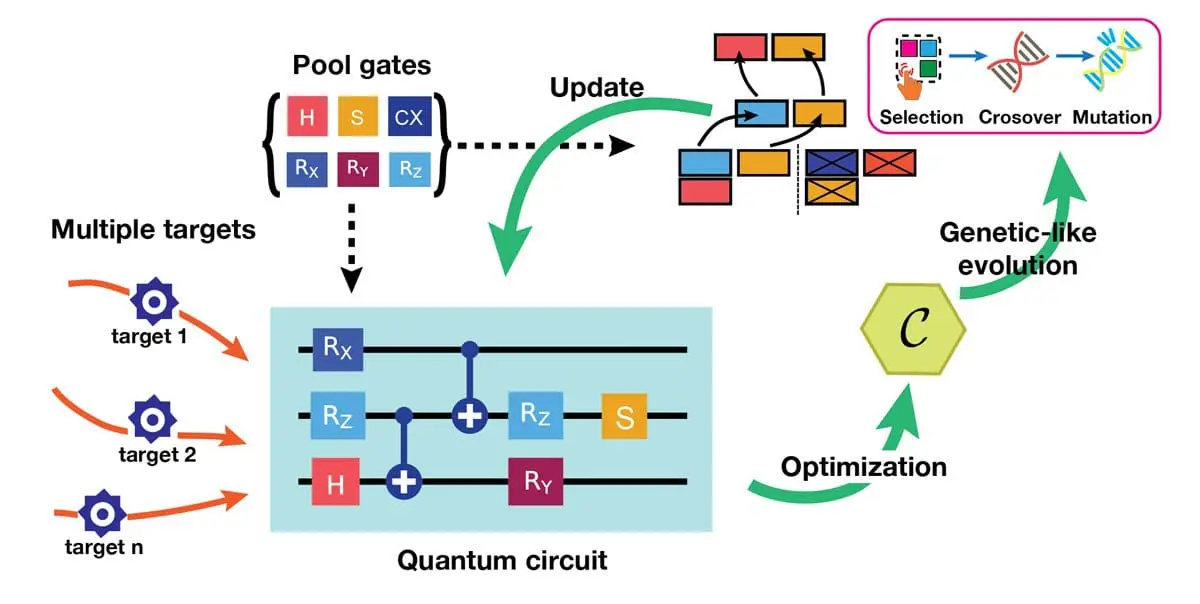
The core of this multi-target protocol is a quantum circuit designed for quantum computers. The circuit is built from a pool of gates, with the input being a set of target operations. It is then optimized and evolved like a gene through selection, crossover, and mutation. This process continues with each new generation until the circuit reaches an optimal form. By optimizing multiple targets at once, this algorithm increases flexibility and maximizes performance, leading to improvements in complex-system simulations or tasks that involve multiple variables in quantum machine learning.
The development of this multi-target algorithm represents a significant advancement in quantum computing. It brings us closer to the day when quantum computers can efficiently handle complex, multi-faceted tasks, providing solutions to problems beyond the reach of classical computers. The potential applications of this algorithm are vast and varied, with possibilities in materials science, physics, and other scientific disciplines.
In addition to performance improvements, this multi-target algorithm opens the door to new applications previously limited by the single-target approach. For instance, researchers could use this algorithm to study systems that evolve or require various interactions to be fully understood. The ability to optimize multiple targets simultaneously also enables the exploration of complex phenomena that were previously inaccessible due to the limitations of traditional quantum compilation algorithms.
Applications and Implications of Multi-Target Quantum Compilation
The development of a multi-target quantum compilation algorithm has significant implications for various scientific disciplines. In materials science, researchers could use this algorithm to simultaneously explore multiple properties of a material at the quantum level. This could lead to a deeper understanding of the behavior of materials under different conditions, enabling the development of new materials with unique properties.
In physics, the algorithm may assist in studying systems that evolve or require various interactions to be fully understood. The ability to optimize multiple targets simultaneously enables the exploration of complex phenomena that were previously inaccessible due to the limitations of traditional quantum compilation algorithms. This could lead to breakthroughs in our understanding of complex systems and the development of new theories to describe their behavior.
The potential applications of this algorithm are not limited to materials science and physics. It could also be used in chemistry, biology, and other scientific disciplines where complex systems are studied. The ability to optimize multiple targets simultaneously enables the exploration of complex phenomena that were previously inaccessible due to the limitations of traditional quantum compilation algorithms.
Furthermore, the development of a multi-target quantum compilation algorithm has significant implications for the field of machine learning. Quantum machine learning is an emerging field that combines the principles of quantum mechanics and machine learning to develop new algorithms and models. The ability to optimize multiple targets simultaneously enables the exploration of complex phenomena that were previously inaccessible due to the limitations of traditional quantum compilation algorithms.
Future Directions and Challenges
The development of a multi-target quantum compilation algorithm represents a significant advancement in quantum computing, but there are still challenges to be addressed. One of the main challenges is the optimization of the algorithm’s performance, which requires further research and development. Additionally, the integration of this algorithm with other quantum algorithms and models is crucial for its practical application.
Another challenge is the scalability of the algorithm, as it needs to be able to handle complex systems with many variables. The development of new quantum compilation algorithms that can efficiently optimize multiple targets simultaneously is an active area of research, with potential applications in various scientific disciplines.
Furthermore, the development of a multi-target quantum compilation algorithm raises questions about the fundamental limits of quantum computing. As we push the boundaries of what is possible with quantum computers, we may encounter new challenges and limitations that need to be addressed. The study of these limitations and the development of new algorithms and models to overcome them is an exciting area of research.
In conclusion, the development of a multi-target quantum compilation algorithm represents a significant advancement in quantum computing, with potential applications in various scientific disciplines. However, there are still challenges to be addressed, including the optimization of the algorithm’s performance, scalability, and integration with other quantum algorithms and models. Further research and development are needed to fully realize the potential of this algorithm and to explore its implications for our understanding of complex systems.
Conclusion
In conclusion, the development of a multi-target quantum compilation algorithm is a significant advancement in quantum computing, with potential applications in various scientific disciplines. The ability to optimize multiple targets simultaneously enables the exploration of complex phenomena that were previously inaccessible due to the limitations of traditional quantum compilation algorithms. This algorithm has the potential to lead to breakthroughs in our understanding of complex systems and the development of new theories to describe their behavior.
The potential applications of this algorithm are vast and varied, with possibilities in materials science, physics, chemistry, biology, and other scientific disciplines. The development of this algorithm represents a significant step towards the realization of the full potential of quantum computing, enabling the solution of complex problems that were previously inaccessible due to the limitations of classical computers.
However, there are still challenges to be addressed, including the optimization of the algorithm’s performance, scalability, and integration with other quantum algorithms and models. Further research and development are needed to fully realize the potential of this algorithm and to explore its implications for our understanding of complex systems. The study of these limitations and the development of new algorithms and models to overcome them is an exciting area of research that has the potential to lead to significant breakthroughs in various scientific disciplines.
External Link: Click Here For More
See today’s quantum computing news on Quantum Zeitgeist for the latest breakthroughs in qubits, hardware, algorithms, and industry deals.