Researchers at RTX’s BBN Technologies are developing next-generation photonic sensors that can detect environmental elements with unprecedented precision, exceeding current sensor capabilities by more than ten times. This breakthrough technology has far-reaching implications for defense and commercial applications, including LiDAR, fiber-based sensing, biosensing, system and network monitoring, navigation, and communications.
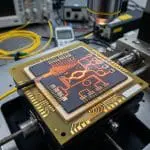
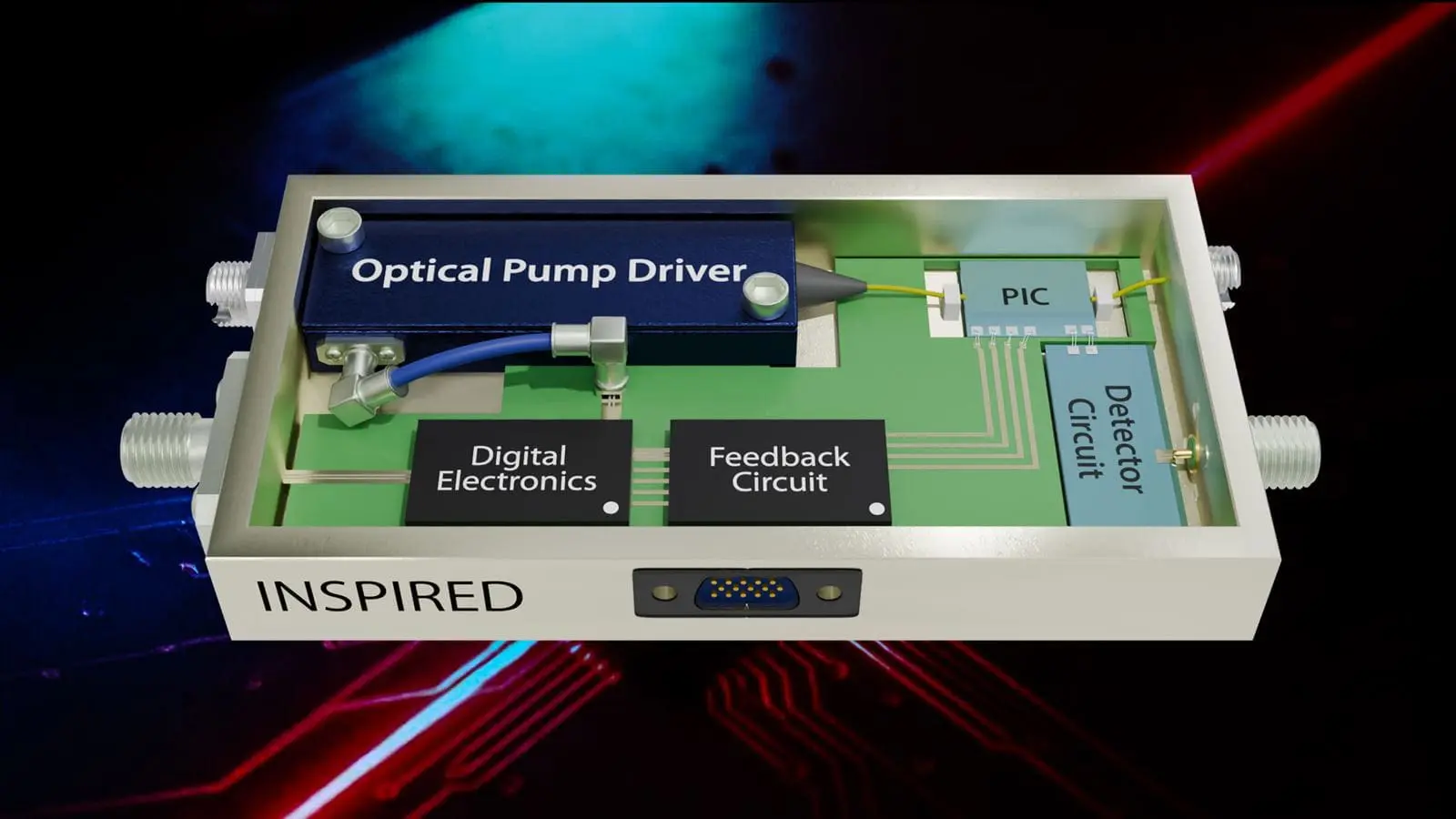
As part of DARPA‘s Intensity Squeezed Photonic Integration with Revolutionary Detection (INSPIRED) program, the BBN-led team is creating a prototype photonic chip that leverages exotic quantum states of squeezed light to achieve its goals. Dr. Mo Soltani, principal investigator on the effort, and Dr. Michael Grace, a quantum information scientist at BBN, are leading the charge.
By harnessing the power of quantum mechanics, the team’s chip-scale detector can fine-tune light generation, minimizing photon noise and allowing for more precise measurements. This innovation has the potential to revolutionize sensor technology, providing users with better awareness of their surroundings and enabling more effective decision-making.
Next-Generation Photonic Sensors: Defying Standard Limits
RTX’s BBN Technologies has been tapped by DARPA to develop compact, low-power, deployable photonic sensors that will provide users with better awareness of environmental elements critical to their missions. These next-generation sensors are expected to have greater than ten-times the precision of current sensors, disrupting fields such as LiDAR, fiber-based sensing, biosensing, system and network monitoring, navigation, and communications.
The development of these photonic sensors is part of DARPA’s Intensity Squeezed Photonic Integration with Revolutionary Detection (INSPIRED) program. The BBN-led team will deliver a prototype photonic chip that uses exotic quantum states of squeezed light to achieve its goals. This requires pushing detection sensitivity 16 dB below the fundamental “shot noise” limit, which imposes a strict bound on the sensitivity of conventional sensors.
Shot noise is a major limitation in sensor technology, arising from the randomness inherent in the way light fluctuates. Even with a perfectly stable light source, the number of photons counted each second will vary due to the quantum nature of light. This variation limits how precisely a sensor can use light to probe its surroundings. To overcome this problem, the team’s chip-scale detector will use quantum mechanics to fine-tune the light it generates.
Overcoming Shot Noise with Squeezed Light
The key innovation in these photonic sensors is the use of squeezed light to increase the precision of photon measurements. By “squeezing” the light source, certain kinds of quantum fluctuations are suppressed while others are augmented. This allows for the extraction of information embedded in a specific photonic property of interest without being limited by shot noise.
Squeezed light has been proven in meter-scale laboratory experiments and kilometer-scale gravitational wave facilities to increase precision. The team will use its expertise in photonic integrated circuits and quantum measurement devices to achieve the design and fabrication innovations required to transfer squeezed light capabilities to a fieldable, millimeter-scale detector for detection across a wide frequency range within 100 MHz to 10 GHz.
A Multidisciplinary Approach to Sensor Development
The development of these next-generation photonic sensors requires a multidisciplinary approach. BBN will use its proficiency in systems integration to manage a team that includes leading quantum and photonic experts from Xanadu Quantum, the University of Maryland, and the Photonics group of Raytheon’s Advanced Technology division.
This team brings robust capabilities in quantum sensor design, squeezing and sub-shot noise detection, quantum photonic testing and chip packaging, and rapid prototyping of compact RF-synthesizer modules. The collaboration will enable the development of a highly sensitive and accurate photonic sensor that can be deployed in a wide range of applications.
Applications and Implications
The successful development of these next-generation photonic sensors is expected to have widespread defense and commercial applicability. Improving the accuracy, sensitivity, resolution, and efficiency of fielded sensors makes them more effective in a wide range of applications, from mapping and surveying to autonomous navigation and obstacle detection.
This translates to better information for decision-making, enabling users to make more informed decisions in various fields. The potential impact of these photonic sensors is significant, with the potential to revolutionize various industries and applications.
RTX BBN Technologies provides advanced technology research and development with a focus on national security priorities. Founded in 1948, BBN consistently transitions advanced research to produce innovative solutions for its customers.
RTX, the parent company of BBN Technologies, is a global leader in technology and science, pushing the limits of innovation to redefine how we connect and protect our world. With more than 185,000 global employees, RTX advances aviation, engineering integrated defense systems for operational success, and develops next-generation technology solutions and manufacturing to help global customers address their most critical challenges.
External Link: Click Here For More
See today’s quantum computing news on Quantum Zeitgeist for the latest breakthroughs in qubits, hardware, algorithms, and industry deals.