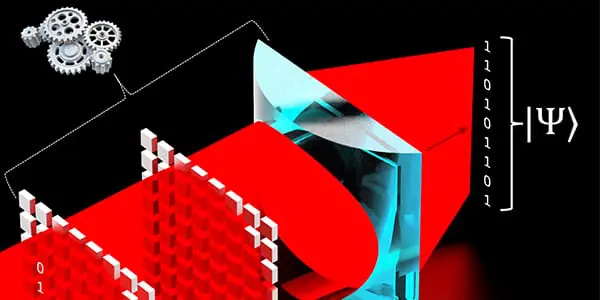
Researchers at the University of Witwatersrand have made a significant breakthrough in quantum computing, harnessing the unique properties of light to process multiple possibilities simultaneously. This innovative approach uses laser beams and everyday display technology, offering a simpler and more cost-effective solution for advanced quantum computing.
The team, led by Dr Isaac Nape, the Optica Emerging Leader Chair in Optics, has developed a system that can handle far more information than conventional computers, which are limited to working with just ones and zeros. In theory, their method could expand to handle millions of levels of information, making it a game-changer for processing complex data.
The research, published in APL Photonics, was achieved using surprisingly ordinary components, including laser beams, digital displays similar to those found in projectors, and simple lenses. Key team members include MSc students Mwezi Koni and Hadrian Bezuidenhout. This development has significant implications for fields such as logistics, finance, and artificial intelligence, and could unlock exciting new possibilities in areas like quantum optimization and quantum machine learning.
Harnessing Light for Quantum Computing Breakthroughs
The quest for more powerful quantum computing solutions has taken a significant leap forward with developing an innovative computing system using laser beams and everyday display technology. Researchers at the University of the Witwatersrand’s Structured Light Lab have successfully harnessed the unique properties of light to create a more straightforward and more cost-effective approach to advanced quantum computing.
The breakthrough, published in APL Photonics as the editor’s pick, offers a promising solution for speeding up complex calculations in fields such as logistics, finance, and artificial intelligence. By leveraging the properties of light, the system can process multiple possibilities simultaneously, dramatically increasing computing power. This is in contrast to traditional computers, which work like switchboards, processing information as simple yes or no decisions.
The research team, led by Dr. Isaac Nape, built their system using ordinary components – laser beams, digital displays similar to those found in projectors, and simple lenses. The key was linking how light interacts with optical devices, such as digital displays and lenses, to the mathematical operations that a quantum operation in a quantum computer performs. These operations can be broken down to multiplication and addition (using vectors and matrices) all performed at the speed of light.
Unlocking Quantum Algorithms
The system has been successfully tested using the Deutsch-Jozsa algorithm, a clever test determining whether an operation performed by a computer is random or predictable – something a quantum computer can do far faster than any classical computing machine. This paves the way for simulating even more complex quantum algorithms, which could unlock exciting new possibilities in areas like quantum optimization and quantum machine learning.
The team’s method can handle far more information than conventional computers, which are limited to working with just ones and zeros. In theory, they could expand this to handle millions of levels, which would be a game-changer for processing complex information. This is because light can process multiple calculations simultaneously, making it perfect for handling complex problems that would take traditional computers much longer to solve.
Accessibility and Practicality
What makes this development particularly significant for South Africa and other emerging economies is its accessibility. The system uses readily available equipment, making it a practical option for research laboratories that may not have access to more expensive computing technologies. This could lead to more widespread adoption of quantum computing solutions in regions where cutting-edge technology infrastructure might be limited by cost constraints.
The research forms part of the WitsQ Quantum Initiative and is supported by the South African Quantum Initiative (SAQuTI), positioning South Africa at the forefront of advanced computing research. The team is now working on expanding their system’s capabilities, which could lead to even more powerful computing solutions in the future.
Future Prospects
The potential implications of this breakthrough are far-reaching. With the ability to process complex information at unprecedented speeds, quantum computers could revolutionize fields such as logistics, finance, and artificial intelligence. The accessibility of the system also opens up new possibilities for research laboratories in emerging economies, where access to cutting-edge technology infrastructure may be limited.
As the team continues to work on expanding their system’s capabilities, it is likely that we will see even more powerful computing solutions emerge in the future. This could lead to a new era of advanced computing, where complex problems are solved at unprecedented speeds, and emerging economies have equal access to cutting-edge technology infrastructure.
External Link: Click Here For More



See today’s quantum computing news on Quantum Zeitgeist for the latest breakthroughs in qubits, hardware, algorithms, and industry deals.