Quantum machine intelligence is a rapidly emerging field that combines the power of quantum computing with artificial intelligence (AI) and machine learning. Researchers are exploring how to harness this synergy to solve complex problems in various domains, including AI itself.
A key breakthrough in this area is the development of QV AR, a quantum subroutine that computes variance with logarithmic complexity, offering significant computational speedup over classical counterparts. This innovation has far-reaching implications for the field, enabling new ways to tackle feature selection and outlier detection tasks in AI and paving the way for more powerful quantum algorithms.
What is Quantum Machine Intelligence?
Quantum machine intelligence refers to applying quantum computing principles to artificial intelligence (AI) and machine learning. This emerging field combines the power of quantum computing with the capabilities of AI, enabling new approaches to complex problems in fields such as feature selection, outlier detection, and more.
In this context, researchers are exploring ways to leverage quantum subroutines – essentially, quantum algorithms that can be used as building blocks for larger quantum programs. One such subroutine is the computation of variance, a fundamental metric in statistics and AI. The development of a quantum version of this subroutine, known as QV AR, has significant implications for the design of new quantum algorithms.
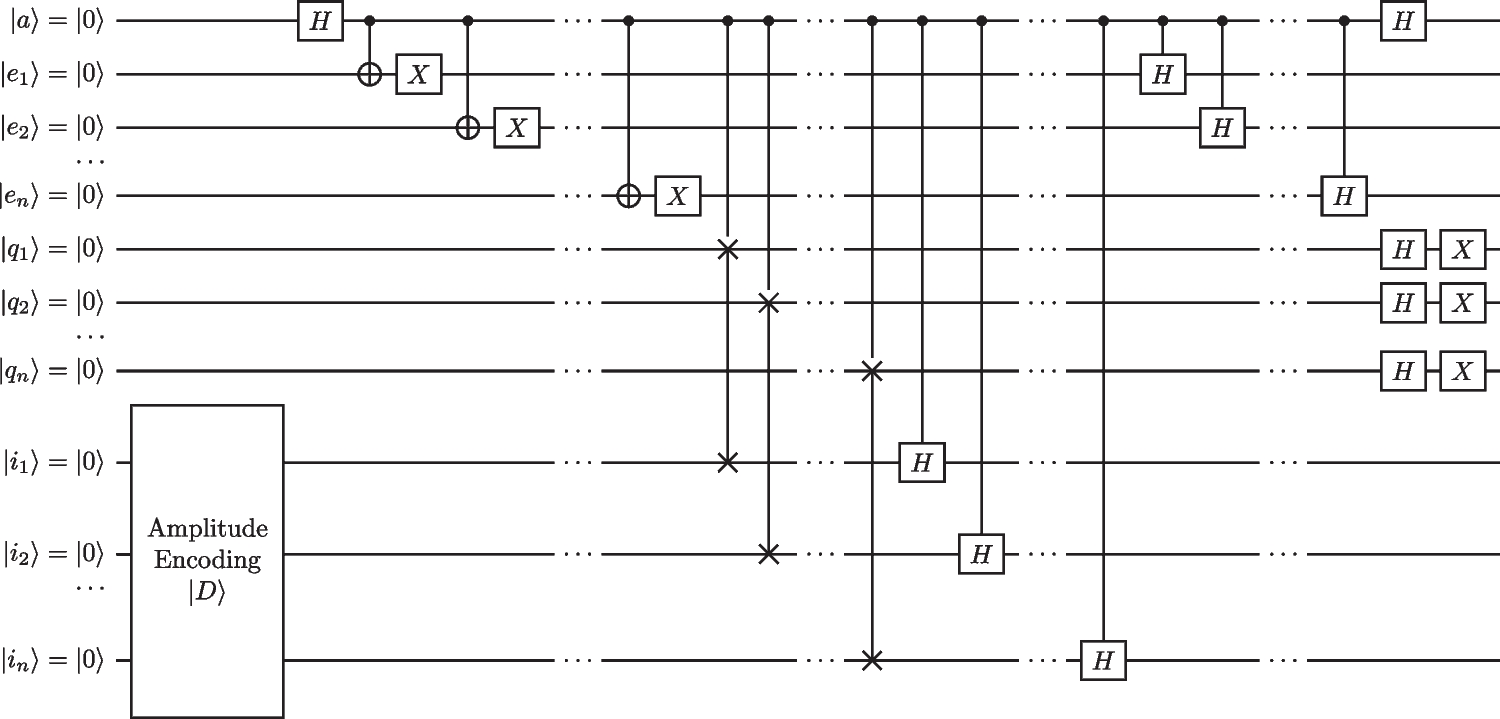
QV AR exhibits logarithmic complexity in circuit depth and width, excluding state preparation costs. This means that it can efficiently compute variance on large datasets, making it an attractive component for AI hybrid quantum algorithms. This work showcases two such algorithms: Hybrid Quantum Feature Selection (HQFS) and Quantum Outlier Detection Algorithm (QODA).
The Emergence of Quantum Computing
Quantum computing has revolutionized the way we approach computational problems. By harnessing the principles of quantum mechanics, researchers can develop algorithms that offer significant speedup over classical computation. This prospect has led to a new wave of innovation in algorithm design.
However, this emerging paradigm also presents challenges. One key research question is identifying and understanding opportunities for speedup in classical grounding subroutines when transitioning them to their quantum counterparts. This requires a deep understanding of the properties inherited by quantum mechanics and how they can be leveraged to create more efficient algorithms.
The design and implementation of quantum versions of
The design and implementation of quantum versions of widespread subroutines employed in the classical domain are crucial for developing advanced quantum algorithms. In this work, researchers delve into the design of QV AR, a quantum subroutine that computes variance with logarithmic complexity.
The Importance of Variance Estimation
Variance estimation is a fundamental problem in statistics and AI. It involves computing the spread or dispersion of a dataset, which is essential for many applications, including feature selection and outlier detection. In the classical domain, algorithms like QV AR have been developed to compute variance efficiently.
However, these classical algorithms may not be optimal when dealing with large datasets or complex systems. Developing a quantum version of QV AR offers significant advantages in terms of efficiency and scalability. By leveraging the power of quantum computing, researchers can create more efficient algorithms that can handle larger datasets and provide better insights into complex systems.
Hybrid quantum algorithms combine the strengths of classical and quantum computation to tackle complex problems. This work showcases two such algorithms: HQFS and QODA. These algorithms leverage the power of QV AR to select features and detect outliers in large datasets efficiently.
HQFS uses QV AR to compute variance on feature sets, allowing for efficient selection of relevant features. QODA employs QV AR to identify outliers in complex systems, providing valuable insights into data quality and distribution.
These hybrid quantum algorithms demonstrate the potential of combining classical and quantum computation to tackle challenging problems in AI and machine learning.
The Design and Implementation of QV AR
The design and implementation of QV AR are critical components of this work. Researchers have developed a quantum subroutine exhibiting logarithmic complexity in circuit depth and width, excluding state preparation costs.
QV AR is designed to efficiently compute variance on large datasets, making it an attractive component for AI hybrid quantum algorithms. The correctness and complexities of QV AR are thoroughly analyzed, providing a solid foundation for developing new quantum algorithms.
Applications and Implications
Applications and Implications
The implications of this work extend beyond the design and implementation of QV AR. By showcasing two hybrid quantum algorithms – HQFS and QODA – researchers demonstrate the potential of combining classical and quantum computation to tackle challenging problems in AI and machine learning.
These applications have significant implications for various fields, including feature selection, outlier detection, and more. The efficient computation of variance using QV AR enables new approaches to complex problems, providing valuable insights into data quality and distribution.
Conclusion
Quantum machine intelligence has emerged as a promising field that combines the power of quantum computing with the capabilities of AI. The development of QV AR, a quantum subroutine for variance estimation, offers significant advantages in terms of efficiency and scalability.
This work showcases two hybrid quantum algorithms – HQFS and QODA – that leverage the power of QV AR to efficiently select features and detect outliers in large datasets. The implications of this research extend beyond the design and implementation of QV AR, providing a solid foundation for the development of new quantum algorithms and applications in AI and machine learning.
In conclusion, quantum machine intelligence has the potential to revolutionize the way we approach complex problems in AI and machine learning. By combining classical and quantum computation, researchers can develop more efficient algorithms that provide better insights into data quality and distribution. The emergence of QV AR and hybrid quantum algorithms like HQFS and QODA marks an exciting new chapter in this field, with significant implications for various applications and industries.
Publication Date: 2024-11-14
Authors: Anna Bernasconi, Alessandro Berti, Gianna M. Del Corso, Riccardo Guidotti, et al.
Source: Quantum Machine Intelligence
DOI: https://doi.org/10.1007/s42484-024-00213-9