Researchers at Singapore University of Technology and Design (SUTD) have developed a novel tool that allows for precision control of light direction and polarization, inspired by the design of a spiral ladder. This breakthrough has significant implications for applications in biological and chemical sensing, optical communications, and quantum computing.
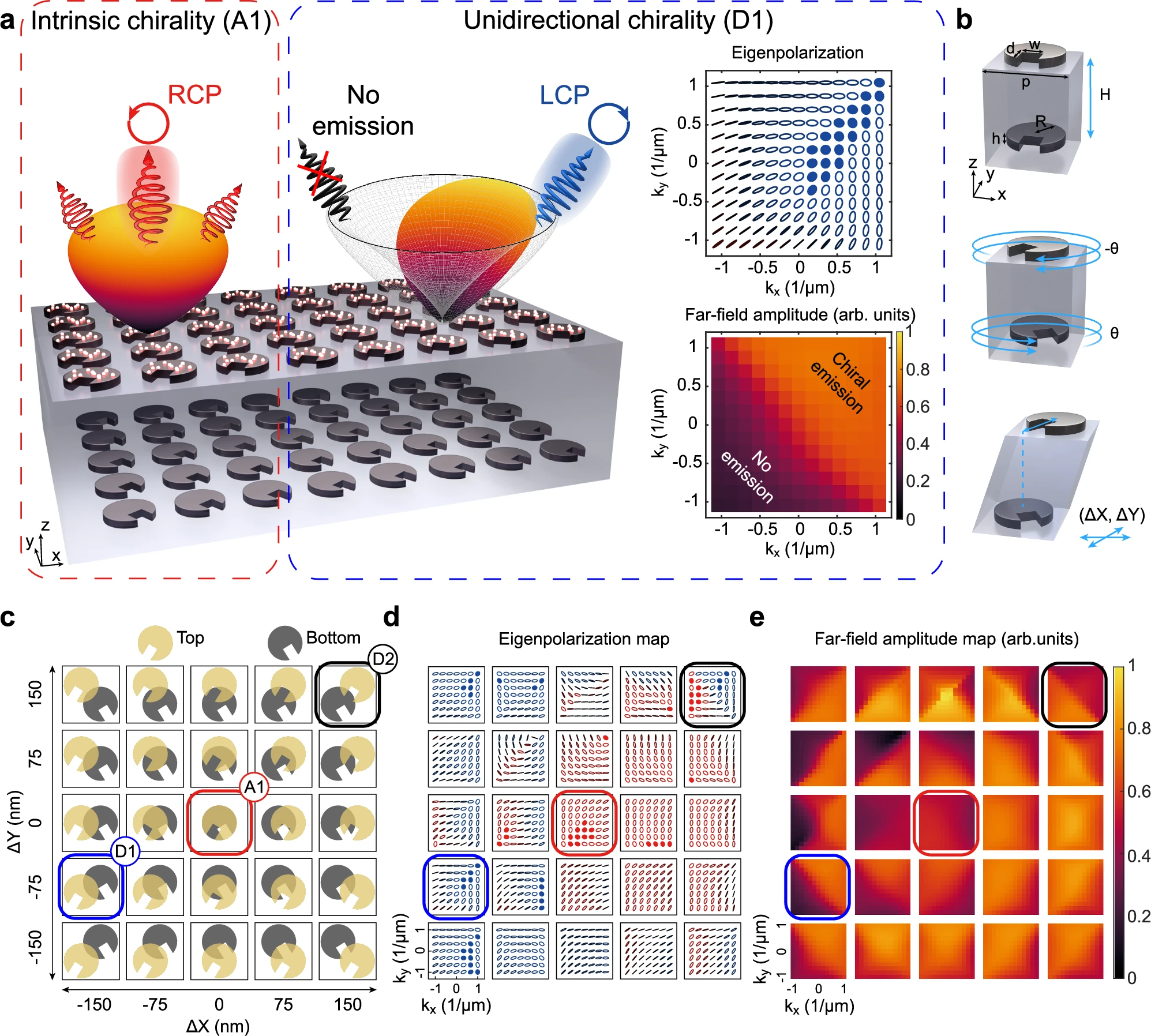
Led by Associate Professor Wu Lin, the team created a twisted bi-layer metasurface consisting of two layers of periodically arranged discs with notches carved at specific angles. This innovative approach enables simultaneous control of both direction and polarization of light, which has never been achieved before. PhD student Dmitrii Gromyko, under the supervision of Associate Prof Wu, played a key role in developing this design. The team’s work paves the way for creating ultra-compact devices with specific properties that meet the needs of modern science and technology.
Controlling Light Direction and Polarization: A Breakthrough in Photonics
Photonics, the study of light waves, has led to numerous breakthroughs in various fields, including biological and chemical sensing, optical communications, and quantum computing. One crucial aspect of photonics is controlling the direction and polarization of light waves. Researchers at the Singapore University of Technology and Design (SUTD) have made a significant advancement in this area by designing a spiral ladder-inspired tool that allows precision control of light direction and polarization.
The Challenge of Controlling Light Waves
Light waves can be polarized, meaning their electric and magnetic fields oscillate in any direction perpendicular to the direction of propagation. Circular polarization occurs when light waves have electric fields that follow a spiral trajectory along the direction of propagation. However, controlling these circularly polarized waves is challenging. The best compact emitters of light are quantum dots, but they emit light in all directions with poor polarization. Placing them next to nanostructures enables directional emission or circular polarization, but simultaneous control of both direction and polarization has never been achieved.
The Innovative Solution: Twisted Bi-Layer Metasurfaces
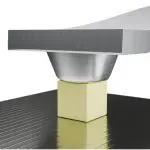
The SUTD research team, led by Associate Professor Wu Lin, proposed a novel solution to this problem. Inspired by a spiral ladder and a double-headed drum, they designed twisted bi-layer metasurfaces consisting of two layers of periodically arranged discs with notches carved at specific angles. This innovative approach allows for the control of three essential parameters: the distance between the two layers, the angle between the notches in the top and bottom discs, and the lateral shift of the centres of the top discs with respect to the bottom discs.
The Science Behind the Design
The key element that makes this structure successful is its bilayer design. Since both layers can be individually controlled prior to their coupling, the metasurface provides both versatility and synergy. The notches in the discs cause asymmetry, allowing the polarization of emitted waves to be controlled by rotating the notched discs in each layer. This design enables the precise control of light direction and polarization, making it an essential tool for various applications.
Fabrication and Measurement Challenges
Creating such a nanostructure was a significant challenge. The team had to vertically align the two layers with a precision of 10 nanometres. The primary experimental work was conducted by the team led by Associate Professor Zhaogang Dong, who recently joined SUTD’s Science, Mathematics, and Technology cluster.
Advancements and Future Directions
Developing these bilayer metasurfaces has several benefits. Theoretically, it advances the field’s understanding of resonances in multi-layer systems, design approaches, and fabrication technology. Practically, it enables the asymmetrical directional emission of waves with tailored properties. The nanostructure can then function as efficient emitters, routers, or grating couplers of circularly polarised waves, among other things. As a next step, the team aims to integrate their bilayer design with nano-electro-mechanical systems to achieve reconfigurable chiral metasurface systems that can actively manipulate light emission angle, wavelength, and polarization.
The Future of Photonics
This study paves the way for making ultra-compact devices with specific properties that meet the needs of modern science and technology. As Associate Professor Wu stated, “There is a myriad of challenges and practical problems waiting to be resolved with a smart design.” This breakthrough embodies SUTD’s principle of intersecting design and technology, demonstrating the potential for innovative solutions to shape the future of photonics.
DOI: http://dx.doi.org/10.1038/s41467-024-54262-6


See today’s quantum computing news on Quantum Zeitgeist for the latest breakthroughs in qubits, hardware, algorithms, and industry deals.