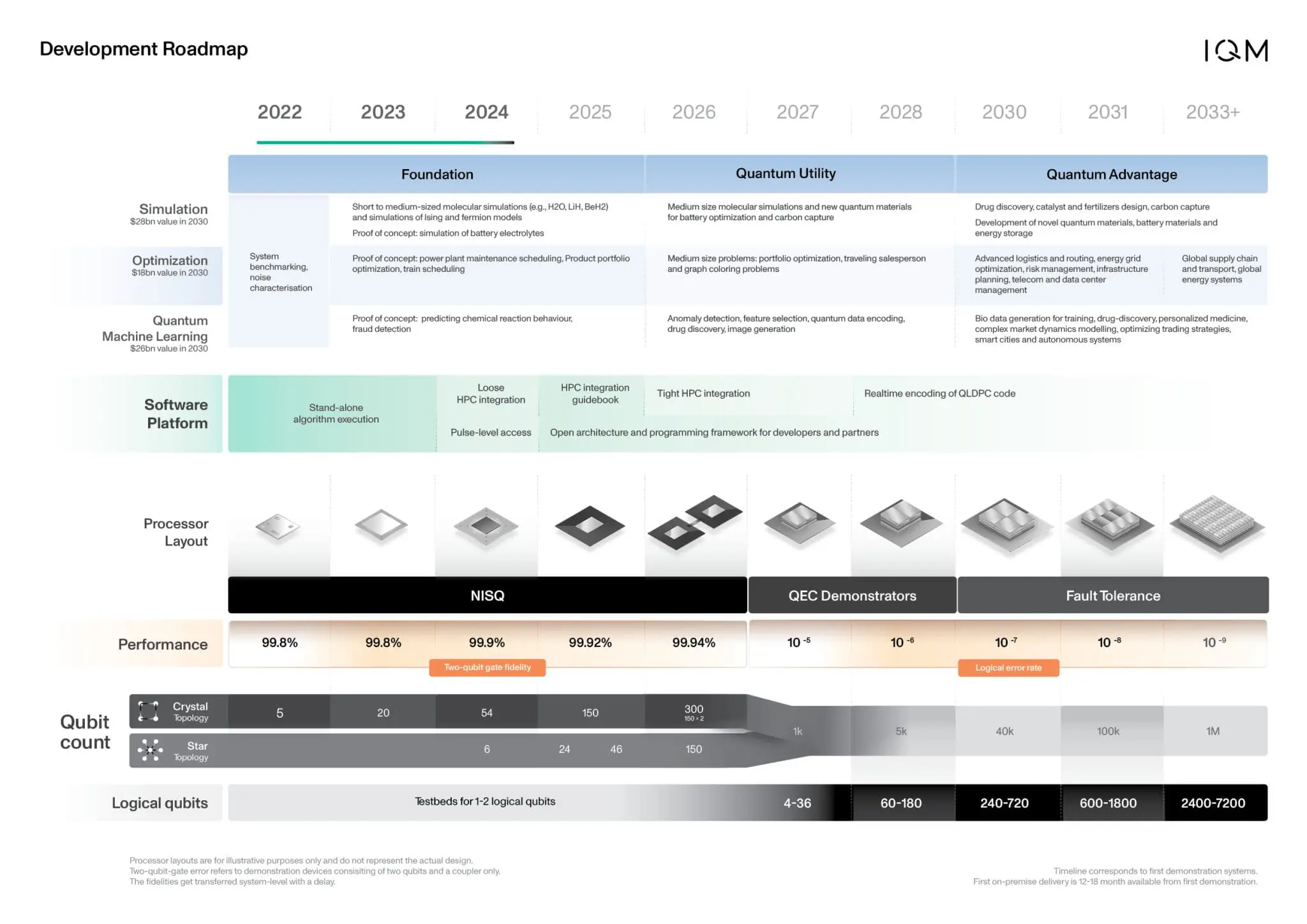
IQM Quantum Computers, a global leader in superconducting quantum computing, has unveiled its development roadmap to achieve fault-tolerant quantum computing by 2030. The company aims to pioneer quantum solutions through novel algorithmic approaches, modular software integration, and scalable hardware advancements.
IQM’s co-founder and co-CEO, Dr. Jan Goetz, emphasized the company’s commitment to hardware efficiency, enabling a feasible and scalable pathway to fault tolerance combined with an open and modular software architecture. The roadmap outlines a path to scaling up to 1 million qubits with combined quantum error reduction and error correction. IQM is also demonstrating early industry use cases in quantum machine learning, simulation of quantum systems, and optimization, which could unlock a value potential of over $28 billion by 2035, according to a McKinsey report.
IQM Quantum Computers Unveils Ambitious Development Roadmap for Fault-Tolerant Quantum Computing by 2030
IQM Quantum Computers, a prominent player in the superconducting quantum computing space, has announced its comprehensive development roadmap aimed at achieving fault-tolerant quantum computing by 2030. The roadmap outlines a path to scaling up to 1 million qubits with combined quantum error reduction and error correction.
The company’s strategy is built on merging its two processor topologies, Star and Crystal, for hardware-efficient error correction, as well as an open modular software stack for high-performance computing (HPC) integration. This approach enables the development of novel algorithmic approaches, modular software integration, and scalable hardware advancements.
IQM has successfully delivered full-stack quantum computers based on its first three processor generations since its inception. The 12-year roadmap reflects the company’s vision for pioneering quantum solutions through innovative co-design capabilities, which steer the roadmap towards efficient error-correction implementations with high system performance.
Merging Processor Topologies for Efficient Error Correction
IQM’s unique co-design capabilities play a crucial role in the development roadmap. By merging its two processor topologies, IQM Star and IQM Crystal, the company aims to achieve efficient error correction implementations with high system performance. This approach enables the design and fabrication of next-generation quantum processors with seamless integration into full-stack systems controlled by an open software stack.
To support this goal, IQM is systematically investing in its research and development (R&D), testing, and fabrication facilities to boost technology scaling up to 1 million qubits while maintaining high qubit quality and gate fidelity. The company’s proprietary cleanroom facilities will support the fabrication of complex processors with unique long-range connections, facilitating high-performance quantum processors.
Enabling High-Performance Computing Integration and Software Development
To ease the usage of quantum computing and support the developer community, IQM will enable tight HPC integration and create a special software development kit (SDK). Open interfaces will empower the ecosystem, including quantum error mitigation, co-develop libraries, and use-cases on IQM’s quantum computers.
The company aims to achieve quantum advantage across multiple industry domains, focusing on quantum simulations, optimization, and quantum machine learning. According to a McKinsey report, these selected use-cases will unlock a value potential of more than US$28 billion by 2035.
Achieving Quantum Advantage through Error-Corrected Systems
IQM is targeting fully error-corrected systems with hundreds to thousands of high-precision logical qubits, for which error correction will be enabled by efficiently implementing novel quantum low-density parity-check (QLDPC) codes. This approach reduces the hardware overhead by a factor of up to 10 compared to surface code implementation.
Furthermore, IQM is targeting high-precision logical qubits with error rates below 10^-7, enabling quantum advantage in fields such as chemistry and materials science. The company’s proprietary cleanroom facilities will support the fabrication of complex processors with unique long-range connections, facilitating high-performance quantum processors.
Novel Solutions for Advanced Packaging and 3D Integration
To ensure scalability while maintaining its ambitious goals to reduce error rates, IQM will implement novel solutions for advanced packaging and 3D integration. The company’s large-scale processors will be built up in a modular way and powered by cryogenic electronics, resulting in reduced heat load, strongly miniaturized packaging solutions, and reduced cost per qubit.
IQM has been specializing in integrating quantum systems into HPC centers since 2020, with the latest being Germany’s first hybrid quantum computer at the Leibniz Supercomputing Centre. The company aims to explain further details of the roadmap in future publications, blog posts, and at industry and academic events.
External Link: Click Here For More