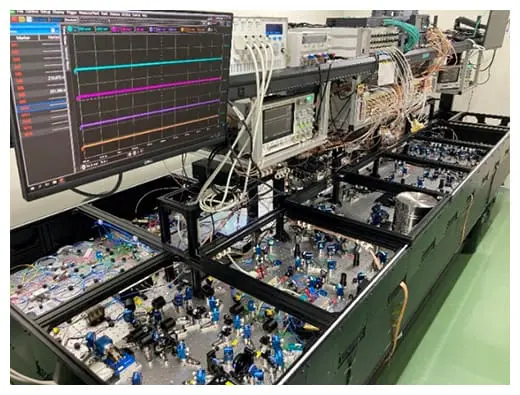
Researchers at the University of Tokyo’s Quantum Computer Research Center have made significant progress in developing a new type of quantum computer based on photopolymerization technology. This innovation allows multiple optical signals to be sent simultaneously on one transmission path, enabling faster and more efficient processing.
Building on previous work by Raussendorf et al. and Menicucci et al., the team has successfully generated large-scale quantum entanglement and demonstrated simple quantum calculations. Led by Professor Akira Furusawa, the joint research group includes experts from the University of Tokyo, NTT Advanced Integrated Device Research Institute, and Fixstars Amplify.
The technology uses light waves to represent continuous variables, with amplitude values corresponding to “position” and “momentum.” The team can manipulate these properties by changing the measurement basis. This breakthrough has significant implications for large-scale quantum computing and could lead to more general-purpose applications.
The research team, led by Akira Furusawa from the University of Tokyo, aims to create a large-scale, general-purpose quantum computer using photons as the quantum bits. This approach is based on previous achievements in generating large quantum entanglements for measurement-induced quantum computers.
One key aspect of this project is using continuous variables (analog) instead of discrete quantum bits. This allows for operations on physical quantities like position and momentum, which can be represented by the amplitude values of light waves. The team employs photopolymerization technology to send multiple optical signals simultaneously over one transmission path, enabling high-speed processing.
Another crucial element is the ability to change the measurement basis by adjusting the phase of reference light in an interferometric measurement. This allows for flexible control over which phase of the quantum light is measured, effectively changing the measurement basis.
The team also utilizes squeezed light, which reduces quantum fluctuations in one amplitude while amplifying them in another. This property is essential for generating entanglements and performing quantum operations.
The researchers employ a programmable logic device called a Field Programmable Gate Array (FPGA) to facilitate rapid digital processing. This enables flexible design and modification of digital circuits to support the high-speed operation of the measurement-induced quantum computer.
The collaboration brings together experts from various fields, including photonics, quantum computing, and semiconductor devices. The joint research group comprises researchers from the University of Tokyo, NTT Advanced Integrated Device Research Institute, and Fixstars Amplify.
This project has significant implications for developing practical, large-scale quantum computers. By harnessing the power of photons and continuous variable (analog) quantum computing, the team aims to create a more versatile and powerful tool for solving complex problems in chemistry, materials science, and machine learning.
External Link: Click Here For More



See today’s quantum computing news on Quantum Zeitgeist for the latest breakthroughs in qubits, hardware, algorithms, and industry deals.