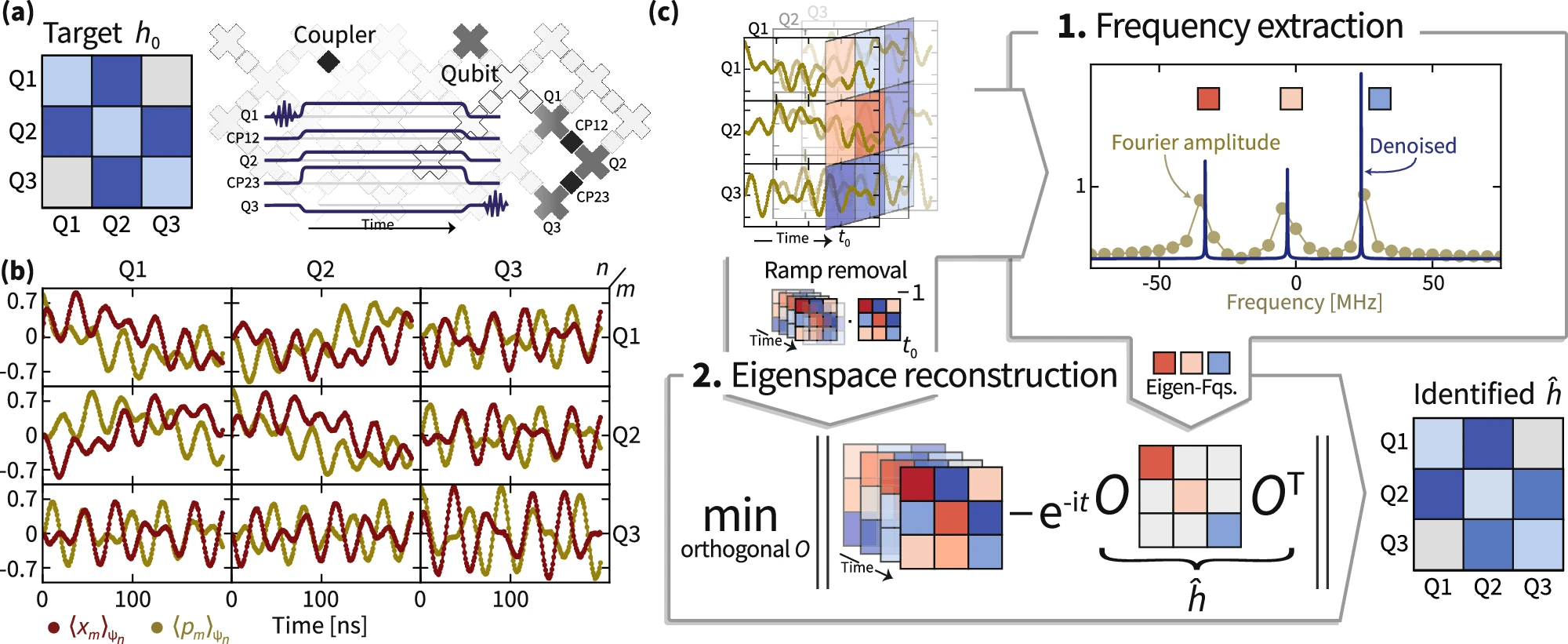
Researchers at Google have made a breakthrough in quantum computing, successfully identifying the dynamics of a complex quantum system using a novel algorithm. The experiment, conducted on a part of the Google Sycamore chip, involved applying carefully crafted pulses to qubits and couplers to manipulate their behavior.
By analyzing the resulting data, the team was able to reconstruct the underlying Hamiltonian, or generator of the unitary, that describes the system’s evolution over time. This achievement is significant because it demonstrates a robust method for identifying the non-interacting part of a potentially interacting quantum system, paving the way for more accurate simulations and improved control over complex quantum phenomena.
The research team employed a two-step approach, first extracting eigenfrequencies using a newly introduced algorithm called tensorESPRIT, and then reconstructing the Hamiltonian eigenspaces using a non-convex optimization algorithm. This work marks an important milestone in the development of quantum computing technologies.
Experiment Overview
The authors are performing an analog simulation on a Google Sycamore chip, using a pulse sequence to collect dynamical data. The goal is to identify the Hamiltonian generator (h) of the unitary matrix that describes the time evolution of the qubits. To achieve this, they prepare the initial state by applying π/2-pulses and ramping pulses to bring the qubits to a common rendezvous frequency.
Data Collection
The experiment yields N × N time-series estimates of the canonical coordinates (xm and pm) for each qubit m over time t = 0, 1, …, T ns. This data is used to identify the “best” coefficient matrix h that describes the time sequence of snapshots of the single-particle unitary matrix.
Identification Method
The identification process consists of two steps:
- TensorESPRIT Algorithm: The authors use a newly introduced algorithm (tensorESPRIT) or an adapted version of the ESPRIT algorithm to extract the Hamiltonian eigenfrequencies from the matrix time-series data.
- Non-Convex Optimization: After removing the initial ramp using the data at some fixed time, the Hamiltonian eigenspaces are reconstructed using a non-convex optimization algorithm over the orthogonal group.
Structural Constraints
To make the identification method noise-robust, the authors exploit structural constraints of the model:
- The Hamiltonian has a sparse frequency spectrum with exactly N contributions.
- The Fourier coefficients of the data have an explicit form as the outer product of the orthogonal eigenvectors of the Hamiltonian.
- The Hamiltonian parameter matrix is real and has an a priori known sparse support due to experimental connectivity constraints.
These constraints are not respected by various sources of noise, including particle loss, finite shot noise, and SPAM errors. Therefore, an identification protocol that takes these constraints into account is intrinsically robust against imperfections.
Key Takeaways
- The authors identify the non-interacting part of a potentially interacting system.
- Their approach is robust against various imperfections, including coherent and incoherent noise.
- The tensorESPRIT algorithm and non-convex optimization method are key components of the identification protocol.
External Link: Click Here For More




See today’s quantum computing news on Quantum Zeitgeist for the latest breakthroughs in qubits, hardware, algorithms, and industry deals.