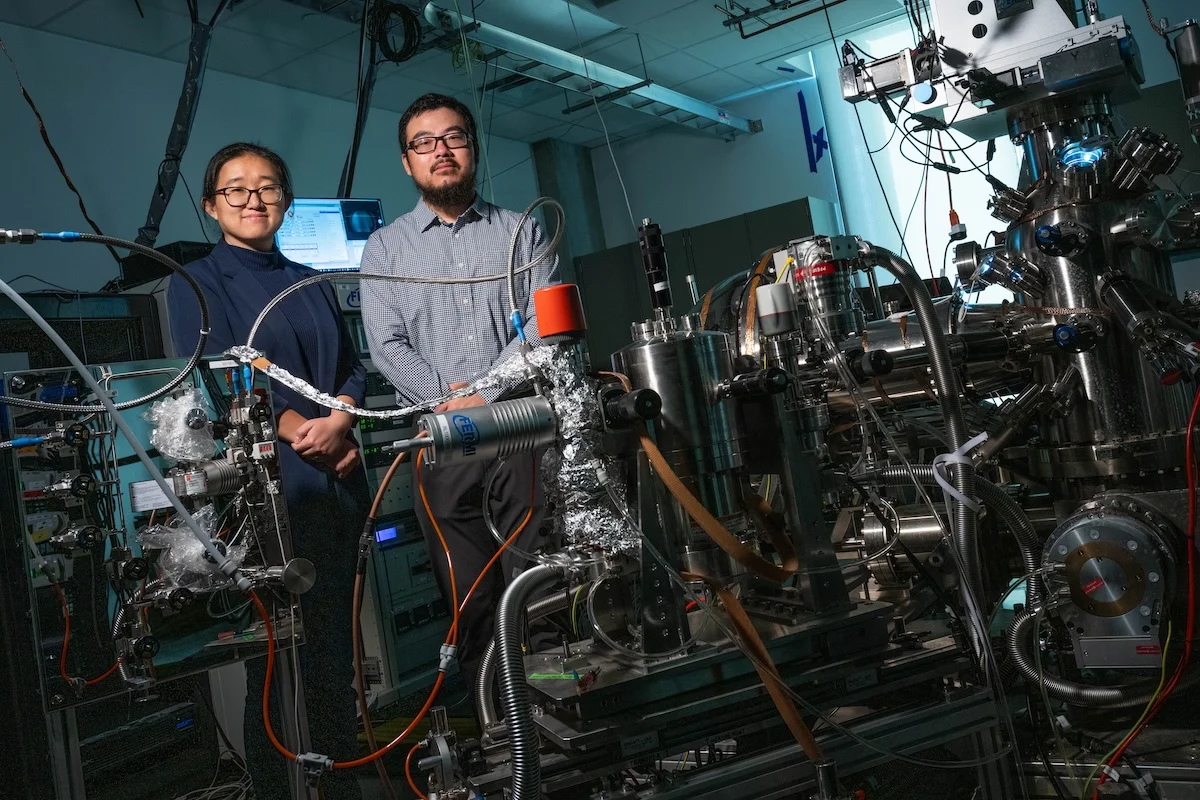
Researchers at Rice University have made a groundbreaking discovery in magnetism that could revolutionize quantum computing and superconductors. Led by physicists Zheng Ren and Ming Yi, the study reveals new magnetic and electronic properties in kagome magnet thin films, specifically iron-tin (FeSn) thin films. These materials are structured in a unique lattice-like design, creating unusual magnetic and electronic behaviors due to quantum destructive interference of the electronic wave function.
The findings challenge existing theories about magnetism in kagome metals, showing that localized electrons drive magnetic behavior, not mobile electrons as previously thought. This discovery could guide the development of materials with tailored properties for advanced tech applications such as quantum computing and superconductors. The research has broader implications for materials with similar properties, influencing the development of new technologies like high-temperature superconductors and topological quantum computation.
Unlocking the Secrets of Magnetism in Kagome Magnets
Researchers at Rice University have made a groundbreaking discovery in the field of magnetism, uncovering new magnetic and electronic properties in kagome magnet thin films. Led by Zheng Ren and Ming Yi, the research team’s study on iron-tin (FeSn) thin films has reshaped our understanding of kagome magnets, materials named after an ancient basket-weaving pattern and structured in a unique, lattice-like design.
Kagome magnets are known for their unusual magnetic and electronic behaviors due to the quantum destructive interference of the electronic wave function. The researchers’ findings, published in Nature Communications, reveal that FeSn’s magnetic properties arise from localized electrons, not the mobile electrons scientists previously thought. This discovery challenges existing theories about magnetism in kagome metals, where itinerant electrons were assumed to drive magnetic behavior.
Localized Electrons Drive Magnetism in Kagome Magnets
The research team used an advanced technique that combines molecular beam epitaxy and angle-resolved photoemission spectroscopy to create high-quality FeSn thin films and analyze their electronic structure. They found that even at elevated temperatures, the kagome flat bands remained split, indicating that localized electrons drive magnetism in the material. This electron correlation effect adds a new layer of complexity to understanding how electron behavior influences magnetic properties in kagome magnets.
The study also revealed that some electron orbitals showed stronger interactions than others, a phenomenon known as selective band renormalization previously observed in iron-based superconductors. This offers a fresh perspective on how electron interactions influence the behavior of kagome magnets. According to Ming Yi, an associate professor of physics and astronomy and Rice Academy Senior Fellow, “This work is expected to stimulate further experimental and theoretical studies on the emergent properties of quantum materials, deepening our understanding of these enigmatic materials and their potential real-world applications.”
Implications for Advanced Technologies
The research has broader implications for materials with similar properties. Insights into flat bands and electron correlations could influence the development of new technologies such as high-temperature superconductors and topological quantum computation. In topological quantum computation, the interplay of magnetism and topological flat bands generates quantum states that can be used as quantum logic gates.
According to Zheng Ren, a Rice Academy Junior Fellow, “Our study highlights the complex interplay between magnetism and electron correlations in kagome magnets and suggests that these effects are non-negligible in shaping their overall behavior.” The discovery could guide the development of materials with tailored properties for advanced tech applications such as quantum computing and superconductors.
Collaborative Effort
The study was a collaborative effort involving researchers from around the world, including the Weizmann Institute of Science, University of West Bohemia, Brookhaven National Lab, and Los Alamos National Laboratory. The research was supported by the U.S. Department of Energy, Robert A. Welch Foundation, Gordon and Betty Moore Foundation’s EPiQS Initiative, Rice Academy of Fellows, Air Force Office of Scientific Research, and Vannevar Bush Faculty Fellowship.
The discovery has significant implications for our understanding of magnetism in kagome magnets and could lead to the development of new technologies with potential applications in fields such as quantum computing and energy storage.
External Link: Click Here For More




See today’s quantum computing news on Quantum Zeitgeist for the latest breakthroughs in qubits, hardware, algorithms, and industry deals.