Researchers at Intel have made a significant development in quantum computing, developing a device that can control up to 12 qubits, the largest number reported in a single device using silicon-germanium (SiGe) technology.
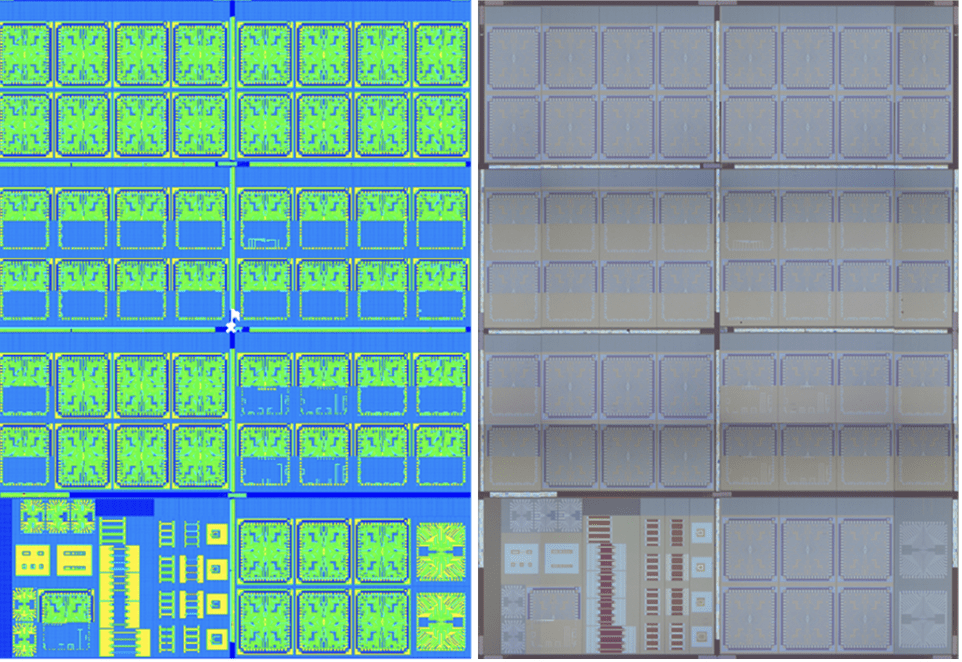
This achievement paves the way for the development of extensible 2-dimensional spin-qubit architectures. The device uses advanced semiconductor manufacturing techniques to fabricate thousands of devices on a single wafer.
The team demonstrated individual control of selected qubits, minimizing crosstalk, and achieved uniformity in qubit drive power, which is essential for future scaling and simultaneous operations. They also measured the exchange coupling between qubits, which is crucial for implementing two-qubit gates, and found that it can be tuned with high fidelity.
This work validates the compatibility of high-volume manufacturing techniques with quantum dot and spin-qubit devices using SiGe technology. The research team’s findings provide a foundation for future spin-qubit devices and bring us closer to realizing practical quantum computing applications.
The researchers have made progress in developing a scalable quantum computing architecture using silicon-based spin qubits. The device, called Tunnel Falls, consists of 12 quantum dots (QDs) arranged in a linear array, the largest number of qubits reported in a single device in Si/SiGe to date.
The key findings:
- Individual control and minimal crosstalk: By applying a magnetic field gradient across the qubit channel, the researchers achieved individual control over each qubit using a shared gate while minimizing crosstalk between them. This is crucial for scaling up the number of qubits in future devices.
- Coherent Rabi oscillations: The team demonstrated coherent Rabi oscillations on each of the 12 qubits by applying an oscillating signal at a given qubit’s resonance frequency to the shared center screening gate. This shows that individual qubits can be controlled and manipulated independently.
- Uniformity of qubit drive power: The researchers achieved a high degree of uniformity in the qubit drive power, which is essential for future scaling and simultaneous operations.
- Coherence times: Although limited by nuclear-spin noise in the substrate, the team reported pure dephasing times (T∗2) of 1.3 ± 0.5 µs across the array, with corresponding Hahn echo times of TH2 = 112 ± 13µs.
- Exchange coupling tunability: The researchers demonstrated exchange coupling between spins in neighboring quantum dots, which is essential for implementing two-qubit gates. They showed that an average voltage swing of 35 ± 7.2 mV/dec is required to achieve an order of magnitude increase in exchange coupling, enabling high-fidelity 2Q gates.
These results are significant because they were achieved using a high-volume manufacturing (HVM) process, which is compatible with advanced 300 mm semiconductor manufacturing lines and production-level process control. This paves the way for mass-producing spin-qubit devices with improved performance and scalability.
In summary, this work is crucial to realizing extensible 2-dimensional spin-qubit architectures. The researchers have demonstrated the feasibility of fabricating large numbers of qubits on a single device using Si/SiGe heterostructures, which is essential for building practical quantum computers.
External Link: Click Here For More



See today’s quantum computing news on Quantum Zeitgeist for the latest breakthroughs in qubits, hardware, algorithms, and industry deals.