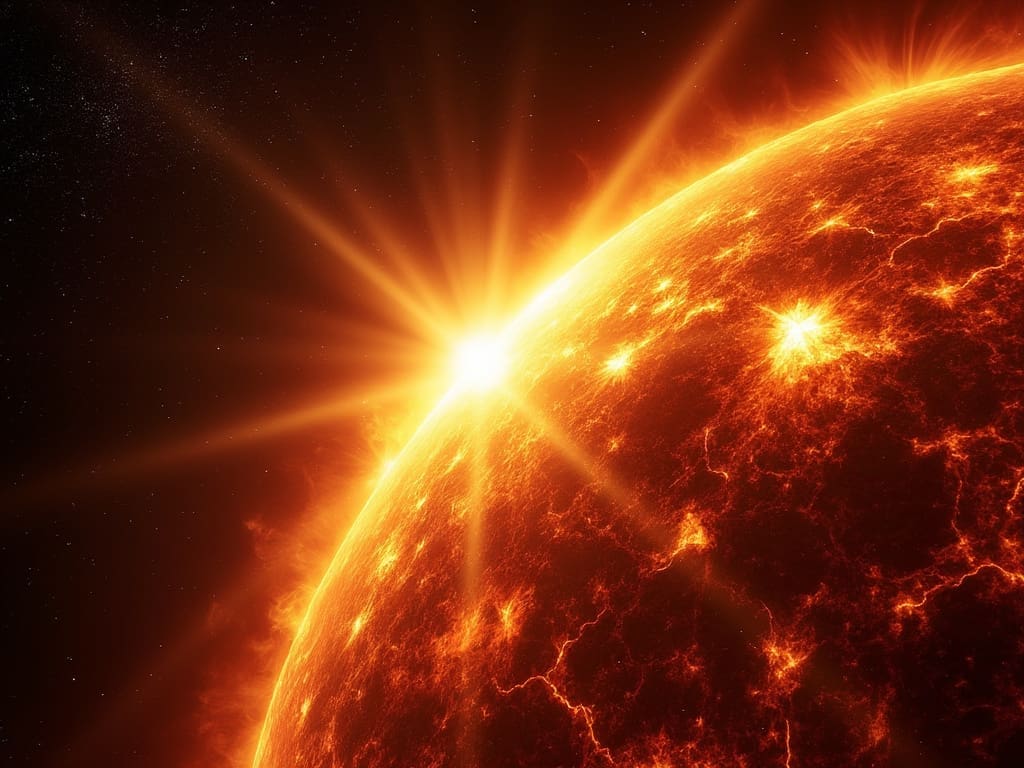
New Jersey Institute of Technology has launched an AI-powered center to advance forecasting of violent solar eruptions, thanks to a $5 million grant from NASA. The AI-Powered Solar Eruption Center of Excellence in Research and Education will partner with NASA, New York University, and IBM to develop artificial intelligence and machine learning tools for predicting powerful solar flares and coronal mass ejections.
Led by Haimin Wang, director of NJIT’s Institute for Space Weather Sciences, and Bo Shen, associate director of the center, the project aims to harness AI-enabled tools to investigate the fundamental nature of space weather, enabling accurate and near real-time forecasting of major solar eruptions. The center will also establish education programs related to space science, providing research opportunities for students at all levels.
By integrating NASA’s solar eruption observations with advanced artificial intelligence methods, researchers hope to gain a deeper understanding of the mechanisms triggering these high-impact solar events, ultimately improving space weather predictions and mitigating their effects on Earth.
Advancing Solar Eruption Prediction with AI-Powered Research
The New Jersey Institute of Technology (NJIT) has launched the AI-Powered Solar Eruption Center of Excellence in Research and Education (SEC), a cutting-edge research center dedicated to developing next-generation solar eruption prediction capabilities powered by artificial intelligence. The SEC, established with a $5 million NASA grant, aims to advance AI-driven forecasting of violent eruptions on the Sun, such as solar flares and coronal mass ejections (CMEs).
The center will partner with NASA, New York University, and IBM to develop AI and machine learning tools for improving the predictability of powerful solar eruptions at their onset. By harnessing AI-enabled tools to investigate the fundamental nature of space weather, researchers aim to significantly enhance their ability to interpret observational data from the Sun and forecast major solar eruptions accurately and in near real-time.
The SEC’s research efforts will focus on integrating physics knowledge with advanced AI tools, ensuring that models not only make accurate predictions but also provide insights aligned with fundamental physical principles. This approach will enable researchers to push the boundaries of interpretable AI and physics-informed learning, ultimately leading to a deeper understanding of the mechanisms triggering high-impact solar events in the Sun’s atmosphere.
Understanding Space Weather and its Impact on Earth
Solar flares and CMEs are known to drive space weather, which can disrupt everything from satellite technologies to power grids on Earth. However, limited understanding of the mechanisms triggering these high-impact solar events has hindered space weather researchers’ ability to make accurate and timely predictions.
The SEC aims to address this gap by integrating NASA’s solar eruption observations and advanced artificial intelligence/machine learning methods to provide a fresh window into how magnetic energy builds up in active regions of the solar atmosphere, contributing to such violent star outbursts. By developing a better understanding of space weather and its impact on Earth, researchers can work towards mitigating the effects of these events on our planet’s technological infrastructure.
Building a Long-Term Dataset for Solar Activity Research
A major hurdle in understanding solar eruption mechanisms is the limited data on large events like X-class flares. To address this challenge, the SEC plans to build a long-term dataset of activity from the Sun over several 11-year solar cycles, potentially giving researchers much deeper insights into precursors of flares and CMEs.
By building a large, homogeneous dataset of solar activity using advanced machine learning methods, researchers can study these major events with unprecedented resolution and cadence, ultimately revealing eruption mechanisms and unlocking better space weather predictions. This dataset will provide a valuable resource for the scientific community, enabling researchers to investigate the underlying physics of solar eruptions and develop more accurate forecasting models.
Education and Outreach Programs in Space Science
In addition to leading the development of AI-powered space weather forecasting, the SEC will also establish a robust education and outreach program, providing research opportunities for students at all levels — from undergraduate and graduate students to K-12 teachers. The center will collaborate with other minority-serving institutions (MSIs) — Kean University and Essex County College — to offer summer boot camps, workshops, and other initiatives aimed at promoting STEM education and inspiring the next generation of space weather researchers.
The SEC’s education and outreach programs will play a critical role in promoting diversity and inclusion in the field of space science, providing opportunities for underrepresented groups to engage with cutting-edge research and develop their skills in AI, machine learning, and data analysis. By fostering a diverse and talented workforce, the SEC aims to drive innovation and advance our understanding of the Sun’s impact on Earth’s technological infrastructure.
External Link: Click Here For More