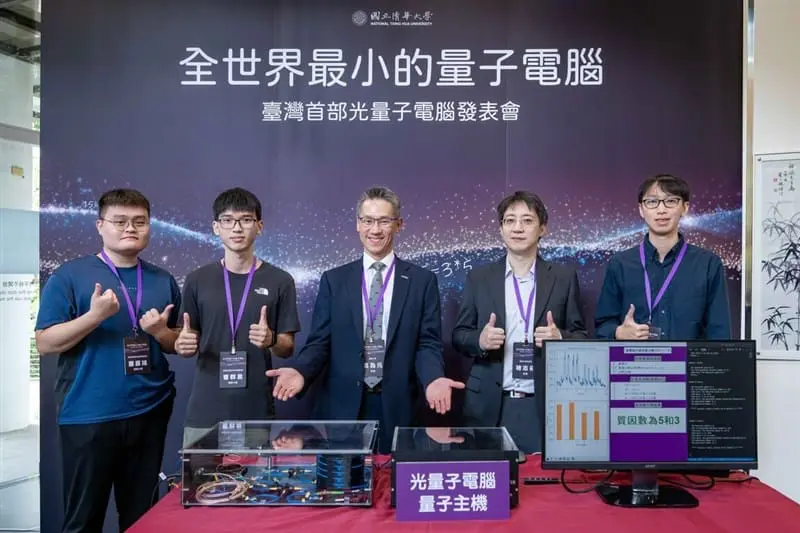
Taiwan’s National Tsing Hua University researchers have successfully developed the world’s smallest quantum computer, capable of performing complex algorithms using a single photon. Led by Professor Chuu Chih-sung, the team demonstrated their box-sized device’s ability to complete prime factorization according to Shor’s algorithm approach.
This breakthrough technology encodes information in 32 time-bins or dimensions within the wave packet of a single high-dimensional photon, offering lower energy costs and minimal interference during long-distance transmission. Unlike other quantum computer types that require cooler temperatures, this photonic device can maintain stable quantum states at room temperature.
National Tsing Hua University President Kao Wei-yuan hailed the achievement as a major milestone in quantum technology, while Professor Mou Chung-yu predicted widespread applications in fields such as drug development, logistics optimization, data security, and artificial intelligence.
Quantum Computing Breakthrough: Taiwan Develops World’s Smallest Single-Photon Quantum Computer
The field of quantum computing has witnessed a significant milestone with the development of the world’s smallest single-photon quantum computer by researchers at National Tsing Hua University (NTHU) in Taiwan. This innovative device, demonstrated at a press conference on October 16, 2024, marks a crucial step forward in harnessing the power of quantum mechanics for practical applications.
Compact Design and Room Temperature Operation
The NTHU research team, led by Professor Chuu Chih-sung, has successfully designed a box-sized quantum computer that utilizes a single photon to perform quantum algorithms. This compact device is capable of encoding information in 32 time-bins or dimensions within the wave packet of a single high-dimensional photon. The significance of this achievement lies in the fact that photons can maintain stable quantum states at room temperature, resulting in lower energy costs compared to other types of quantum computers that require cooler temperatures.
The implications of this breakthrough are far-reaching, as it opens up possibilities for commercial applications where energy efficiency and compact design are crucial. Moreover, the ability to operate at room temperature eliminates the need for complex and expensive cooling systems, making the device more accessible and user-friendly.
Photonic Quantum Computing: A Promising Future
The NTHU team’s research, published in the Physical Review Applied journal on September 3, 2024, demonstrates the potential of photonic quantum computing to revolutionize various fields. According to Professor Mou Chung-yu, director of NTHU’s College of Science, photonic quantum computing will eventually be used in various applications, including drug development, logistics optimization, data security, and artificial intelligence.
The advantages of photonic quantum computing are multifaceted. Photons enable long-distance transmission of information with minimal interference, making them ideal for secure communication networks. Furthermore, the ability to process vast amounts of data quickly and efficiently will profoundly impact fields such as medicine, finance, and transportation.
A Major Milestone in Quantum Technology
The development of this single-photon quantum computer represents a significant milestone in quantum technology. As noted by NTHU President Kao Wei-yuan, unlike leading quantum computer labs in the United States, the team’s device does not require large cooling systems, making it a more practical and viable option for real-world applications.
This achievement underscores Taiwan’s commitment to advancing quantum research and its potential to become a leader in this field. The NTHU team’s breakthrough has paved the way for further innovation and exploration of the vast possibilities offered by quantum computing.
Future Prospects and Applications
As researchers continue to push the boundaries of quantum computing, it is essential to consider its broader implications. The development of compact, energy-efficient quantum computers will have far-reaching consequences for various industries and aspects of daily life.
In data security, photonic quantum computing offers unparalleled opportunities for secure communication networks. In medicine, the ability to process vast amounts of genomic data quickly and efficiently will accelerate the discovery of new treatments and therapies. Furthermore, the optimization of logistics and supply chains will have a profound impact on the global economy.
As the field of quantum computing continues to evolve, it is crucial to remain aware of its potential applications and implications. The NTHU team’s breakthrough is a testament to human ingenuity and the boundless possibilities offered by the intersection of physics and engineering.
External Link: Click Here For More



See today’s quantum computing news on Quantum Zeitgeist for the latest breakthroughs in qubits, hardware, algorithms, and industry deals.