Researchers at Shanghai Jiao Tong University have made a significant breakthrough in quantum information technology, achieving a remarkable bandwidth of up to 13 nanometers for broadband frequency conversion. This advancement paves the way for more efficient data transfer and integrated photonic systems.
The team, led by Professor Yuping Chen, utilized X-cut thin film lithium niobate (TFLN), a material known for its nonlinear optical properties, to develop a novel method for wavelength conversion. By employing a technique called mode hybridization in a micro-racetrack resonator, they achieved precise control over the frequency conversion process.
This breakthrough could have wide-ranging implications for integrated photonic systems, enabling on-chip tunable frequency conversion and opening the door to enhanced quantum light sources, larger capacity multiplexing, and more effective multichannel optical information processing.
Enhanced Wavelength Conversion for Quantum Information Networks
The development of quantum information technology has been rapidly advancing, with a key challenge being the efficient transfer of qubits between different wavelengths without losing their essential properties. Recently, researchers from Shanghai Jiao Tong University (SJTU) have made significant strides in this area by developing a novel method for broadband frequency conversion, a crucial step for future quantum networks.
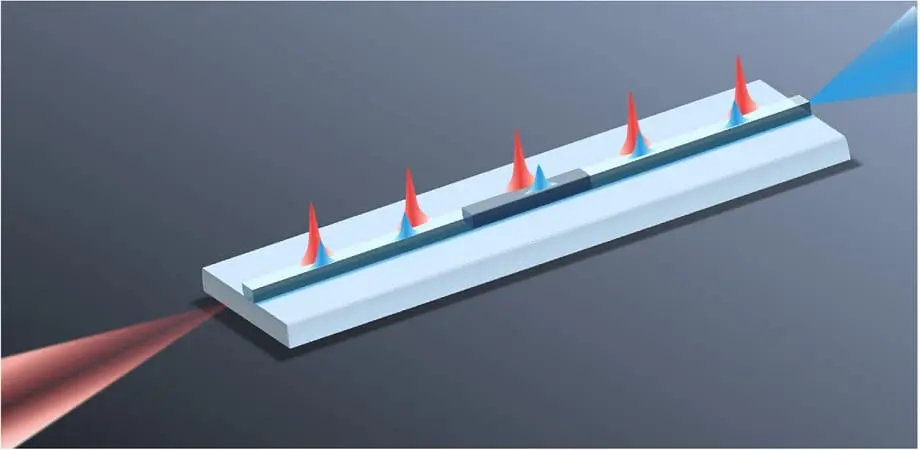
The SJTU team focused on a technique using X-cut thin film lithium niobate (TFLN), a material known for its nonlinear optical properties. They achieved broadband second-harmonic generation—an important process for converting light from one wavelength to another—with a remarkable bandwidth of up to 13 nanometers. This was accomplished through a process called mode hybridization, which allows for precise control over the frequency conversion in a micro-racetrack resonator.
The researchers’ approach utilized a birefringent racetrack resonator on X-cut TFLN, where SH-band light experiences a mode-hybridization in the half-circle waveguide. This enabled them to achieve efficient second-order nonlinear processes with widely-tunable pump bandwidths. According to corresponding author Professor Yuping Chen, this breakthrough could have wide-ranging implications for integrated photonic systems.
Dispersion-Designed Structural Geometry Enables Efficient Frequency Conversion
The SJTU team’s approach relied on dispersion-designed structural geometry, which enables the group-velocity mismatch of interacting lights to be smoothed to zero. This allows for wide-range frequency conversion, a crucial step in advancing quantum information networks. The researchers’ design utilized a micro-racetrack resonator with a half-circle waveguide, where the effective refractive indices of the hybrid mode in SH-band and TE0 mode in FW-band were precisely controlled.
The team’s results demonstrated that the average vector mismatch dispersion versus different FW wavelengths was positive in the straight waveguide and negative in the half-circle waveguide. This enabled them to achieve efficient frequency conversion with a remarkable bandwidth of up to 13 nanometers. The researchers’ approach has significant implications for the development of integrated photonic systems, enabling on-chip tunable frequency conversion.
Mode Hybridization Enables Precise Control over Frequency Conversion
The SJTU team’s approach relied on mode hybridization, which allows for precise control over the frequency conversion in a micro-racetrack resonator. This process enables the efficient conversion of light from one wavelength to another, a crucial step in advancing quantum information networks. The researchers’ design utilized a birefringent racetrack resonator on X-cut TFLN, where SH-band light experiences a mode-hybridization in the half-circle waveguide.
The team’s results demonstrated that this approach enables efficient second-order nonlinear processes with widely-tunable pump bandwidths. According to corresponding author Professor Yuping Chen, this breakthrough could have wide-ranging implications for integrated photonic systems, enabling on-chip tunable frequency conversion and paving the way for chip-scale nonlinear frequency conversion between ultrashort optical pulses and even quantum states.
Implications for Quantum Information Networks
The SJTU team’s breakthrough has significant implications for the development of quantum information networks. By enabling on-chip tunable frequency conversion, it opens the door to enhanced quantum light sources, larger capacity multiplexing, and more effective multichannel optical information processing. As researchers continue to explore these technologies, the potential for expanding quantum information networks grows, bringing us closer to realizing their full capabilities in various applications.
The development of efficient wavelength conversion techniques is crucial for advancing quantum information networks. The SJTU team’s approach has demonstrated a significant breakthrough in this area, paving the way for more efficient quantum information transfer and integrated photonic systems. As researchers continue to explore these technologies, we can expect significant advancements in the field of quantum information technology.
External Link: Click Here For More