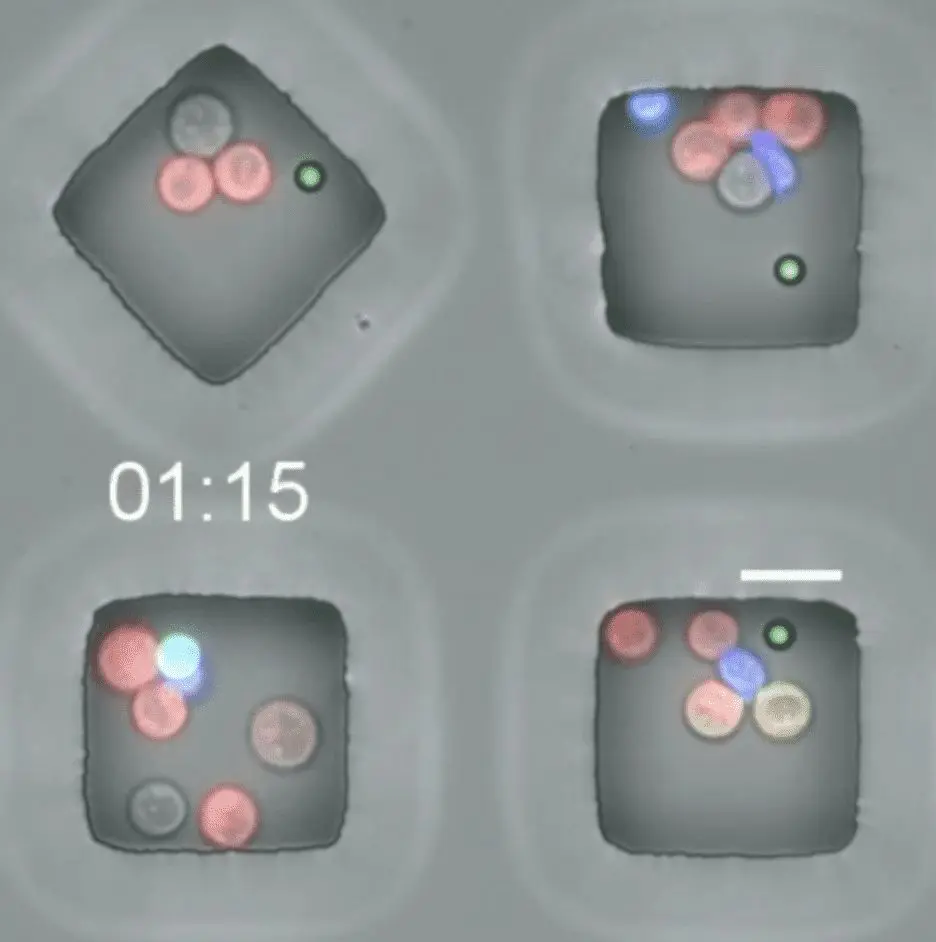
Researchers at the University of Houston have received a $2.5 million grant from the National Center for Advancing Translational Sciences to develop an advanced software technology that uses artificial intelligence to analyze single cells, with potential applications in cancer treatment and other diseases. The technology, called Time-lapse Imaging Microscopy In Nanowell Grids, or TIMING, is being commercialized by CellChorus Inc., a spinoff from the University of Houston.
Led by Professor Badri Roysam and Professor Navin Varadarajan, the project aims to create a “label-free” version of the technology that can quantify cell behavior without the need for fluorescent dyes. This will allow scientists to study cells in their natural state and gather important information about their movement, interactions, and changes. The grant will support the development of artificial intelligence and machine learning models trained on tens of millions of images of cells, enabling fast and high-throughput single-cell analysis.
Artificial Intelligence in Cancer Research: A New Frontier
The intersection of artificial intelligence (AI) and cancer research has led to a significant breakthrough, with the development of a new software technology that leverages AI for advancing cell-based immunotherapy to treat cancer and other diseases. This innovative approach is being commercialized by CellChorus Inc., a spinoff from the University of Houston, which has received a $2.5 million grant from the National Center for Advancing Translational Sciences (NCATS) of the National Institutes of Health.
The grant will fast-track the development of an advanced “label-free” version of the Time-lapse Imaging Microscopy In Nanowell Grids™ (TIMING) platform, which enables dynamic single-cell analysis with label-free analysis. This technology has the potential to revolutionize the field of cancer research by providing deep insights into cellular behaviors that directly impact human disease and new classes of therapeutics.
The Power of TIMING: A Specialized Tool for Studying Single Cells
TIMING is a video-array-based technology that observes cell interactions and produces tens of thousands of videos. Analyzing these massive video arrays requires automated computer vision systems, which is where AI comes into play. By combining AI, microscale manufacturing, and advanced microscopy, the label-free TIMING platform will yield deep insights into cellular behaviors.
The goal of the grant is to quantify the behavior of cells without the need for fluorescent staining, allowing scientists to watch cells in their natural state and gather important information about their movement, interactions, and changes. This approach will also enable researchers to use selective fluorescent staining to observe new molecules of interest, which is particularly useful in studying diseases like cancer or how cells react to treatments.
The Role of Artificial Intelligence in Label-Free Analysis
The label-free analysis enabled by the TIMING platform is made possible by new AI and machine learning models trained on tens of millions of images of cells. These models will be optimized for fast, high-throughput single-cell analysis by customers. The use of AI in this context allows for the automation of image analysis, enabling researchers to process large amounts of data quickly and accurately.
The development of these AI models is a critical component of the grant, as they will enable the analysis of massive video arrays generated by the TIMING platform. By leveraging AI, researchers can extract valuable insights from these datasets, which would be impossible to analyze manually.
The Future of Cancer Research: Integrating Single-Cell Dynamic Functional Analysis
The development of the label-free TIMING platform has significant implications for the future of cancer research. By integrating single-cell dynamic functional analysis with intracellular signaling events, researchers will gain a deeper understanding of cellular behaviors that directly impact human disease and new classes of therapeutics.
This approach has the potential to lead to the development of new treatments for cancer and other diseases, as well as improve our understanding of how cells react to treatments. The integration of AI, microscale manufacturing, and advanced microscopy will enable researchers to study single cells in unprecedented detail, leading to breakthroughs in our understanding of human disease.
Conclusion: A New Era in Cancer Research
The development of the label-free TIMING platform, enabled by AI and machine learning models, marks a significant shift in the field of cancer research. By leveraging these technologies, researchers will be able to study single cells in unprecedented detail, leading to breakthroughs in our understanding of human disease and the development of new treatments.
This grant is a critical step forward in this journey, enabling the development of computational tools that will ultimately integrate single-cell dynamic functional analysis of cell behavior with intracellular signaling events. As researchers continue to push the boundaries of what is possible with AI and cancer research, we can expect significant advances in our understanding of human disease and the development of new treatments.
External Link: Click Here For More




See today’s quantum computing news on Quantum Zeitgeist for the latest breakthroughs in qubits, hardware, algorithms, and industry deals.