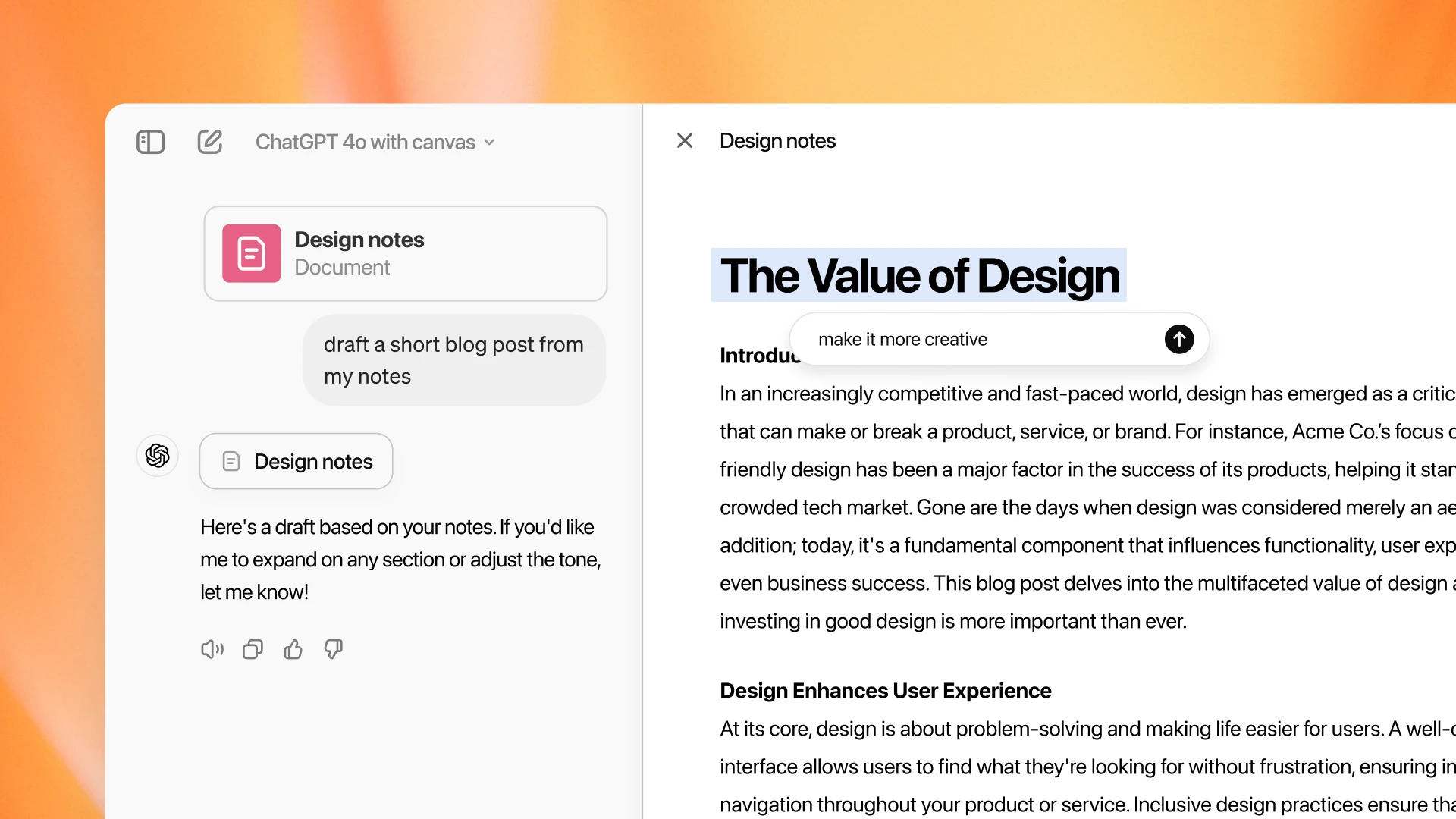
Introducing Canvas, a revolutionary new interface for working with ChatGPT on writing and coding projects that go beyond simple chat. Developed by OpenAI, Canvas allows users to collaborate with ChatGPT in a separate window, creating and refining ideas side by side. This early beta introduces a new way of working together, not just through conversation, but by creating and editing text or code directly. With Canvas, ChatGPT can better understand the context of what you’re trying to accomplish, offering inline feedback and suggestions with the entire project in mind. The technology was built using GPT-4o, a advanced language model, and is initially available to ChatGPT Plus and Team users, with plans to roll it out to all ChatGPT Free users once it’s out of beta.
Introducing Canvas: A New Approach to AI Collaboration
The development of artificial intelligence (AI) has revolutionized various aspects of our lives, from healthcare to finance. However, the way humans interact with AI systems remains largely unchanged. To address this limitation, researchers have introduced a new approach to AI collaboration called Canvas.
Canvas is an innovative visual interface that enables users to collaborate with AI models more effectively. This novel approach is designed to make AI more useful and accessible by rethinking how we interact with it. In this article, we will delve into the details of Canvas, its capabilities, and its potential implications for various industries.
Training the Model: A Collaborative Partner
The development of Canvas involved training a model to collaborate as a creative partner. The researchers achieved this by teaching the model to understand when to open a canvas, make targeted edits, and fully rewrite content. This approach enabled the model to provide precise feedback and suggestions, making it an effective collaborator.
To support this functionality, the research team developed core behaviors such as triggering the canvas for writing and coding tasks, generating diverse content types, making targeted edits, rewriting documents, and providing inline critique. The team measured progress using over 20 automated internal evaluations and novel synthetic data generation techniques.
Canvas Decision Boundary Trigger: Writing & Coding
One of the key challenges in developing Canvas was defining when to trigger a canvas. The researchers taught the model to open a canvas for prompts like “Write a blog post about the history of coffee beans” while avoiding over-triggering for general Q&A tasks like “Help me cook a new recipe for dinner.” For writing tasks, they prioritized improving “correct triggers,” reaching 83% compared to a baseline zero-shot GPT-4o with prompted instructions.
Similarly, for coding tasks, the researchers intentionally biased the model against triggering to avoid disrupting power users. They will continue refining this based on user feedback. The results show that Canvas improved correctly triggering the canvas decision boundary, reaching 83% and 94% respectively compared to a baseline zero-shot GPT-4o with prompted instructions.
Canvas Edits Boundary: Writing & Coding
Another challenge involved tuning the model’s editing behavior once the canvas was triggered. The researchers trained the model to perform targeted edits when users explicitly select text through the interface, otherwise favoring rewrites. This behavior continues to evolve as they refine the model.
The results show that Canvas prioritized improving canvas targeted edits, with GPT-4o with canvas performing better than a baseline prompted GPT-4o by 18%. This demonstrates the effectiveness of Canvas in making targeted edits and rewrites.
Canvas Suggested Comments
Training the model to generate high-quality comments required careful iteration. Unlike other tasks, measuring quality in an automated way is particularly challenging. Therefore, the researchers used human evaluations to assess comment quality and accuracy. The results show that the integrated canvas model outperforms the zero-shot GPT-4o with prompted instructions by 30% in accuracy and 16% in quality.
What’s Next for Canvas
Canvas is currently in early beta, and the researchers plan to rapidly improve its capabilities. This new approach to AI collaboration has the potential to revolutionize various industries, from education to healthcare. As AI becomes more integrated into our daily lives, innovative interfaces like Canvas will play a crucial role in making AI more useful and accessible.
In conclusion, Canvas represents a significant step forward in AI collaboration. Its ability to understand when to open a canvas, make targeted edits, and fully rewrite content makes it an effective collaborator. As the researchers continue to refine and improve Canvas, we can expect to see significant advancements in various industries.
External Link: Click Here For More




See today’s quantum computing news on Quantum Zeitgeist for the latest breakthroughs in qubits, hardware, algorithms, and industry deals.