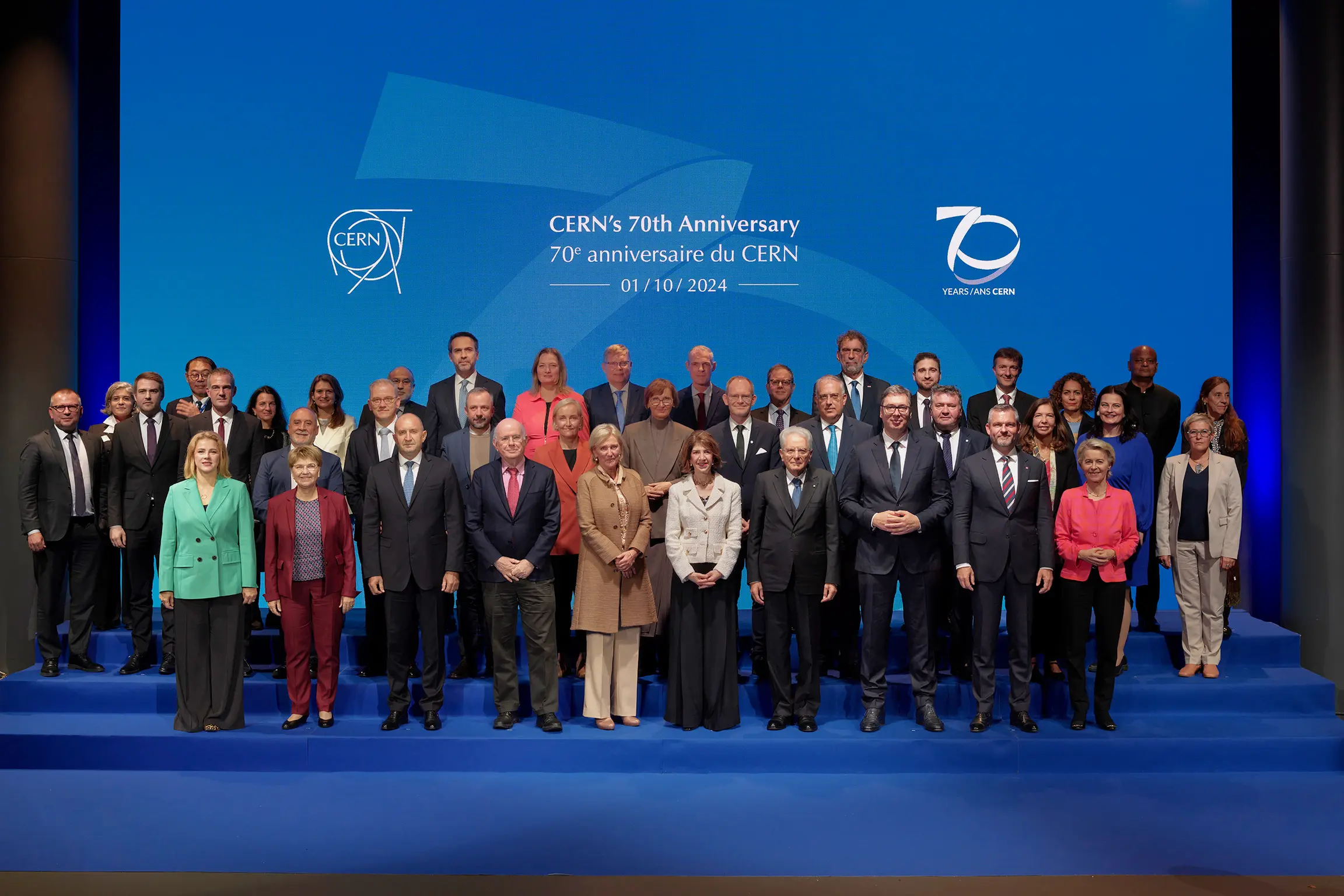
CERN, the European Laboratory for Particle Physics, celebrated its 70th anniversary with a high-level ceremony attended by 38 national delegations, including Heads of State and Government from several countries, as well as Her Royal Highness the Princess Astrid of Belgium and the President of the European Commission. CERN Director-General Fabiola Gianotti welcomed the distinguished guests, highlighting the laboratory’s mission to pursue scientific knowledge and technological developments for humanity’s benefit. Since its founding after World War II, CERN has made groundbreaking discoveries, including neutral currents, W and Z bosons, and the Higgs boson.
The laboratory is also credited with innovations like the multiwire proportional chamber and the birthplace of the World Wide Web. Today, CERN has 24 Member States, 10 Associate Member States, and a community of over 17,000 people from more than 110 nationalities. Eliezer Rabinovici, President of the CERN Council, praised the laboratory’s vision and contributions to human endeavors. As CERN looks ahead, engineers and physicists are working on the High-Luminosity LHC and a possible new facility, the Future Circular Collider, to further understand the fundamental laws of nature.
Celebrating 70 Years of Scientific Excellence: CERN’s Journey and Future Ambitions
CERN, the European Laboratory for Particle Physics, has marked its 70th anniversary with a high-level ceremony attended by dignitaries from around the world. This milestone celebration is a testament to the organization’s commitment to advancing scientific knowledge and technological innovation.
The ceremony, held at the CERN Science Gateway, brought together representatives from 38 national delegations, including Heads of State and Government, as well as prominent scientific, political, and economic leaders. The event demonstrated the strong support for CERN’s mission and its ambition to continue pushing the boundaries of human knowledge. As Fabiola Gianotti, CERN Director-General, emphasized, “CERN is a great success for Europe and its global partners, and our founders would be very proud to see what CERN has accomplished over the seven decades of its life.”
A Legacy of Groundbreaking Discoveries
CERN’s history is replete with foundational discoveries that have reshaped our understanding of the universe. From the discovery of neutral currents in 1973 to the detection of the W and Z bosons in 1983, CERN has consistently pushed the frontiers of scientific knowledge. The Large Electron-Positron (LEP) collider, which operated from 1989 to 2000, enabled extremely precise measurements of the Z boson and other parameters of the Standard Model. More recently, the Large Hadron Collider (LHC), which started up in 2009, led to the discovery of the Higgs boson in 2012.
Beyond its core mission of advancing particle physics, CERN has also generated innovations with far-reaching implications. The multiwire proportional chamber, invented in 1968, is a notable example. Moreover, numerous technologies developed at CERN are now used in fields such as medical diagnostics and therapy, aerospace, and more.
A Beacon for International Collaboration and Education
CERN’s success is not only a testament to human ingenuity but also a shining example of international collaboration. With 24 Member States, 10 Associate Member States, 4 Observers, and many other partners from around the world, CERN has created a vibrant community of over 17,000 people representing more than 110 nationalities.
As Eliezer Rabinovici, President of the CERN Council, noted, “CERN is living proof that human ingenuity knows no bounds when set on a common goal that transcends borders.” The organization’s commitment to education and training has also been instrumental in promoting inclusiveness in the world of science. The year-long anniversary program, which included over 100 events in 63 cities across 28 countries, brought together thousands of people to discuss the future of physics and the role of CERN as a model for international collaboration.
Charting the Future: Upcoming Projects and Ambitions
As CERN looks to the future, its community is already focused on uncovering the many mysteries that remain about the universe. The High-Luminosity LHC, scheduled to begin operation after 2030, aims to increase tenfold the amount of data collected by experiments and greatly enhance their physics potential.
Furthermore, CERN is currently performing a feasibility study for a possible new facility, the Future Circular Collider, which may become the most extraordinary instrument ever built to study the fundamental laws of nature. This ambitious project has the potential to address many of the outstanding fundamental questions in physics and further cement CERN’s position as a leader in scientific innovation.
In conclusion, CERN’s 70th anniversary is a celebration not only of its past achievements but also of its future ambitions. As the organization continues to push the boundaries of human knowledge, it remains an inspiration to scientists and non-scientists alike, demonstrating the power of international collaboration and education in advancing our understanding of the universe.
External Link: Click Here For More




See today’s quantum computing news on Quantum Zeitgeist for the latest breakthroughs in qubits, hardware, algorithms, and industry deals.