Spectroscopy has long been a cornerstone of physics, serving as a vital link between experimental observations and theoretical understanding. By analyzing the vibrational fine structures of molecules with high precision, researchers have made significant breakthroughs in our understanding of molecular structures and properties.
In this study, scientists employed density functional theory (DFT) to simulate X-ray absorption and photoelectron spectra for diatomic molecules such as N2, NO, CO, and others, achieving excellent agreement between theoretical and experimental results. The findings highlight the importance of considering anharmonic effects in spectroscopic analysis, particularly when dealing with systems exhibiting significant geometrical changes.
Spectroscopy has long been a cornerstone of physics, serving as a vital link between experimental observations and theoretical understanding. The precision of spectroscopic measurements has reciprocally driven the development of quantum theory, with high-resolution spectroscopy acting as a litmus test for assessing the accuracy of theoretical methods. In the context of high-resolution vibrationally-resolved X-ray spectroscopy, comparison to experimental data provides an evaluation of the quality of potential energy surfaces (PESs) for both the core-electron excited or ionized state.
The study of diatomic molecules has been a significant area of research in spectroscopy, with the Franck-Condon approximation being a widely used method for simulating X-ray spectra. However, the harmonic oscillator approximation has limitations when dealing with complex vibronic structures, particularly in systems where significant geometrical changes occur upon excitation or ionization.
The harmonic oscillator (HO) approximation is commonly used to simulate X-ray spectra of diatomic molecules. However, this approach has limitations when dealing with complex vibronic structures, particularly in systems where significant geometrical changes occur upon excitation or ionization. In such cases, the HO approximation may not accurately capture the fine details of the spectrum, leading to discrepancies between theoretical and experimental data.
The study of NO, CO, and N2 molecules
The study of NO, CO, and N2 molecules has highlighted the limitations of the HO approximation in simulating X-ray spectra. The O1s XAS spectra of these molecules exhibit complex vibronic structures that cannot be accurately captured by the HO approximation. In contrast, anharmonic (AH) calculations based on potential energy curves (PECs) generated by density functional theory (DFT) methods or multiconfigurational levels have been shown to reproduce the experimental spectra with high accuracy.
Density functional theory (DFT) has emerged as a powerful tool for simulating X-ray spectra of diatomic molecules. The use of DFT with selected functionals, such as BLYP, BP86, B3LYP, and M062X, has been shown to provide excellent agreement between theoretical and experimental spectra in most systems studied. The functional dependence in diatomic systems is generally more pronounced than in polyatomic ones, highlighting the importance of selecting the appropriate functional for accurate simulations.
The study of CNOK edge vibrationally-resolved X-ray spectra of common diatomic molecules has validated the performance of DFT and highlighted the effects of anharmonicity. The excellent agreement between theoretical and experimental spectra found in most systems suggests that DFT is a reliable method for simulating X-ray spectra of diatomic molecules.
Anharmonic effects play a crucial role in simulating X-ray spectra of diatomic molecules, particularly in systems where significant geometrical changes occur upon excitation or ionization. The study of NO, CO, and N2 molecules has highlighted the importance of anharmonic calculations based on potential energy curves (PECs) generated by DFT methods or multiconfigurational levels.
The use of quantum wavepacket dynamics based on PECs has been shown to reproduce the experimental spectra with high accuracy. The sensitivity of the results to the anharmonic effect and the quality of the PECs highlights the importance of selecting the appropriate method for accurate simulations.
The functional dependence in diatomic systems is generally
The functional dependence in diatomic systems is generally more pronounced than in polyatomic ones, highlighting the importance of selecting the appropriate functional for accurate simulations. The study of CNOK edge vibrationally-resolved X-ray spectra of common diatomic molecules has validated the performance of DFT and highlighted the effects of anharmonicity.
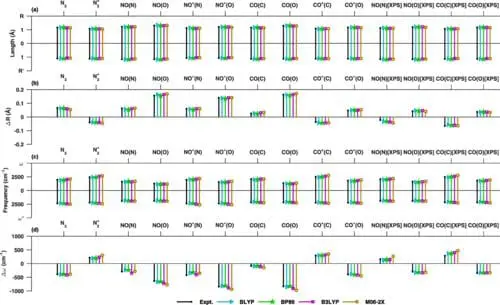
The BLYP, BP86, and B3LYP functionals consistently exhibited high accuracy in predicting spectral profiles, bond lengths, and vibrational frequencies, slightly outperforming the M062X functional. This study highlights the importance of selecting the appropriate functional for accurate simulations of X-ray spectra of diatomic molecules.
The study of CNOK edge vibrationally-resolved X-ray spectra of common diatomic molecules has highlighted the power of spectroscopy in unlocking the secrets of matter. The use of density functional theory (DFT) with selected functionals has been shown to provide excellent agreement between theoretical and experimental spectra in most systems studied.
The importance of anharmonic effects, functional dependence in diatomic systems, and the selection of appropriate methods for accurate simulations have been emphasized. This study provides a valuable contribution to the field of spectroscopy, highlighting the power of DFT in simulating X-ray spectra of diatomic molecules.
Publication Date: 2024-03-19
Authors: L. Zhang, Minrui Wei, Guoyan Ge, Weijie Hua, et al.
Source: Physical review. A/Physical review, A
DOI: https://doi.org/10.1103/physreva.109.032815




See today’s quantum computing news on Quantum Zeitgeist for the latest breakthroughs in qubits, hardware, algorithms, and industry deals.