Microsoft and Quantinuum have made significant strides in quantum computing. By applying Microsoft’s qubit-virtualization system to Quantinuum’s H2 trapped-ion quantum computer, they created 12 highly reliable logical qubits.
This achievement demonstrates continued progress toward scientific quantum advantage, a milestone that will be reached when a hybrid quantum-classical computer can solve complex problems more efficiently than classical computers alone. Krysta Svore, a researcher at Microsoft, has been instrumental in developing the qubit-virtualization system.
The logical qubits were used to simulate and solve a chemistry problem with high accuracy, outperforming physical qubits. This proof-of-concept study showcases the emerging usefulness of quantum-classical hybrid computing in chemistry and demonstrates how high-performance computing, artificial intelligence, and logical qubits can be used collectively to solve scientific problems. The integration of Quantinuum’s InQuanto computational-chemistry software package into Azure Quantum Elements, Microsoft’s cloud platform, further expands its capabilities.
In a groundbreaking achievement, a team at Microsoft has successfully demonstrated an end-to-end workflow that combines quantum computing, high-performance computing (HPC), and artificial intelligence (AI) to simulate and solve a complex chemistry problem. This proof-of-concept case study showcases the emerging usefulness of quantum-classical hybrid computing in chemistry and highlights the potential of logical qubits to outperform classical computation.
The Problem: Simulating Iron Catalyst Reactions
The team focused on simulating the reaction pathways of a P-N-N-P iron catalyst, which is crucial for understanding its functionality. Using AutoCAS and AutoRXN in Azure Quantum Elements, they conducted HPC simulations to identify the active space of the catalyst and its reaction pathways.
The team then optimized error-detection codes for use within a customized quantum algorithm on two logical qubits to simulate the quantum behavior of the active space. These logical qubits were created using Microsoft’s qubit-virtualization system on Quantinuum’s H1 machine. The results were measured to generate classical data, which was used to train an AI model on the quantum properties of the molecule.
Accurate Results and Comparison with Physical Qubits
The estimated ground state energy of the active space was found to be within chemical accuracy (1.6 mHa of the true ground state energy). Notably, the logical-qubit computation yielded a better estimate than the physical-qubit computation in 97% of cases.
This demonstration provides evidence of the emerging usefulness of quantum-classical hybrid computing in chemistry. The integration of Microsoft’s qubit-virtualization system with Quantinuum’s InQuanto computational-chemistry software package into Azure Quantum Elements expands the platform’s tool kit, enabling scientists to solve complex scientific problems.
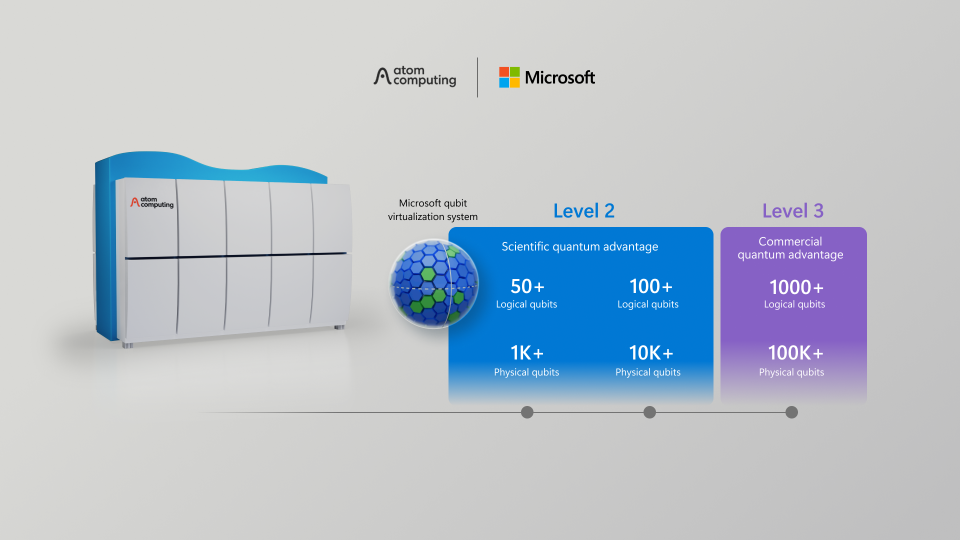
As advances are made in both quantum hardware and software, logical qubits will continue to increase in number and fidelity, enabling deeper and more complex quantum computations. With approximately 100 logical qubits, scientific quantum advantage is expected to be achievable, helping to solve some of the world’s most pressing challenges.
Azure Quantum: A New Era of Reliable Quantum Computing
Microsoft is ushering in a new era of reliable quantum computing by offering the Azure Quantum compute platform, which brings together Microsoft’s qubit-virtualization system with industry-leading quantum processing units (QPUs) from hardware partners to create reliable logical qubits. This hybrid-computing offering integrates computation with logical qubits, accelerated HPC simulations, Copilot for Azure Quantum, and advanced AI models.
This breakthrough demonstrates the potential of quantum-classical hybrid computing to solve complex scientific problems and paves the way for further innovations in this field.
Microsoft and Atom Computing Unveil Groundbreaking Commercial Quantum Offering
In a significant development for the quantum computing industry, Microsoft has teamed up with Atom Computing to launch a new commercial quantum computing solution. This collaboration merges Microsoft’s advanced qubit-virtualization technology with Atom Computing’s neutral-atom hardware, creating a system designed to generate reliable logical qubits. The companies are optimizing the system to enable dependable, scalable quantum computation, positioning the new offering as potentially one of the most powerful quantum machines ever built, with far-reaching scientific implications.
Atom Computing’s hardware stands out for its ability to advance quantum error correction, featuring large numbers of high-fidelity qubits, all-to-all qubit connectivity, long coherence times, and mid-circuit measurements that allow qubits to be reset and reused. The company is developing second-generation systems with more than 1,200 physical qubits and aims to increase this figure tenfold with each hardware iteration. By integrating Microsoft’s cutting-edge fault-tolerance protocols with this new qubit architecture, Azure Quantum is set to offer a versatile array of logical qubits across multiple platforms, providing customers with flexibility and future-proofing their investments in quantum technology.
External Link: Click Here For More