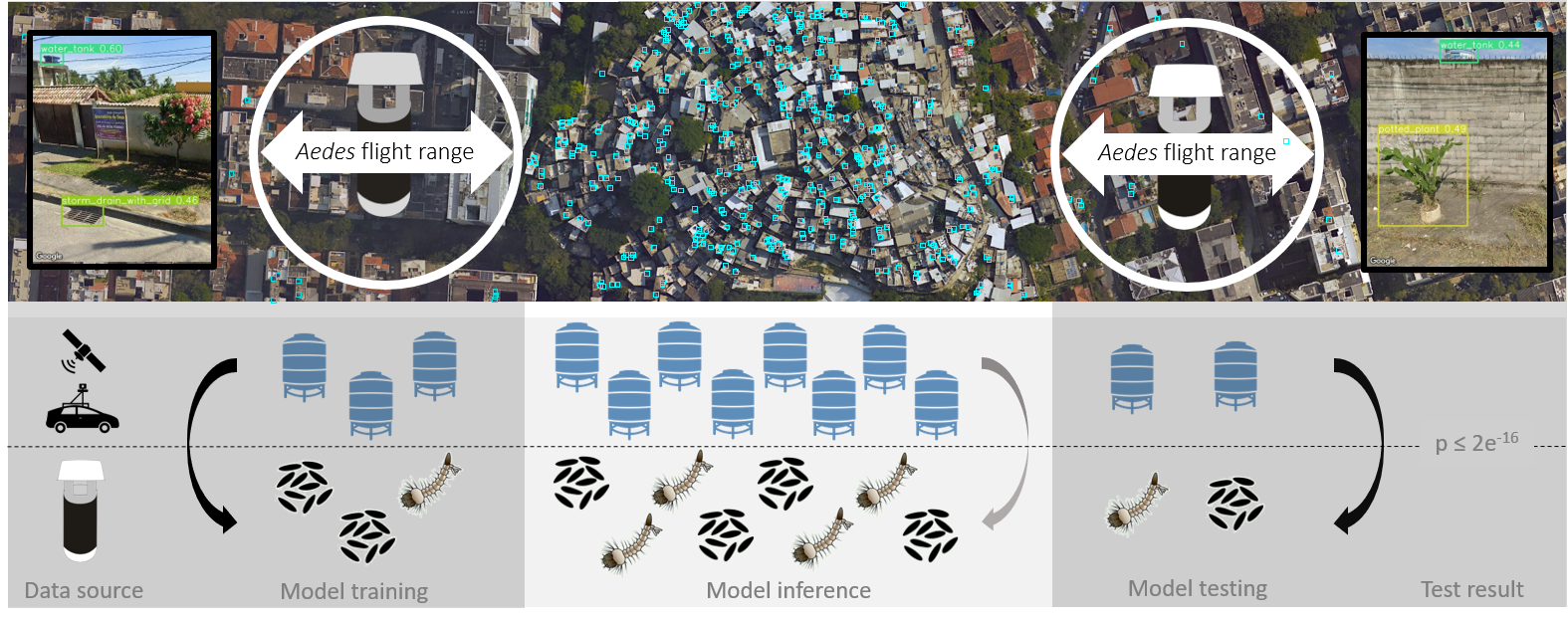
Scientists have developed a new method to combat the spread of infectious diseases such as dengue, Zika, chikungunya, and yellow fever by using artificial intelligence to map mosquito populations more precisely. Led by geoinformation scientists from Heidelberg University, an international research team analyzed satellite and street view images to detect and map possible breeding sites in cities, which can be a significant predictor for the number of eggs and larvae measured in traps. This approach overcomes the limitations of manual field measurements and provides a more targeted disease control.
The Aedes aegypti mosquito, responsible for spreading these diseases worldwide, is mostly found in tropical and subtropical regions, particularly in cities where it breeds in man-made water containers. Controlling mosquito populations is currently the most effective intervention, but requires urban mosquito distribution maps. The new method, developed by researchers including Steffen Knoblauch and Prof. Dr Alexander Zipf, uses artificial intelligence to analyze satellite and street view images from companies like Google, providing a more precise assessment of environmental conditions that favor the presence of Aedes aegypti.
Mapping Mosquito Populations with Artificial Intelligence
Mosquito-borne diseases such as dengue, Zika, chikungunya, and yellow fever affect millions worldwide, making it essential to develop accurate mosquito distribution maps. Led by geoinformation scientists from Heidelberg University, an international research team has created a novel AI-supported method for mapping Aedes aegypti populations. This approach leverages satellite and street view images to assess environmental conditions that favor the presence of this mosquito species.
Aedes aegypti, also known as the Egyptian tiger mosquito, is commonly found in tropical and subtropical regions, particularly in urban areas where it breeds in man-made water containers. Controlling mosquito populations is currently the most effective intervention against these diseases, as vaccine availability and acceptance are limited. However, implementing control measures requires precise urban mosquito distribution maps, which have traditionally been based on manual field measurements of single mosquito traps.
Challenges in Mapping Mosquito Populations
The traditional approach to mapping mosquito populations has several limitations. In large urban areas, countless traps would need to be set up, and significant personnel would be required to maintain a reliable overview of the spread of mosquito populations. Additionally, the limited flight range of Aedes aegypti (approximately 1,000 meters without wind assistance) makes it difficult to derive distribution maps for major urban areas from mosquito trap measurements.
AI-Assisted Breeding Site Detection
To overcome these challenges, the geoinformation scientists developed an innovative approach that utilizes artificial intelligence to analyze satellite and street view images. This method detects and maps possible breeding sites in cities, which can then be used to assess environmental conditions that favor the presence of Aedes aegypti more precisely than before. By combining field measurements with AI-assisted breeding site detection, researchers can create more accurate mosquito distribution maps.
Integrating Mobile Communications Data
In addition to mapping breeding sites, the research team is also working on analyzing mobile communications data to model human movement patterns in Rio de Janeiro. This information can be used to better trace the occurrence of infectious diseases transmitted by Aedes aegypti and incorporate this knowledge into intervention maps. However, modeling human movement patterns at different times of day poses a challenge, as the mosquito is most active during early morning and evening hours.
International Collaboration and Funding
The research was conducted in collaboration with researchers from Austria, Brazil, Germany, Singapore, Thailand, and the USA. The German Research Foundation and the Klaus Tschira Foundation, which supports HeiGIT, an affiliated institute of Heidelberg University, funded the study. The research results were published in the journals “Scientific Reports” and the “International Journal of Applied Earth Observation and Geoinformation”.
External Link: Click Here For More
See today’s quantum computing news on Quantum Zeitgeist for the latest breakthroughs in qubits, hardware, algorithms, and industry deals.