The quest for large-scale, fault-tolerant quantum computing has been intense in recent years, but researchers have already reported achieving quantum advantage for impractical problems. To take it a step further, there is growing interest in achieving quantum advantage for practical problems. One of the most promising candidates for this goal is quantum machine learning (QML). In this article, we explore the rise of QML and its potential to unlock new possibilities in machine learning.
Can Quantum Kernels Unlock New Possibilities in Machine Learning?
The quest for large-scale, fault-tolerant quantum computing has been intense in recent years. However, we are still limited to accessing noisy intermediate-scale quantum (NISQ) devices. Despite these limitations, researchers have already reported achieving quantum advantage for impractical problems. To take it a step further, there is growing interest in achieving quantum advantage for practical problems. One of the most promising candidates for this goal is quantum machine learning (QML).
The Rise of Quantum Machine Learning
In recent years, several QML algorithms have been proposed theoretically for qubit-based systems and demonstrated experimentally on several physical platforms. Among these algorithms, the quantum kernel method has garnered significant attention due to its simplicity of implementation and potential to achieve quantum advantage.
The classical kernel method is a well-established technique in machine learning that aims to perform tasks such as classification and regression by nonlinearly mapping data into a higher-dimensional Hilbert space. In contrast, the quantum kernel method utilizes quantum states as a non-linear mapping. This approach has been shown to be particularly effective for noisy intermediate-scale quantum devices.
Continuous variable (CV) systems have the potential to offer superior computational power compared to qubit-based systems. This is because CV systems can utilize their infinite-dimensional Hilbert space, which allows for more complex and nuanced computations.
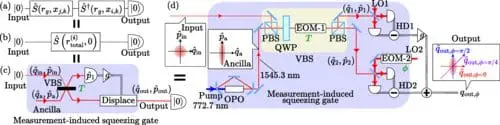
In this article, researchers from the University of Tokyo demonstrate the implementation of the quantum kernel method on a programmable photonic quantum processor using CV systems. They experimentally prove that the CV quantum kernel method successfully classifies several datasets robustly even under experimental imperfections with high accuracies comparable to classical kernels.
The demonstration of the CV quantum kernel method on a programmable photonic quantum processor is an important step towards achieving quantum advantage for practical problems. This approach has the potential to unlock new possibilities in machine learning and could lead to breakthroughs in fields such as image recognition, natural language processing, and recommender systems.
The development of QML algorithms like the quantum kernel method is an exciting area of research that holds great promise for the future. As researchers continue to push the boundaries of what is possible with NISQ devices, we can expect to see even more innovative applications of QML in the years to come.
The University of Tokyo has been at the forefront of quantum computing research, and this article is a testament to the institution’s commitment to advancing our understanding of quantum systems. As universities and research institutions continue to drive innovation in the field of QML, we can expect to see even more breakthroughs and advancements in the years to come.
The demonstration of the CV quantum kernel method on a programmable photonic quantum processor is an important step towards achieving quantum advantage for practical problems. This approach has the potential to unlock new possibilities in machine learning and could lead to breakthroughs in fields such as image recognition, natural language processing, and recommender systems.
The development of QML algorithms like the quantum kernel method is an exciting area of research that holds great promise for the future. As researchers continue to push the boundaries of what is possible with NISQ devices, we can expect to see even more innovative applications of QML in the years to come.
As the field of QML continues to evolve, it will be important for industry and government to play a role in supporting research and development. This could involve providing funding for research initiatives, as well as creating policies that support the growth of the quantum computing industry.
The demonstration of the CV quantum kernel method on a programmable photonic quantum processor is an important step towards achieving quantum advantage for practical problems. This approach has the potential to unlock new possibilities in machine learning and could lead to breakthroughs in fields such as image recognition, natural language processing, and recommender systems. As researchers continue to push the boundaries of what is possible with NISQ devices, we can expect to see even more innovative applications of QML in the years to come.
Publication details: “Continuous-variable quantum kernel method on a programmable photonic quantum processor”
Publication Date: 2024-08-02
Authors: Keitaro Anai, Shion Ikehara, Yoshichika Yano, Daichi Okuno, et al.
Source: Physical review. A/Physical review, A
DOI: https://doi.org/10.1103/physreva.110.022404




See today’s quantum computing news on Quantum Zeitgeist for the latest breakthroughs in qubits, hardware, algorithms, and industry deals.