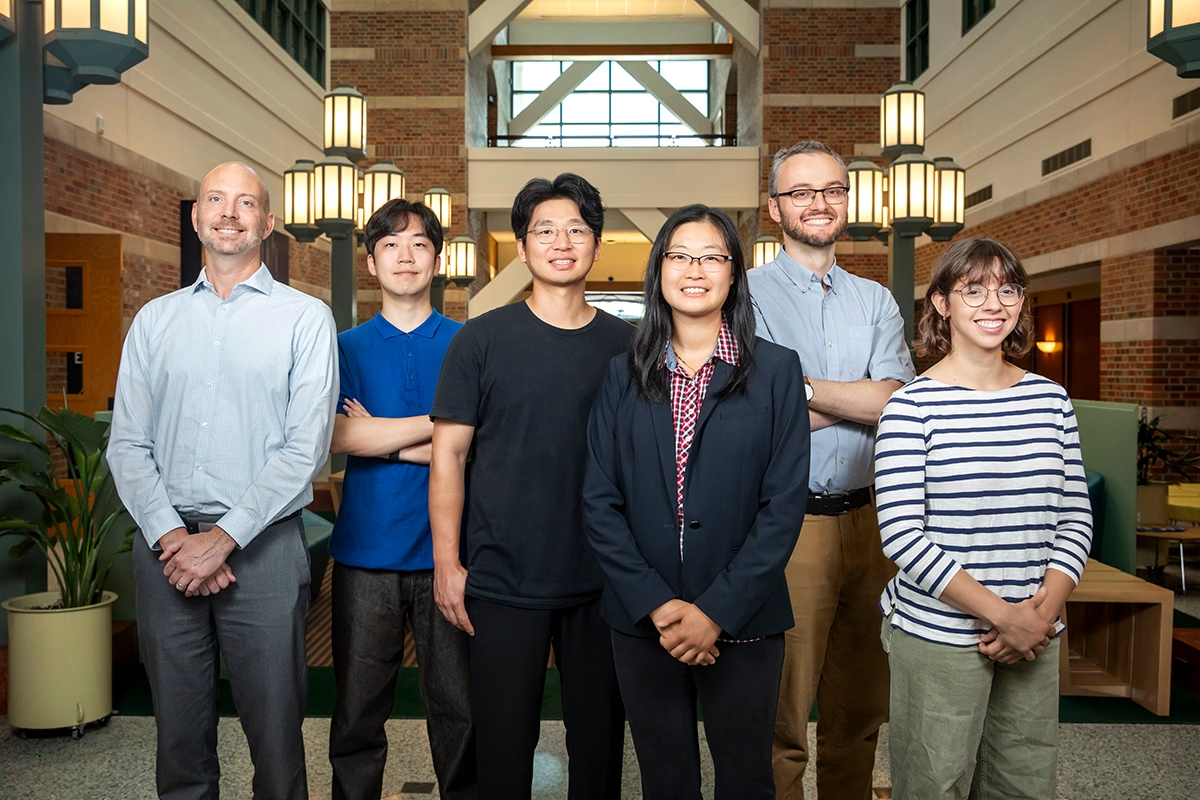
Researchers at the University of Illinois Urbana-Champaign have made a breakthrough in understanding artificial intelligence’s decision-making process, often referred to as the “AI black box.” By combining AI with automated chemical synthesis and experimental validation, the team has uncovered key chemistry principles that improve molecules for harvesting solar energy.
Led by professors Martin Burke, Ying Diao, Nicholas Jackson, and Charles Schroeder, along with University of Toronto professor Alán Aspuru-Guzik, the researchers used a method called “closed-loop transfer” to identify what makes light-harvesting molecules more stable. The team produced 30 new chemical candidates over five rounds of experimentation, resulting in molecules four times more stable than the starting point. This achievement has significant implications for the development of organic solar cells, which stability issues have hindered since the 1980s.
Unveiling the Secrets of Artificial Intelligence: A Breakthrough in Solar Energy Chemistry
Artificial intelligence (AI) has revolutionized various fields, including chemistry, but its decision-making process remains shrouded in mystery, often referred to as the “AI black box.” Researchers at the University of Illinois Urbana-Champaign have made a significant breakthrough by combining AI with automated chemical synthesis and experimental validation, effectively opening up the black box. This innovative approach has led to the discovery of key chemical principles that improve molecules for harvesting solar energy.
The Quest for Stable Organic Solar Cells
Organic solar cells, based on thin, flexible materials, offer an attractive alternative to traditional silicon-based panels. However, their commercialization has been hindered by stability issues, with high-performance materials degrading when exposed to light. The Illinois team aimed to address this challenge by optimizing the photostability of light-harvesting molecules.
Closed-Loop Transfer: A Novel Approach to AI-Guided Optimization
The researchers employed a novel method called “closed-loop transfer,” which begins with an AI-guided optimization protocol. The AI algorithm provided suggestions about what kinds of chemicals to synthesize and explore in multiple rounds of closed-loop synthesis and experimental characterization. After each round, the new data were incorporated back into the model, which then provided improved suggestions, moving closer to the desired outcome.
Uncovering Hidden Rules: From Black Box to Transparent Glass Globe
Instead of simply ending the query with the final products singled out by the AI, the closed-loop transfer process sought to uncover the hidden rules that made the new molecules more stable. Another set of algorithms continuously analyzed the molecules made, developing models of chemical features predictive of stability in light. Once the experiment concluded, the models provided new lab-testable hypotheses.
A Proof of Principle: Unlocking the Secrets of Photostability
To test their hypothesis about photostability, the researchers investigated three structurally different light-harvesting molecules with a particular high-energy region and confirmed that choosing the proper solvents made the molecules up to four times more light-stable. This breakthrough demonstrates the potential of AI-guided optimization in chemistry, paving the way for addressing other material systems.
The Future of Materials Discovery: A Multidisciplinary Approach
The Illinois team’s work highlights the importance of multidisciplinary collaboration and cutting-edge facilities. By combining expertise from various fields, researchers can unlock new scientific insights that would not have been possible with individual teams working in isolation. This innovative approach has far-reaching implications for materials discovery, enabling the development of novel interfaces where researchers can input a chemical function they want, and the AI will generate hypotheses to test.
External Link: Click Here For More
See today’s quantum computing news on Quantum Zeitgeist for the latest breakthroughs in qubits, hardware, algorithms, and industry deals.