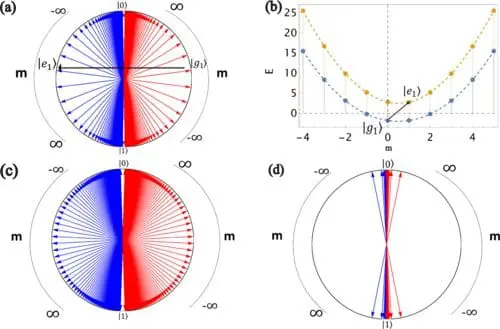
The quest for scalable quantum computing has led researchers to explore innovative solutions, including topological quantum computing. A new conceptual model of a toroidal flux qubit proposes a revolutionary approach to this field. By coupling a charged particle living in a ring with a quantized toroidal magnetic flux, scientists Adel Ali and Alexey Belyanin demonstrate the potential for nonlocal operations on these flux qubits, protected from environmental noise. This breakthrough could enable entanglement creation and teleportation of excitation energy between qubits, paving the way for a new era in quantum computing.
Can Toroidal Flux Qubits Revolutionize Quantum Computing?
The quest for scalable quantum computing has led researchers to explore innovative solutions, including topological quantum computing. In this article, scientists Adel Ali and Alexey Belyanin propose a conceptual model of a toroidal flux qubit, which could potentially revolutionize the field.
Toroidal Flux Qubits: A New Approach
The concept of a toroidal flux qubit is based on a quantized toroidal magnetic flux coupled to a charged particle living in a quantum ring. This system allows for field-free interaction between the two components, enabling the creation of emergent field-free coupling when scaling up to multiple flux qubits.
Topological and Nonlocal Aspects
The topological and nonlocal aspects of this system have profound implications for quantum information processing. The researchers demonstrate that these features can be leveraged to perform nonlocal operations on the flux qubits, including creating entanglement and teleporting excitation energy between them.
Introduction: The Quest for Scalable Quantum Computing
The pursuit of scalable quantum computing is contingent upon reducing decoherence and errors. Topological quantum computing is an attempt to achieve this by encoding quantum information in a many-body system where local errors cannot destroy the encoded information. However, finding materials that realize non-Abelian anyons has not been unambiguously confirmed.
The Toroidal Flux Qubit: A Well-Isolated Candidate
One example of a well-isolated qubit candidate is the toroidal flux qubit or fluxon, which is defined as a volume of enclosed magnetic flux lines whose outer surface is topologically equivalent to a torus. As in the case of normal flux qubits, the persistent toroidal current generating this magnetic flux can be in a superposition.
Isolation from Environmental Noise
Fluxons can be isolated from environmental noise such as flux noise, charge noise, 1/f noise, external electromagnetic fields, etc. This raises the question: how to do operations on its quantum state if it is isolated from the environment? The researchers propose solving this problem by coupling the fluxon with a charged particle living in a ring that encloses the flux lines of the fluxon or the quantum ring (QR).
Flux-Electron Interaction
The fluxonelectron interaction is mediated by the coupling of the electron with the gauge field of the fluxon, essentially the field-quantized version of the Aharonov-Bohm effect. Any noise charge must close a loop around the fluxon to get coupled to it. The environmental noise charge fluctuations do not affect the fluxon’s quantum state.
Nonlocal Operations
The researchers demonstrate that nonlocal operations can be performed on these flux qubits, which are protected from environmental noise. These operations include creating entanglement and teleporting excitation energy between the flux qubits. This has profound implications for quantum information processing and could potentially revolutionize the field of quantum computing.
Conclusion: A New Era in Quantum Computing?
The proposed conceptual model of a toroidal flux qubit offers a new approach to scalable quantum computing. The topological and nonlocal aspects of this system have the potential to enable nonlocal operations on the flux qubits, which could be protected from environmental noise. This raises exciting possibilities for the future of quantum computing.
Publication Date: 2024-08-06
Authors: A.A. Ali and Alexey Belyanin
Source: Physical review. A/Physical review, A
DOI: https://doi.org/10.1103/physreva.110.022604



See today’s quantum computing news on Quantum Zeitgeist for the latest breakthroughs in qubits, hardware, algorithms, and industry deals.