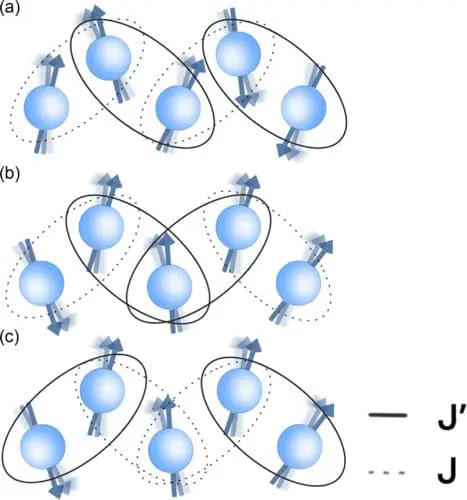
The quest to understand topological matter has reached a milestone with recent breakthroughs in simulating its dynamics on quantum computers. Symmetry-protected topological (SPT) phases, a class of topological matter, exhibit novel emergent behaviors and have been observed in various systems. Researchers have successfully simulated the longtime dynamics of bulk and surface modes in topological insulators on noisy intermediate-scale quantum processors, paving the way for stable implementation of topological quantum spin systems. This development has far-reaching implications for the creation of novel devices and applications in quantum science.
Can Quantum Computers Simulate Topological Matter?
The quest to understand topological properties of matter has been a longstanding challenge in physics. Recently, researchers have made significant progress in simulating the dynamics of symmetry-protected topological (SPT) matter on quantum computers. This breakthrough has far-reaching implications for the development of novel devices and applications in quantum science.
In this article, we will look at SPT phases and explore how quantum computers can simulate their behavior. We will also examine the challenges and limitations of current quantum hardware and discuss the potential solutions that have been proposed to overcome these hurdles.
The Power of Symmetry-Protected Topological Phases
SPT phases are a class of topological phases that are protected by global symmetries. These phases exhibit novel emergent behaviors, such as chiral phenomena, which have been observed in various systems, including acoustic and mechanical systems, photonics, and magnetic materials.
The protection provided by global symmetries is the key to the robustness of SPT phases against local noise and perturbations. This property makes SPT phases an attractive platform for foundational research and device applications in quantum science.
Simulating Topological Matter on Quantum Computers
Simulating the dynamics of topological matter on quantum computers is a challenging task due to the limitations of current quantum hardware. However, recent advances in constant-depth quantum circuits have opened up new possibilities for simulating SPT phases on noisy intermediate-scale quantum (NISQ) processors.
In this study, researchers demonstrated successful longtime dynamics simulation of bulk and surface modes in topological insulators on NISQ processors. The results showed robust signatures of localized topological modes, which is a crucial step towards the stable implementation of topological quantum spin systems on present-day quantum processors.
Challenges and Limitations of Current Quantum Hardware
Despite the progress made in simulating SPT phases on quantum computers, there are still significant challenges and limitations that need to be addressed. One of the main hurdles is the growth of noise with the number of time steps, which can lead to errors and decoherence in the simulation.
Another challenge is the limited circuit depth of current quantum hardware, which can make it difficult to simulate complex topological systems. However, recent advances in constant-depth quantum circuits have shown promise in addressing these limitations.
A Pathway Towards Stable Implementation
The results of this study provide a pathway towards stable longtime implementation of topological quantum spin systems on present-day quantum processors. The identification of a class of one-dimensional topological Hamiltonians that can be readily simulated with NISQ hardware is an important step towards achieving this goal.
Furthermore, the demonstration of successful longtime dynamics simulation of bulk and surface modes in topological insulators on NISQ processors opens up new possibilities for exploring the properties of SPT phases. This could lead to the development of novel devices and applications in quantum science, such as high-performance transistors, quantum sensors, and protected room-temperature superconductors.
Conclusion
In conclusion, simulating topological matter on quantum computers is a challenging task that requires significant advances in quantum hardware and software. However, recent progress in constant-depth quantum circuits has shown promise in addressing the limitations of current quantum hardware.
The results of this study provide a pathway towards stable longtime implementation of topological quantum spin systems on present-day quantum processors. The identification of a class of one-dimensional topological Hamiltonians that can be readily simulated with NISQ hardware is an important step towards achieving this goal.
Furthermore, the demonstration of successful longtime dynamics simulation of bulk and surface modes in topological insulators on NISQ processors opens up new possibilities for exploring the properties of SPT phases. This could lead to the development of novel devices and applications in quantum science.
Publication Date: 2024-08-08
Authors: Miguel Mercado, Kyle Chen, Parth Hemant Darekar, Aiichiro Nakano, et al.
Source: Physical review. B./Physical review. B
DOI: https://doi.org/10.1103/physrevb.110.075116



See today’s quantum computing news on Quantum Zeitgeist for the latest breakthroughs in qubits, hardware, algorithms, and industry deals.